


Baoyu’s Drunken Stupor
This section is confusing, largely because Jia Baoyu is in a drunken stupor. It’s disorienting and is extremely confusing. And yet there’s some interesting poetic symbolism here.
My Translation
As Jia Baoyu said this, he went to his bedroom where he saw writing brushes and ink laid out on his desk.
Qingwen greeted him as soon as he walked in. “Okay,” she said with a smile, “you had me prepare the ink this morning, you eagerly wrote three characters, and then you tossed the brush aside and left. I’ve been waiting for you this entire day! You’d better use up every drop of this ink now!”
Only then did Baoyu remember what he had done that morning. “Where are those three chracters I wrote?” he asked with a smile.
“You must be drunk!” replied Qingwen, still smiling. “Before you went to the Ningguo Mansion you ordered me to paste them on the door frame. I was afraid that another person would do it wrong, and so I went up the ladder myself and spent a lot of time sticking it up. My hands are still stiff from the cold!”
“I forgot your hands were cold,” said Baoyu with a smile. “Let me warm them for you.”
He reached out and took Qingwen’s hands in his, and they then looked up together at the three newly written characters on top of the frame of the door.
Daiyu arrived before long. “Dear Daiyu,” said Baoyu to her, “please don’t make fun of me. Please tell me which one of those three characters you like the best.”
Daiyu looked up and saw the characters. They said “Crimson Rue Studio.”
“They’re all excellent!” she said with a smile. “How is your calligraphy so good? You really should write a plaque like that for me one day.”
“You’re flattering me again,” said Baoyu with a smile.
“And where is Xiren?” he asked after a pause.
Qingwen pursed her lips towards the couch in the inner room. Baoyu looked inside and saw Xiren lying asleep, fully dressed.
“I see,” said Baoyu, smiling. “She’s sleeping pretty early.”
Baoyu then turned back to Qingwen. “At breakfast at the other mansion today,” he said, “they served a plate of large dumplings made with thin tofu skin. I remembered that you like them. And so I asked Lady Zhen if she could send them over, telling her that I’d eat them later. Did you get them?”
“Don’t even mention it!” replied Qingwen. “As soon as they arrived, I knew they were for me. But I had just eaten, so I put them aside for the time being. Then Li came, saw them, and said, ‘Baoyu won’t eat these. I’ll take them home for my grandson.’ She then had someone send them to her home.”
As she was explaining all this, Qianxue came in with tea. “Please have some tea, sister Lin,” said Baoyu politely.
Everybody laughed. “Miss Lin left a while ago. Who are you offering the tea to?” they asked.
Baoyu drank half a cup of tea, and then suddenly remembered the tea from that morning. “I brewed a cup of ‘maple dew’ tea early this morning,” he explained to Qianxue. “I’ve said before that its full color doesn’t come out until it’s been watered three or four times. So why have you served this other tea now?”
“I did save it for you,” replied Qianxue. “But then Li came and drank it all.”
When he heard this, Baoyu threw his cup to the floor. It crashed and splintered into pieces, splashing tea all over Qianxue’s skirt.
Baoyu sprang up and asked her, “What kind of ‘Nanny’ is she to all of you that makes you wait on her so respectfully? The only reason you treat her like this is because she was my wet nurse for a few days when I was a child! You’ve all indulged her to the point that she’s more respected than my ancestors! Send her out, and we’ll clean up the mess!”
And Baoyu immediately left to complain to Grandmother Jia.
Translation Critique
Hawkes
David Hawkes calls 晴雯 (Qingwen) “Skybright,” which is a direct translation of her name. It’s also a pretty easy name to remember.
Hawkes translates 絳 as “red.” It actually refers to a deep shade of red, which is why I think “crimson” is a more appropriate translation. However, “red” does fit in more obviously with the “red chamber” motif in the book.
Note that Hawkes talks about the “maple dew tea” (which he simply calls “Fung Loo”) as only reaching its full flavor after it’s been watered three or four times. The verb in Chinese is 出色, which means for a color to come out, but can also refer to a flavor. My guess is that 出色 here refers to both the color and the flavor of the tea. It’s interesting to note that the “maple” (楓) part of the tea name likely refers to leaves that were reddish-brown, which is another reference to the color red.
Yang
The Yangs translate 絳芸軒 as “Red Rue Studio,” which is similar to David Hawkes (he calls 軒 a “study” instead, but it’s basically the same thing). It’s interesting to me that they also call 絳 “red” instead of “crimson,” and that they don’t mention at all what “rue” means or why it is significant.
The Yangs translate 楓露茶 as “maple dew tea,” which I think is the right way to handle the difficult term. I suspect that Hawkes simply transliterated it as “Fung Loo” because he wasn’t sure whether it referred to a specific type of tea or if it was just something symbolic.
Chinese Text
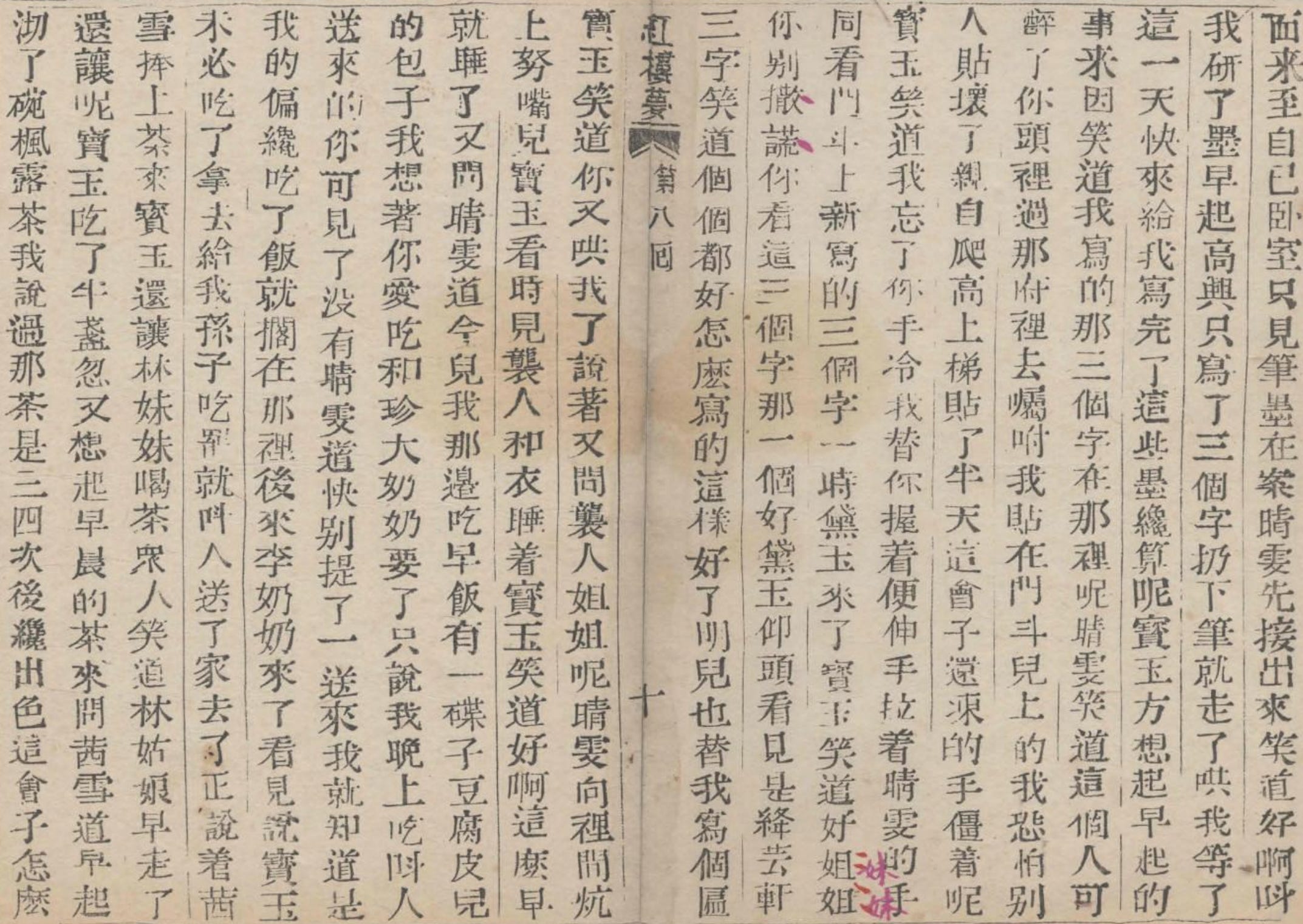
一面說,一面來至自己臥室,只見筆墨在案。晴雯先接出來,笑道:「好啊,叫我研了墨,早起高興,只寫了三個字,扔下筆就走了,哄我等了這一天。快來給我寫完了這些墨才算呢!」寶玉方想起早起的事來,因笑道:「我寫的那三個字在那裡呢?」晴雯笑道:「這個人可醉了。你頭裡過那府裡去,囑咐我貼在門斗兒上的。我恐怕別人貼壞了,親自爬高上梯,貼了半天,這會子還凍的手僵著呢!」寶玉笑道:「我忘了你手冷,我替你握著。」便伸手拉著晴雯的手,同看門斗上新寫的三個字。
一時,黛玉來了。寶玉笑道:「好妹妹,你別撒謊,你看這三個字,那一個好?」黛玉仰頭看見是「絳芸軒」三字,笑道:「個個都好。怎麼寫的這樣好了!明兒也替我寫個匾。」寶玉笑道:「你又哄我了。」說著,又問:「襲人姐姐呢?」晴雯向裡間炕上努嘴兒。寶玉看時,見襲人和衣睡著。寶玉笑道:「好啊,這麼早就睡了。」又問晴雯道:「今兒我那邊吃早飯,有一碟子豆腐皮兒的包子,我想著你愛吃,和珍大奶奶要了,只說我晚上吃,叫人送來的,你可見了沒有?」晴雯道:「快別提了。一送來,我就知道是我的,偏才吃了飯,就擱在那裡。後來李奶奶來了,看見說:『寶玉未必吃了,拿去給我孫子吃罷。』就叫人送了家去了。」正說著,茜雪捧上茶來。寶玉還讓:「林妹妹喝茶。」眾人笑道:「林姑娘早走了,還讓呢。」
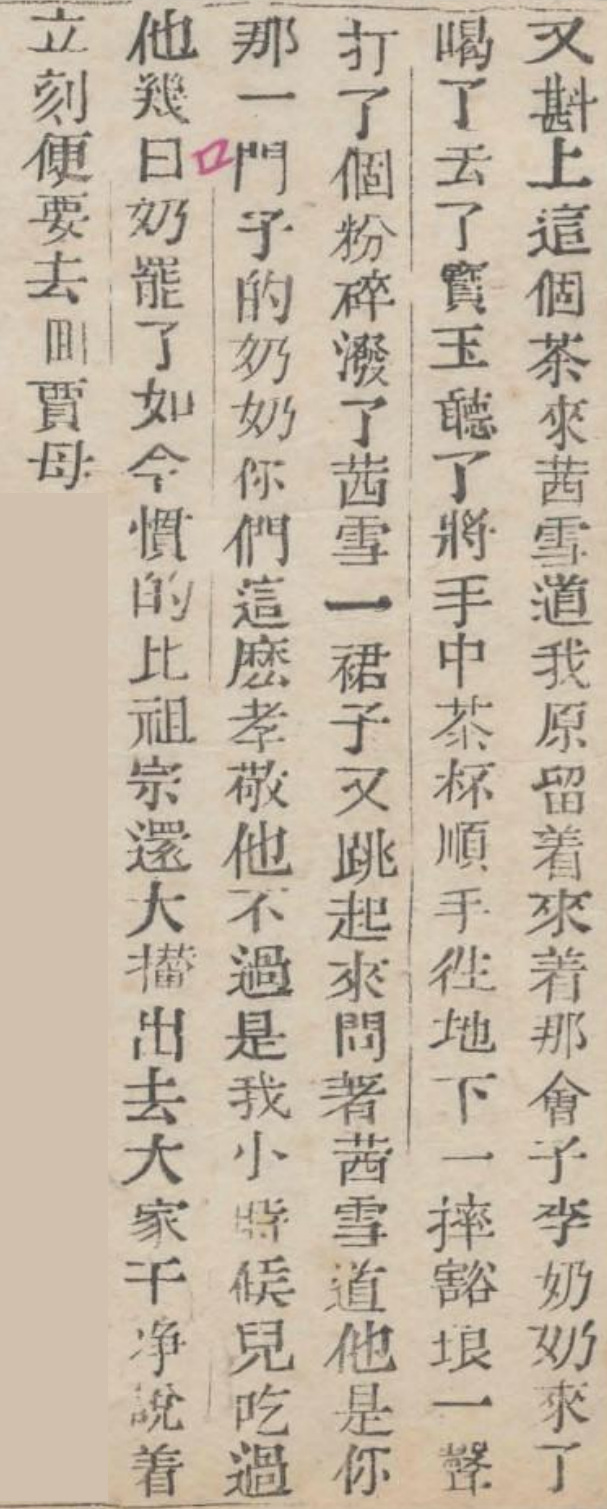
寶玉吃了半盞,忽又想起早晨的茶來,問茜雪道:「早起沏了碗楓露茶,我說過那茶是三四次後才出色,這會子怎麼又斟上這個茶來?」茜雪道:「我原留著來著,那會子李奶奶來了,喝了去了。」寶玉聽了,將手中茶杯順手往地下一摔,豁琅一聲,打了個粉碎,潑了茜雪一裙子。又跳起來問著茜雪道:「他是你那一門子的奶奶,你們這麼孝敬他?不過是我小時候兒吃過他幾日奶罷了,如今慣的比祖宗還大!攆出去,大家乾淨!」說著,立刻便要去回賈母。
Translation Notes
晴雯 is Qingwen, one of Jia Baoyu’s personal maids. This is the first time we’ve met her, though she was mentioned specifically in this poem in chapter 5:

Here’s an interpretive post I wrote about that poem as well:

Qingwen’s name literally means “bright cloud.”
絳 means deep red or crimson.
芸 here refers to the word 芸香, which means the “rue” plant. You can learn more about it here.
The character 芸 was commonly used in ancient times in connection with books. This is because the rue plant was used to protect books from damage from insects.
軒 means a room, a studio, or a study. Jia Baoyu was naming his own study, which was a common practice among scholars.
Qianxue (茜雪) is one of Jia Baoyu’s maids that we’ve briefly seen before:

楓露茶 literally means “maple dew tea,” and refers to a type of tea that doesn’t actually exist in the real world. It’s interesting to note that the maple (楓) leaves in the fall have a reddish-brown color, which is probably the color that Jia Baoyu is referring to.
攆 means to expel or drive out