


Beautiful Language
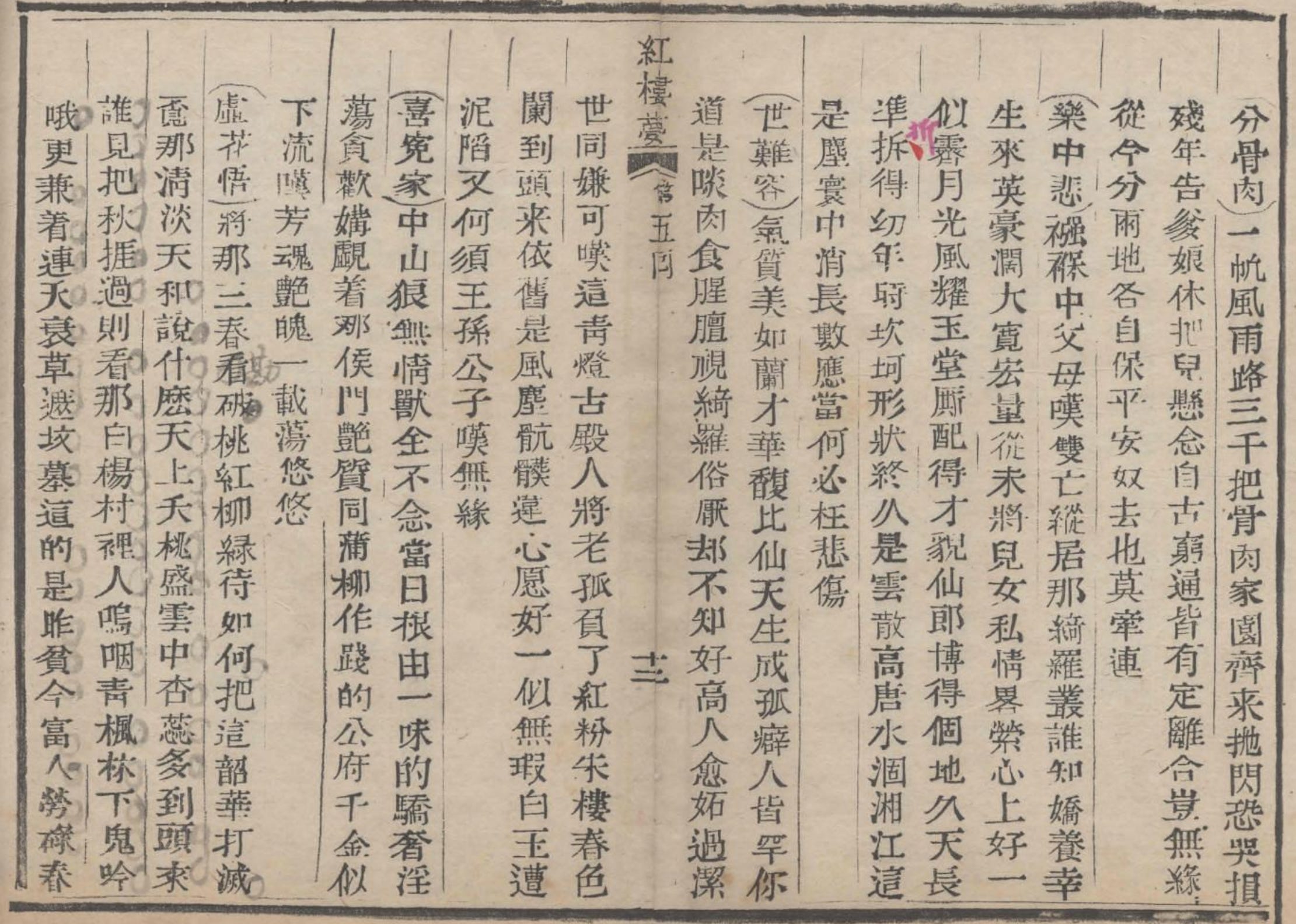
One of the most frustrating things about classic literature in translation is that there’s no way to adequately translate the beauty of the original language.
You can translate the meaning, sure. You can translate each of the words. You can try to massage your translated text to come close to the original text - as close as you possibly can come, that is.
But the problem is that you can’t capture the flavor of the original text in a foreign language, no matter how hard you try.
But I’ll do my best to fight against that fact.
We saw two really interesting phrases in yesterday’s short translation segment.
I was actually planning on making yesterday’s post a bit longer, but decided to keep it short after running across these two unique and somewhat interesting phrases.
The thing I’ve learned after studying literature in a number of languages is that the best writers seem to have a knack for how to use words in unusual ways. Instead of using conventional adjectives, adverbs, and even verbs to describe what they’re seeing or imagining, they tend to borrow words from one category and use them in other categories. And we’ve got two examples of that here.
Here’s the first:
賈瑞見鳳姐如此打扮,越發酥倒
When Jia Rui saw how she was dressed and made up, he was absolutely overcome with desire.
Now, my translation here is pretty inadequate. The thing is that 酥 is an adjective that means something like “weak” or “limp.” When combined with 倒, which means to fall over, it gives the reader this impression of Jia Rui being so overwhelmed by Wang Xifeng’s beauty that he’s unable to walk or move without falling flat on his face.
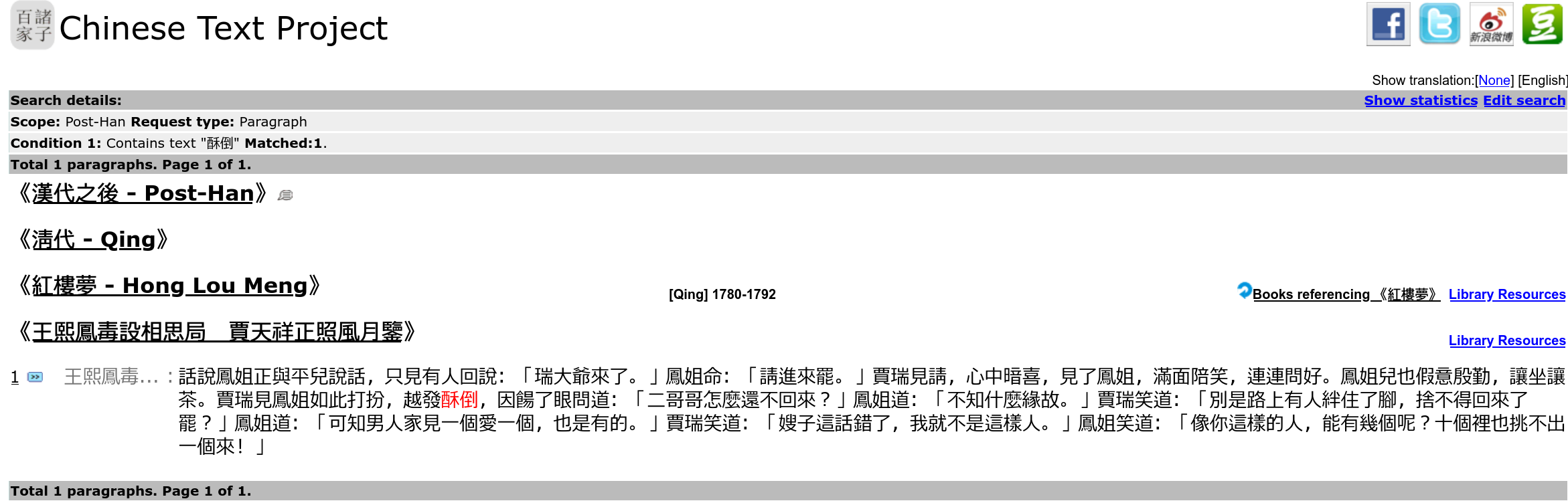
Through all the centuries of Chinese text, this is the only version of 酥倒 that shows up in the Chinese Text Project:
And here’s the second:
因餳了眼問道:「二哥哥怎麼還不回來?」
And so he gazed at her with longing eyes and asked, “Why hasn’t Jia Lian come back yet?”
Note that this is actually part of the same sentence as our first example. Now, the key word here is 餳, which is normally a noun that means “syrup.” As a verb it can mean to make something sticky or syrupy - something like dough.
Here, the phrase 餳眼 means something like “he looked at her with sweet, syrupy eyes,” a phrase that might seem a little bit awkward but actually winds up working very well in Chinese.
This time, however, this phrase is not entirely unique to Dream of the Red Chamber. There are also three examples of this from Journey To The West:
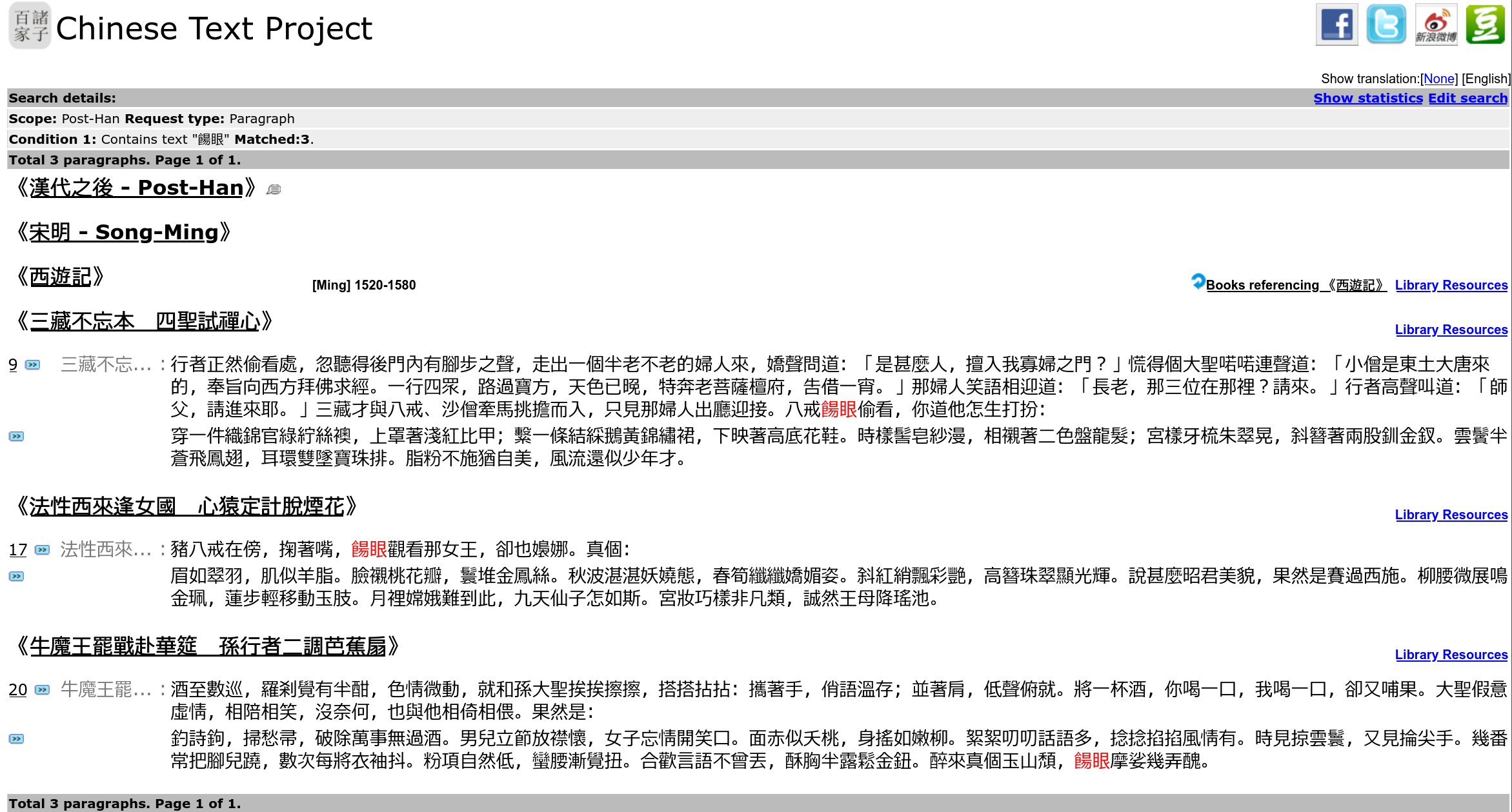
Perhaps this might indicate that 餳眼 was a phrase that was colloquially used in the 16th and 17th centuries. However, my guess is that this was a creative phrase from Journey to the West that Cao Xueqin enjoyed and decided to use himself.
Either way, it’s absolutely fascinating.