


Bum Cake
Our story continues with more direct references to homosexuality. This section is a pretty good way to learn Qing Dynasty terms that insinuated homosexual behavior.
My Translation
One day, Jia Dairu had some business to take care of at home. He gave the students a two line, seven character poem to work on and promised to continue the lesson the next day. He put his oldest grandson Jia Rui in charge while he was away.
Fortunately, this was one of the days Xue Pan decided not to bother with attending class. And so Qin Zhong and Xianglian began exchanging glances with each other. Before long, both of them said they needed to use the bathroom and slipped out into the backyard to talk.
“Does your family mind if you make friends?” Qin Zhong asked him.
But he had barely finished saying this when he heard a cough from behind them. Both boys were startled and turned around quickly. It turnd out to be a classmate of theirs named Jin Rong.
Xianglian was quick to anger by nature. Feeling frustrated and upset, his words were sharp: “What are you coughing about? Are we not allowed to talk?”
“Sure you can talk,” replied Jin Rong with a sneer. “But am I not allowed to cough? I’ll ask you this: if you’ve got something to say, why not just say it out loud? Why are you two sneaking around like a pair of ghosts? I caught you red-handed, so don’t try to deny it! Let me in on the action and I’ll keep quiet. Otherwise I’ll let everyone know – and it will cause chaos!”
Both Qin Zhong and Xianglian quickly turned deep red in their panic. “What did you catch us doing?” they demanded.
“What I’ve discovered is simply the truth!” was Jin Rong’s smiling reply. After he said that, he clapped his hands together and laughed. “Aren’t you sticking together fine buns?” he said in a loud voice. “Won’t anybody come buy one?”
Qin Zhong and Xianglian were furious, and hurried inside to complain to Jia Rui about Jin Rong bullying them for no reason.
Translation Critique
Hawkes
David Hawkes names Jin Rong “Jokey Jin.” I don’t understand at all why Hawkes gives him the nickname “Jokey.”
Hawkes deals with the somewhat obscure homosexual innuendo by translating it as a kind of nursery rhyme:
Bum-cake!
Bum-cake!
Let’s all have a
Bit to eat!
We’ll see in a few days that Hawkes isn’t censoring things at all; there’s a very direct and unmistakable reference to gay sex that he translates very bluntly. In this case, Hawkes’ ingenuity is fascinating – and I think his translation of the difficult 貼的好燒餅 reference is very well done.
Yang
The Yangs interpret 先讓我抽個頭兒 as meaning “let me have a go first,” which clearly means that Jin Rong wanted to have sexual relations with one or both of the boys in exchange for his silence. I think it’s a defensible translation because of the context, though the words in the Chinese original are a little bit more vague than this translation indicates.
They translate the “bum cake” section as “Fine pancakes for sale. Come on, fellows, and buy one.” It’s a bit more vague than Hawkes’ translation, though you could argue that it’s better to be vague because the original is vague. I should also note that the Yangs are not quite as direct in translating the homosexual references as Hawkes – likely because the Yangs were published by Beijing Foreign Language Press back in 1978.
Chinese Text
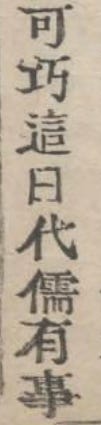
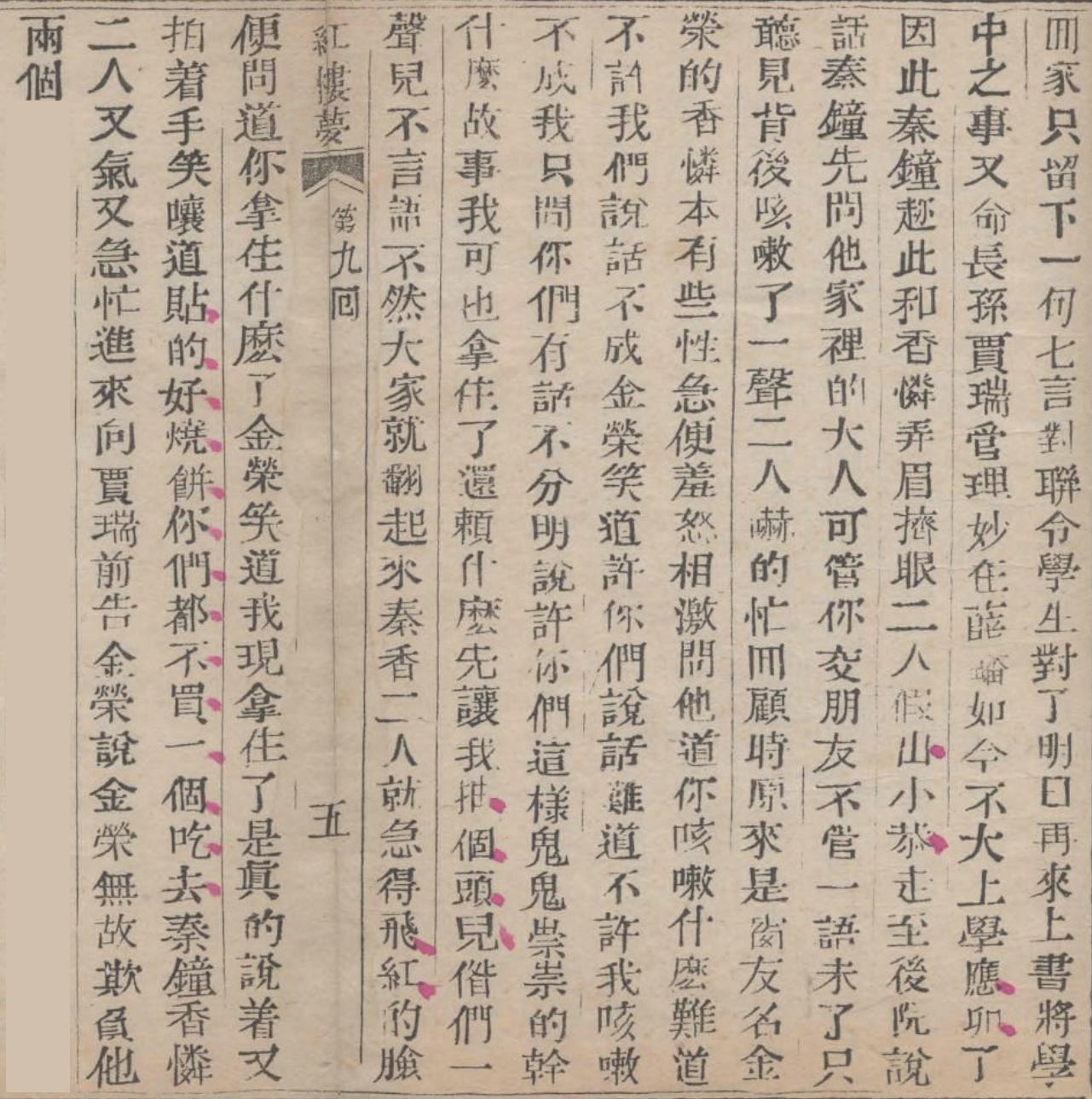
可巧這日代儒有事回家,只留下一句七言對聯,令學生對了,明日再來上書;將學中之事又命長孫賈瑞管理。妙在薛蟠如今不大上學應卯了,因此,秦鍾趁此和香憐弄眉擠眼,二人假出小恭,走至後院說話。秦鍾先問他:「家裡的大人可管你交朋友不管?」一語未了,只聽見背後咳嗽了一聲。二人嚇的忙回顧時,原來是窗友名金榮的。香憐本有些性急,便羞怒相激,問他道:「你咳嗽什麼?難道不許我們說話不成?」金榮笑道:「許你們說話,難道不許我咳嗽不成?我只問你們,有話不分明說,許你們這樣鬼鬼祟祟的幹什麼故事?我可也拿住了!還賴什麼?先讓我抽個頭兒,咱們一聲兒不言語;不然,大家就翻起來!」秦香二人就急得飛紅的臉,便問道:「你拿住什麼了?」金榮笑道:「我現拿住了是真的!」說著,又拍著手笑嚷道:「貼的好燒餅!你們都不買一個吃去?」秦鍾香憐二人又氣又急,忙進來向賈瑞前告金榮,說金榮無故欺負他兩個。
Translation Notes
可巧這日 means “as luck would have it, on this day…” In context, translating this passage this way doesn’t make much sense. Our previous segment ended with a general discussion of the other boys making certain noises to point out times when the four lovebirds were making eyes at each other.
七言對聯 means the same thing as 七言聯, or a seven character couplet. This is a poem with seven characters per line and two lines.
Jia Rui’s Chinese name, 賈瑞, is pretty interesting. 瑞 (Rui) means “auspicious” or “lucky.” Remember that the surname Jia (賈) is a homophone with the word “fake” or “false” (假) – which could indicate that Jia Rui’s luck is just an illusion. We’ll learn more about him before long.
應卯 refers to the old Chinese tradition of holding a roll call between 5 AM and 7 AM. 卯 (mǎo) comes from the traditional Chinese time keeping system in which the day was divided into 12 periods of about 2 hours each; it referred specifically to the time between 5 AM and 7 AM. The verb was used figuratively to indicate going through the motions or putting in a token appearance. In this case, it refers to Xue Pan doing the bare necessity and bothering to simply show up to school.
窗友 is an old term for classmate.
The name Jin Rong (金榮) literally means “gold and glory.”
There’s a bit of an unusual older grammatical structure here. 名金榮的, or “named Jin Rong,” isn’t the normal way to refer to a name because it’s an adjectival phrase. The 的 at the end shows that this is an adjectival phrase. It’s more common in modern Chinese to use a verb – something like 他名字叫金榮, or “His name was Jin Rong.” This is a good example of how the language in Dream of the Red Chamber straddles the line between classical Chinese and modern Chinese.
鬼鬼祟祟 means sneaking or stealthy. It’s a pretty interesting phrase. 鬼 means “ghost,” and 祟 means “evil spirit.”
抽頭 is a gambling phrase that means to take a cut of the winnings. It also means to profit from somebody else. Jin Rong is asking them to let him in on the action.
貼燒餅 literally means to stick shaobing (燒餅) together. Shaobing is a traditional northern Chinese kind of flatbread. 貼燒餅 was used in the Qing Dynasty as a reference to homosexual activity.