


New here? This is Chapter 22 of Dream of the Red Chamber, China's greatest novel, in a living translation you can be part of, one scene at a time. Start with the Start Here guide, or meet the family on the Characters page.
The first riddle on the screen was written by a woman who isn’t at the party. So who tells her father he guessed right?
Previously: After Jia Zheng fed his mother the answer to his inkstone riddle, she told him to guess the riddles on the lantern screen. (See Feeding Her the Answer.)
The riddle comes from Jia Yuanchun, Jia Zheng’s eldest daughter, who now lives in the palace as an imperial consort. Watch the clues in her riddle, and watch who answers.
Who’s here: Jia Zheng, Jia Baoyu and Jia Yuanchun (in the palace; her riddle is on the screen) (All the characters)
Members can comment on every passage, the members-only ones included, old or new, and when a member's suggestion changes the English, the notes say so. Through November 30, a year's membership is $35 instead of $50.
The Translation
Jia Zheng agreed. He got up and went over to the screen. The first riddle was Jia Yuanchun’s. It read:
It can make demons lose all their nerve.
Its body is like a bundle of silk, its breath like thunder.
The sound it makes shakes people, and just as they’re trembling,
They turn to look at it, but it’s already become ashes.
Name the toy.
“Is this a firecracker?” asked Jia Zheng.
“Yes,” answered Baoyu.
The Chinese Text
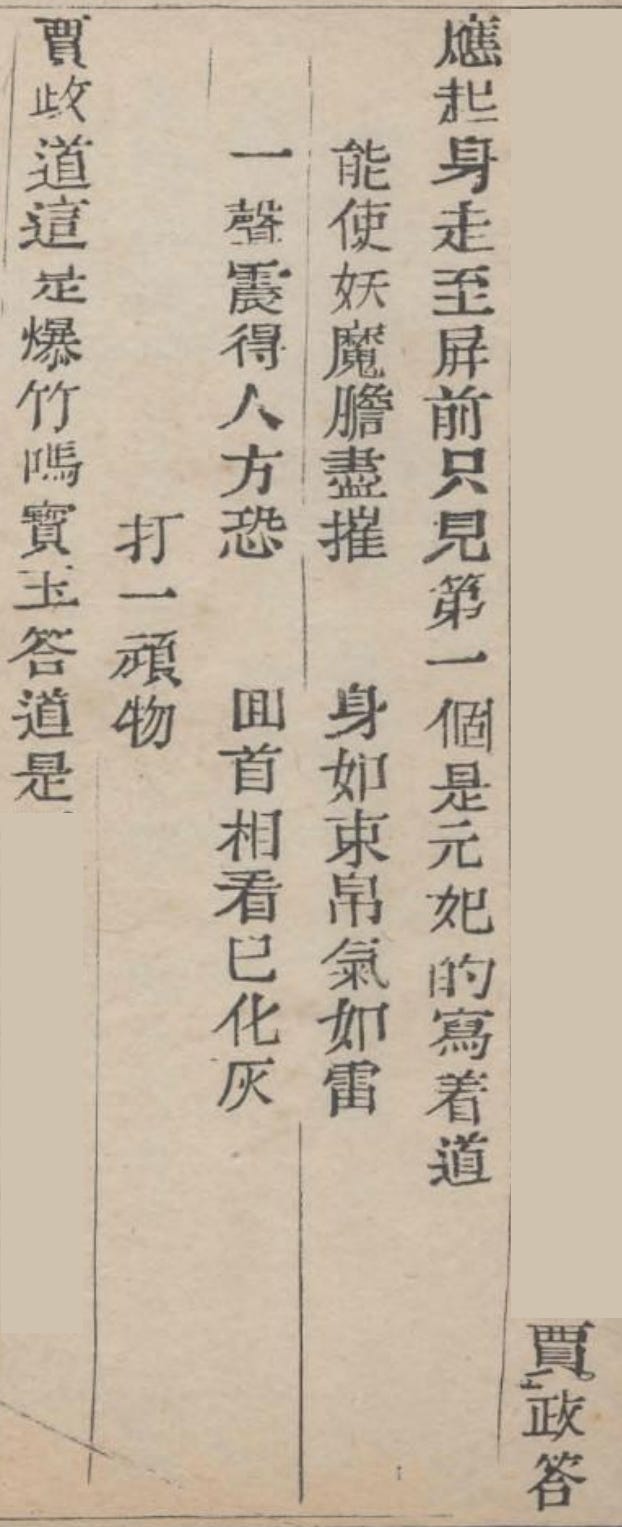
賈政答應,起身走至屏前,只見第一個是元妃的,寫著道:
能使妖魔膽盡摧,身如束帛氣如雷。
一聲震得人方恐,回首相看已化灰。
打一頑物。
賈政道:「這是爆竹嗎?」寶玉答道:「是。」
Reading Notes
元妃的 (Yuán fēi de): “the Imperial Consort Yuan’s.” 元妃 is Jia Yuanchun’s title now that she lives in the palace. I’ve used her name instead, so readers know exactly whose riddle this is.
能使妖魔膽盡摧 (néng shǐ yāomó dǎn jìn cuī): literally means “it can make the gallbladders of demons and monsters be completely crushed.” In Chinese the gallbladder (膽) is where courage lives, so a crushed gallbladder means lost nerve. This is the first clue, and it points to an old New Year custom. The sixth-century Jingchu suishi ji (荊楚歲時記) says that on New Year’s Day people got up at cockcrow and set off 爆竹 in the courtyard to drive away 山臊, a mountain demon. A note in the same book says the demon has one leg, and that bamboo thrown into a fire crackles loudly and frightens it off.
身如束帛 (shēn rú shùbó): “its body is like a bundle of silk.” 束帛 is bolts of silk rolled and tied together, and it’s an old, formal word. In the Yili (儀禮), a bundle of five bolts of black and red silk is one of the gifts a groom’s family sends for a wedding. In the riddle it describes the shape: a firecracker is a tight roll of paper tied up like a bundle of silk.
氣如雷 (qì rú léi): “its breath like thunder.” 氣 is breath or the force inside a thing. Here it’s the bang.
一聲震得人方恐 (yī shēng zhèn de rén fāng kǒng): literally means “one sound shakes people, and just then they are afraid.” 方 means “just at that moment,” and it ties this line to the next one. The fright and the ashes come almost at once, so the English runs the two lines together as one sentence.
回首相看已化灰 (huíshǒu xiāng kàn yǐ huà huī): literally means “turning their heads to look, it has already turned to ash.” 已, “already,” is the punch line. By the time anyone turns to look, the firecracker is gone, and only ashes are left.
打一頑物 (dǎ yī wánwù): “the answer is a toy.” 頑 usually means “stubborn,” but here it stands for 玩, “to play,” so 頑物 is a plaything.
爆竹 (bàozhú): a firecracker. The two characters literally mean “bursting bamboo.” Early firecrackers were bamboo stalks thrown on a fire, where they popped as they burned. By Cao Xueqin’s time a firecracker was gunpowder in a paper tube, but it kept the old bamboo name.
寶玉答道:「是」 (Bǎoyù dá dào: “shì”): “Baoyu answered, ‘Yes.’” Yuanchun isn’t there to tell her father he guessed right, and it’s Baoyu who answers.
The Other Translations
Hawkes
David Hawkes translates the riddle like this:
At my coming the devils turn pallid with wonder.
My body’s all folds and my voice is like thunder.
When, alarmed by the sound of my thunderous crash,
You look round, I have already turned into ash.
An object of amusement.
It’s a nicely rendered poem, and it’s actually a pretty good representation of the original.
Yang
The Yangs take this approach:
Monsters I can affright and put to fight;
A roll of silk my form; my thunderous crash
Strikes dread into the hearts of all,
Yet when they look around I’ve turned to ash.
This is a much more literal translation of the original, though I think both translations actually work quite well.
Hawkes and the Yangs both make the riddle rhyme, and my version doesn’t rhyme at all. Which one reads most like a riddle to you? Tell me in the comments, and if a line of mine sounds wrong, say so.
Go deeper: In Feeding Her the Answer, Jia Zheng gives his mother an inkstone riddle and makes sure she wins.
Meet them: Jia Zheng / Jia Baoyu / Jia Yuanchun / All the characters