


Cardamom and Roseleaf Raspberry
Sometimes it feels like each new section of this chapter is harder than the one before it. This passage is no exception. If you’re trying to follow along in Chinese, I wish you all the best, and will do my best to help you.
My Translation
“I’ve written a couplet as well,” said another one of the men. “Please let me know what you think.” And he recited:
A fragrant wind drifts over the jade orchids along three paths,
The bright moonlight floods the golden orchids across a single courtyard.
Jia Zheng stroked his beard and thought deeply, hoping to compose his own couplet. But he then raised his head and looked at Baoyu, who was standing nearby silently, not daring to say a word. “Why don’t you say something when you should be talking?” Jia Zheng demanded of him. “Are you waiting for somebody to come and beg you to teach them?”
“This place doesn’t have any musk orchids,” replied Baoyu, “nor a bright moon, nor sandbars or islets. If we’re going to keep citing cliches from the past, we could compose 200 couplets and still not be finished.”
“And who is threatening you,” replied Jia Zheng, “telling you that you absolutely have to use these words?”
“In that case,” answered Baoyu, “the best inscription for the horizontal plaque would be ‘The Pure Fragrance of Wild Ginger and Angelica.’ And here is its couplet:
When you compose poems next to cardamom, they remain vividly bright;
When you sleep your fill next to roseleaf raspberry, your dreams are likewise sweet.
“But that’s just an imitation of the line ‘When written on banana leaves, the script still retains its green,’” replied Jia Zheng with a laugh. “There’s nothing remarkable about that.”
“But Li Bai’s poem ‘On the Phoenix Terrace’ was an imitation of Cui Hao’s ‘Yellow Crane Tower,’” replied the gentlemen. “And yet it’s that style of imitation that makes it work so well. If you look closely and carefully at it, you’ll see that Baoyu’s couplet is even more refined, elegant, and lively than ‘Written on Banana Leaves.’”
“How in the world could that be?!” replied Jia Zheng with a smile.
Translation Critique
Hawkes
In The Story of the Stone, David Hawkes translates the first couplet like this:
Down garden walks a fragrant breeze caresses bed of melilot.
By courtyard walls a brilliant moon illumines golden orchises.
Honestly, I think this was probably an early draft that Hawkes inadvertently included in the final published version. The grammar makes no sense in English, and it feels like a bunch of gibberish.
Hawkes translates 蘅芷清芬 as “The Garden of Spices,” which I honestly find a little bit disappointing. There’s no “garden” anywhere in the name, and the references to wild ginger and angelica, plants that grow up from the ground in damp environments, are unfortunately missing.
Hawkes does an interesting job translating Baoyu’s couplet:
Composing amidst cardamoms, you shall make verses like flowers.
Slumbering amidst the roses, you shall dream fragrant dreams.
It’s certainly a possible interpretation, though it’s interesting to me that he uses the imperative form (“you shall”) in this poem. I never would have seen it in the original.
He translates Jia Zheng’s quotation like this:
Composing midst the plantains
Green shall my verses be.
However, Hawkes offers no explanatory notes, nor does he say what in the world the scholars are talking about when they reference Li Bai and Cui Hao.
Yang
The Yangs translate the first poem like this:
Along three paths white angelica scents the breeze,
In the court a bright moon shines on golden orchids.
However, this is grammatically incorrect (though at least it makes sense, unlike the David Hawkes version). If 玉蕙 (“white angelica”) is “scenting the breeze” (香風, which I suppose means to add its scent to the breeze), then the flower must be the subject of the sentence. The problem, however, is that the second part of the couplet has 金蘭 (“golden orchids”) as the object and 明月 (a bright moon) as the subject.
Now you can see some of the difficulty involved in making a translation that actually makes sense. The hardest part is figuring out what the couplet actually means first. You can’t translate it until you understand it.
The Yangs translate 蘅芷清芬 as “Pure Scent of Alpinia and Iris,” which is a perfectly fine translation. And they translate Baoyu’s couplet like this:
Singing on cardamons makes lovely poetry;
Sleeping beneath roses induces sweet dreams.
This is also an excellent translation.
They translate Jia Zheng’s reference like this:
Write on plantain leaves and green is the writing.
It’s also a perfectly fine translation, though it’s not clear at all to an English reader that the three lines are supposed to be parallel.
There is a brief explanatory note about the relationship between Yellow Crane Pavilion and Phoenix Tower, but it only says that Cui Hao was “another Tang poet.” Sadly, the Yangs don’t even attempt to explain the reference.
Chinese Text
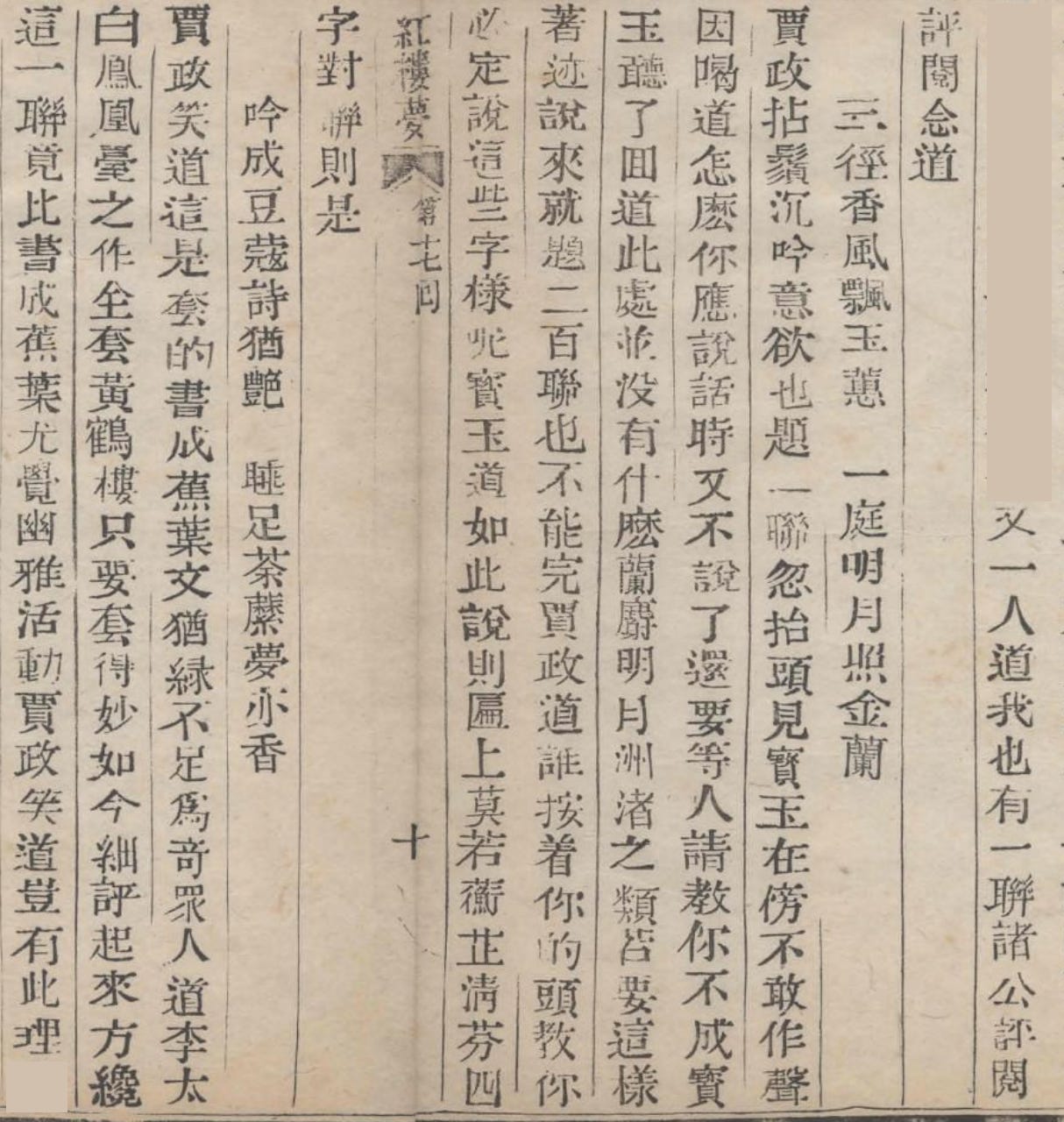
又一人道:「我也有一聯,諸公評閱評閱。」念道:「三徑香風飄玉蕙,一庭明月照金蘭。」
賈政拈鬚沉吟,意欲也題一聯,忽抬頭見寶玉在旁,不敢作聲,因喝道:「怎麼你應說話時又不說了?還要等人請教你不成?」寶玉聽了,回道:「此處並沒有什麼蘭麝、明月、洲渚之類,若要這樣著跡說來,就題二百聯也不能完。」賈政道:「誰按著你的頭,教你必定說這些字樣呢?」寶玉道:「如此說,則匾上莫若『蘅芷清芬』四字。對聯則是:『吟成豆蔻詩猶豔,睡足荼蘼夢亦香』。」賈政笑道:「這是套的『書成蕉葉文猶綠』,不足為奇。」眾人道:「李太白《鳳凰臺》之作全套《黃鶴樓》,只要套得妙。如今細評起來,方才這一聯竟比『書成蕉葉』尤覺幽雅活動。」賈政笑道:「豈有此理?」
Translation Notes
Jia Baoyu’s criticism focuses on the cliches that the most recent poem includes. The poem right before this one was also filled with these cliches. Here are a few:
三徑 (three paths) is an allusion to Jiang Xu (蔣詡) of the Han dynasty, a hermit who cleared three paths in his bamboo grove to receive only a select few friends. It later became a standard trope for a reclusive scholar’s garden.
香風 (fragrant breeze) and 玉蕙 (jade orchids) are also common literary tropes.
Similarly, 明月 (bright moonlight) and 金蘭 (golden orchids) are also common literary tropes.
Jia Baoyu is insisting that the scholars aren’t actually talking about the place that they’ve visited. Instead, they’re using common literary tropes to try to outdo one another in being generic. It’s like having AI write your book.
The four character title that Jia Baoyu gives this place is another nightmare for translators and Chinese students alike.
蘅 refers to the plant 杜衡, which is a low growing and creeping wild ginger plant with heart-shaped leaves and a subtle, spicy-sweet fragrance. It usually grows in damp, shaded forest floors.
芷 refers to 白芷 or angelica. This is a tall, slender herb with white flowers and a very aromatic root. It also grows in humid and damp ground.
Jia Baoyu chooses these two flowers because they actually match the scene that they’ve come across. Notice again that the other scholars are talking about orchids, the setting sun, the moon, and other things that don’t match the scene.
清 means clear; that part is pretty simple. 芬 means fragrant or sweet smelling. This is why we call it “pure fragrance.”
The poem is even more difficult to understand.
豆蔻 is called cardamom in English. This is a certain spice that comes from India, as Wikipedia tells us. However, in Chinese 豆蔻 also refers to the teenage years of a girl, specifically around ages 13 and 14.
荼蘼 means roseleaf raspberry. This is a kind of flower that blooms in the late spring and signifies the end of the flowering season. Therefore, in Chinese literature, this flower can carry with it a kind of finality or a sense of fulfilled contentment – especially if you’re sleeping around it or dreaming of it.
豔 means bright and gorgeous when it refers to colors; it can also mean romantic when you’re talking about love relationships.
The difficult thing about translating Baoyu’s couplet is preserving the grammatical parallel. 睡足 means to sleep one’s fill; 足 is a resultative complement here. Of course, that means that 成 in 吟成 must also be a resultative complement to keep to the rules of the poetic genre.
Similarly, 豆蔻 and 荼蘼 are not the objects of the verbs. Instead, these need to be adverbs, and likely adverbs of location. You compose poetry among or next to the 豆蔻, and you sleep among or next to or underneath the 荼蘼.
書成蕉葉文猶綠 comes from this couplet:
書成蕉葉文猶綠,吟到梅花句亦香
When calligraphy is finished on plantain leaves, the writing still seems green;
When one chants of plum blossoms, the verses themselves become fragrant.
This is an anonymous couplet that was common in classical rhyming and phrasing manuals. It refers to Huaisu (懷素), a monk from the Tang dynasty who could not afford paper, and so practiced his wild cursive calligraphy script on large banana leaves. You can see the parallels to Jia Baoyu’s poem even if you’re only reading this in English. Jia Zheng is saying that there’s nothing remarkable about Jia Baoyu’s couplet because it follows the exact form as that basic couplet; in fact, it’s almost the exact same meaning.
黃鶴樓 (Yellow Crane Tower) by Cui Hao (崔顥) goes like this:
昔人已乘黃鶴去,此地空餘黃鶴樓。
黃鶴一去不復返,白雲千載空悠悠。
晴川歷歷漢陽樹,芳草萋萋鸚鵡洲。
日暮鄉關何處是?煙波江上使人愁。
The immortal of old has already ridden the yellow crane away,
Leaving behind only this empty Yellow Crane Tower.
Once the yellow crane departed, it never returned;
For a thousand years, white clouds have drifted aimlessly.
In clear weather, the river renders every Hanyang tree distinct,
Fragrant grasses grow lush and thick on Parrot Island.
At dusk, where is the way back to my homeland?
The mist and waves upon the river fill one with sorrow.
This refers to the Yellow Crane Tower in Wuhan. Cui Hao’s poem was famous when Li Bai (李白) visited it, and he claimed at first that he couldn’t compose anything to compete with it.
But then Li Bai came up with a poem titled 登金陵鳳凰臺 (Ascending Phoenix Terrace in Jinling):
鳳凰台上鳳凰遊,鳳去台空江自流。
吳宮花草埋幽徑,晉代衣冠成古丘。
三山半落青天外,二水中分白鷺洲。
總為浮雲能蔽日,長安不見使人愁。
On the Phoenix Terrace, the phoenixes once came to play;
The birds are gone, the terrace is empty, and the river flows on alone.
The flowers and grass of the Wu palaces now bury the secluded paths,
The caps and gowns of the Jin dynasty nobility have become ancient mounds.
The Three Mountains are half visible beyond the blue sky,
The dual streams divide around White Egret Island.
It is only because the drifting clouds can block the sun
That Chang’an remains hidden from view, filling one with sorrow.
Perhaps the best comparison here is to think of Cui Hao and Li Bai as jazz musicians. Li Bai didn’t copy Cui Hao’s poem. Instead, he took the basic outline of the poem and improvised on it, sort of like a jazz master taking the chord progression and melody of a standard and turning it into his own.
You can actually see the comparisons in English. Cui Hao starts with a legendary immortal flying away on a golden crane, leaving an empty tower behind. Li Bai talks about a group of magical phoenixes flying away, leaving an empty stone platform behind. Both poems then reflect with melancholy on the empty space, then give a scenic snapshot of the immediate geography, and end with that “filling one with sorrow” (使人愁) line. And, if you look even closer in Chinese, you’ll see that the grammatical structure of both poems is identical.
Of course, Cui Hao’s poem is about an immortal, almost like a fairy tale poem. It’s about the heavy weight of homesickness. Li Bai’s poem, on the other hand, is very real, and is a reflection on the collapse of the Wu and Jin dynasties. That “吳宮花草埋幽徑,晉代衣冠成古丘” line (The flowers and grass of the Wu palaces now bury the secluded paths, the caps and gowns of the Jin dynasty nobility have come ancient mounds) is incredibly powerful even in translation. This is why the scholars consider Li Bai’s poem an improvement on the original, even though the original poem is absolutely brilliant.