


Cassia Halls and Orchid Palaces
We’ve got two passages of poetic description today, as well as a fully descriptive poem. As usual, there’s quite a bit to talk about.
My Translation
As Jia Yuanchun entered through the archway, she saw
Torches blazing in the courtyard, encircling the sky,
Fragrant incense powder covering the entire ground,
Trees that seemed to be ablaze and flowers that looked like jade,
Golden windows and jade railings.
And there was no way to fully describe the
Fine and delicate hanging curtains, made of shrimp whiskers,
Carpets spread across the floors, made of otter fur,
The tripods emitting the scent of deer musk and expensive resin,
The screens arrayed with pheasant-tail fans.
Truly:
These were golden gates and jade doors, the dwelling place of immortals;
They were cassia halls and orchid palaces, the household of an imperial concubine.
Translation Critique
Hawkes
David Hawkes does an excellent job with the two descriptive poetic passages:
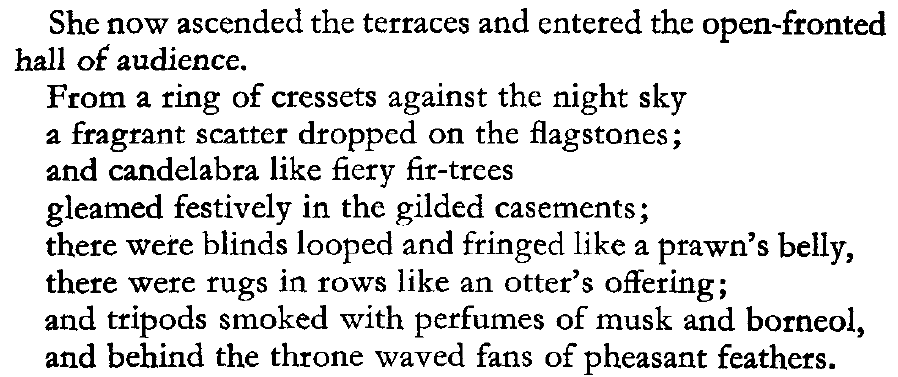
However, the poem at the end is less than ideal:
The abode of the Princess has cassia halls and orchid chambers.
This is a direct reference to Wang Bo’s work as described in the “translation notes” section below. However, Hawkes doesn’t actually spell this out for his reader. And, of course, Hawkes misses the clear and direct reference to the fact that Jia Yuanchun is actually an imperial concubine, not a “princess.”
Yang
The Yang decide against translating the poetic passages as poems, with the exception of the final poem:
An abode with golden gates and jade doors fit for immortals,
Its cassia and orchid chambers a worthy setting for the Imperial Consort.
This is a much better translation than the brief David Hawkes attempt.
Chinese Text
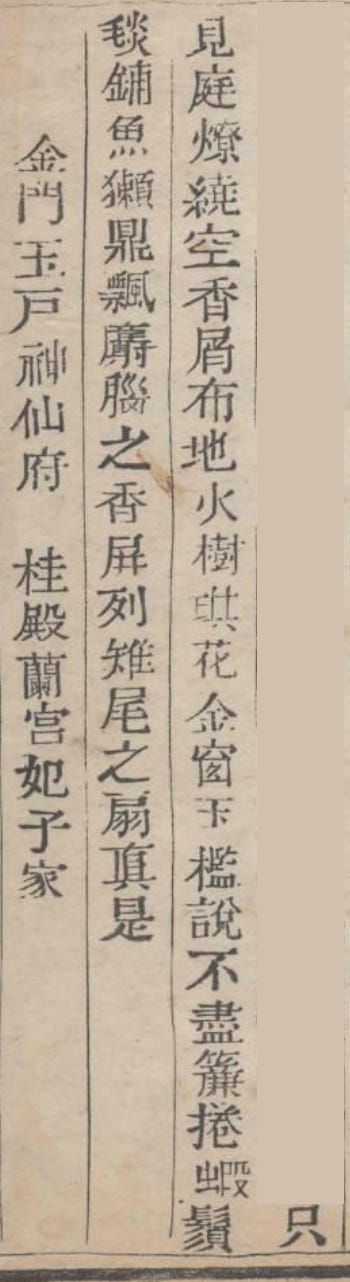
只見庭燎繞空,香屑布地,火樹琪花,金窗玉檻。說不盡簾卷蝦鬚,毯鋪魚獺,鼎飄麝腦之香,屏列雉尾之扇。真是:
金門玉戶神仙府,桂殿蘭宮妃子家。
Translation Notes
庭燎 is a direct reference to the Book of Poetry (詩經):
夜如何其?夜未央,庭燎之光。
How goes the night? It is not yet midnight. The torch is blazing in the courtyard.
As a result, 庭燎 is clearly a politically loaded word, and gives an image of King Xuan of Zhou anxiously awaiting the dawn so he can hold court. Cao Xueqin uses this image to invoke an idea of legitimate royal ritual. However, this is a merchant family burning torches at night to welcome home their daughter – not the family holding court.
蝦鬚 literally mean the long and thin antennae of shrimp. It’s not clear if the curtains here were actually made of shrimp whiskers. This is a phrase usually used to describe curtains that are very fine. However, the other three descriptions in this miniature poem seem to refer to actual animal products.
桂殿蘭宮, or “cassia halls and orchid palaces,” is a direct allusion to a 7th century writing by Wang Bo called Preface to the Pavillion of Prince Teng (滕王閣序). Wang Bo’s work is filled with images of the transience of glory; in fact, he wrote about talented men gathering together, many of whom would die young or go unrecognized. Cao Xueqin is subtly hinting here at the fact that the Jia family’s fate would be unfortunate, and that the talent in the family will be scattered in the end.
Notice that 神仙府, the “mansion for divine immortals,” is matched directly by 妃子家, or “the household of an imperial concubine.” This is a reminder of the actual state of the Jia family. As impressive as the building and garden might have seemed, the truth is that the family is in decline, and that it’s hanging on only because Jia Yuanchun happens to be an imperial concubine.