


Elegance and Literary Grace
Jia Tanchun’s poem today is the first poem in chapter 18 that is truly deep. And we’re going to have some fun diving into this one - especially its complicated literary past.
My Translation
Plaque: Elegance and Literary Grace
By Tanchun
The beautiful waters and bright mountains embrace and wind back around,
This refined charm and literary brilliance surpasses Penglai.
The brilliant green looks like performance fans, fooling even the fragrant grass,
And the red flowers set off the Xiang skirts that dance with the falling plum blossoms.
Pearls and jade should naturally be celebrated in this golden age;
How lucky we are that the immortals descended from the Jade Terrace!
Once this famous garden invites you in to admire its beauty,
It will hardly allow any ordinary mortal to enter.
Translation Critique
Hawkes
Hawkes translates Tanchun’s poem this way:
Tan-Chun: Brightness and Grace
Water on hills and hills on waters smile,
More bright and graceful than the Immortal Isle.
Midst odorous herbs the singer’s green fan hides;
Her crimson skirt through falling petals glides.
A radiant jewel to the world is shown,
A fairy princess from her tower comes down:
And since her steps the garden’s walks have trod,
No mortal foot must desecrate its sod.
Hawkes changes the meaning of this poem significantly. Rather than comparing the inhabitants of the garden directly to immortals, Hawkes modifies the poem to have it compare Jia Yuanchun directly to an immortal. In this case, it seems to be Jia Yuanchun’s green fan hiding in the greens and it seems to be her skirt that glides through the petals.
Hawkes seems to make a lot of these changes for the sake of the rhyme scheme. And the truth is that his poem is actually very well constructed. However, the problem is that the original poem is actually Jia Tanchun reflecting on herself, not on Jia Yuanchun.
Yang
The Yangs shorten this poem and translate it this way:
ALL THINGS VIE IN SPLENDOUR
This garden laid out with consummate art -
I blush, with my poor skill, its fame to render.
Past telling are the marvels in this place
For here, indeed, all things compete in splendour.
Tan-chun
This translation reflects an earlier handwritten version of the text, which reads like this:
萬象爭輝匾額 探春
名園築出勢巍巍,奉命何慚學淺微。
精妙一時言不出,果然萬物有光輝。
All Things Complete In Splendor Tanchun
A famous garden built on such a grand and towering scale;
Having received this command, how can I complain that my learning is shallow and meager?
Such exquisite refinement; words fail to capture it in a single moment.
Indeed, everything here radiates its own brilliance.
I’ve now opened up a pretty big can of worms, since we’re talking about the difference between the few surviving manuscripts (mostly from the late 1750s) and the Cheng Weiyuan and Gao E printed edition, which comes from 1791. It’s not clear whether this poem is the creation of Cheng and Gao or whether it reflects later manuscripts that we do not have today. And, of course, there are numerous changes like this in the novel, changes that are really too lengthy and complicated to talk about in this brief blog entry.
Now, if you insist on seeing physical evidence for what Cao Xueqin originally wrote, you’re likely going to discard the longer poem in favor of the shorter poem. We know that “All Things Complete In Splendor” was actually written by Cao Xueqin, since we have handwritten copies of Cao Xueqin’s drafts.
However, if you’re looking at the literary merits of the poetry and the way it reflects Jia Tanchun’s character, I’d argue that “Elegance and Literary Grace” is the more appropriate poem. Tanchun is fiercely proud and sensitive about the idea that she somehow does not belong, because she is the daughter of a concubine, not the principle wife. The boldness with which she writes about the garden being a place fit only for people close to immortality could be seen as a declaration that she does indeed fit in and belong, which is an excellent reflection of her character as we see it later in the novel.
The earlier poem, “All Things Complete In Splendor,” doesn’t seem much different from the Jia Yingchun poem we saw earlier.
The problem, of course, is trying to figure out how Cao Xueqin’s characters developed as he wrote his manuscript. With a book this long and complex, it’s really not easy to tell if Cao Xueqin first allowed Jia Tanchun to develop a more independent mind and personality and then changed his poem, or if some other person decided to modify the poem after reading the entire book a few times.
I will say this, however. The line 綠裁歌扇迷芳草,紅襯湘裙舞落梅 is absolutely brilliant, and is not the sort of line that a literary hack comes up with by sheer chance. If you compare that line with the infamously controversial final 40 chapters of Dream of the Red Chamber, you’ll see what I mean. In other words, based solely on its literary merits, I strongly doubt that Cheng Weiyuan and Gao E composed “Elegance and Literary Grace.”
Chinese Text
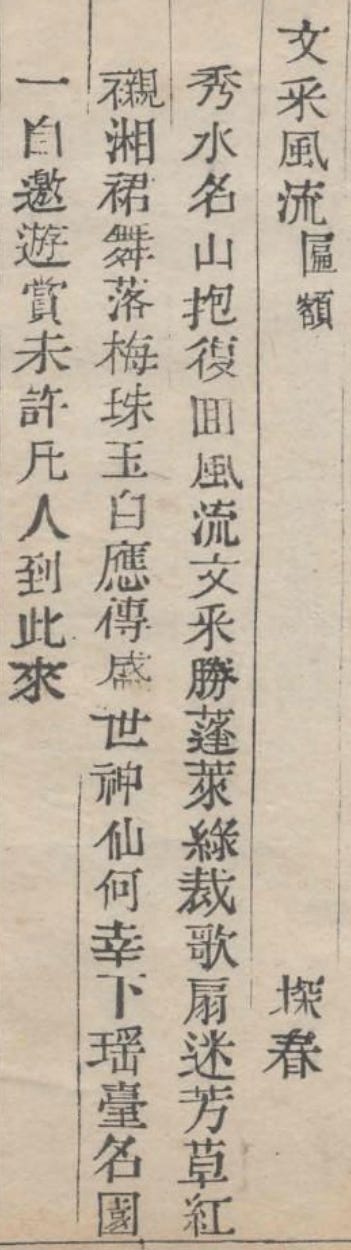
文采風流(匾額)
探春
秀水明山抱復回,風流文采勝蓬萊。綠裁歌扇迷芳草,紅襯湘裙舞落梅。
珠玉自應傳盛世,神仙何幸下瑤臺。名園一自邀遊賞,未許凡人到此來。
Translation Notes
文采 means excellent literary ability, and 風流 means distinguished and graceful
蓬萊, or Penglai, is one of the legendary islands of the immortals in Chinese mythology. This was a legendary paradise of eternal beauty and bliss. Tanchun is saying that the Grand View Garden surpasses even this legendary island.
The line 綠裁歌扇迷芳草,紅襯湘裙舞落梅 is absolutely brilliant, and is difficult to translate. Tanchun is talking about the colors in the garden, obviously. 綠, or green, refers to the bright greenery everywhere in the garden. This green “cuts” (裁) singing fans (歌扇), which might seem confusing. My understanding is that Tanchun sees the green turning into fans used by performers, as if the entire garden is swaying to and fro in a performance for the observers. The whole thing winds up confusing (迷) the fragrant grass, as if the grass itself doesn’t know if it’s seeing an optical illusion or if the garden actually is alive.
Meanwhile, 紅, or red, almost certainly refers to the red flower blossoms. This red “sets off” or “contrasts” (襯) with the Xiang skirts (湘裙). Xiang skirts refer to the Xiang River region in modern day Hunan, which was known in poetry for beautiful women and elegant attire. Those skirts were usually a light color, maybe a pale green or white or something like that. The skirts then dance together with the falling plum blossoms.
The entire image in these two lines is a place of celebration and happiness that seems immortal, one that blends the real with the fantastic.
珠玉 means pearls and jade, and refers figuratively to anything of great value. It’s also frequently used metaphorically to refer to something precious or excellent, like fine writing or speech. And, of course, the word 玉 (jade) has an extremely deep and complicated meaning in Dream of the Red Chamber. Tanchun’s phrase here might remind you of the Chinese idiom 珠聯璧合, which literally means “pearls strung together and jade discs joined.” This idiom refers to marital bliss and harmony, which is exactly the feeling that Tanchun is trying to create with her poem.
瑤臺, or the Jade Terrace, is a legendary place where the immortals live in Taoist mythology.
This poem is set up as a sort of progressive argument for the brilliance of the garden. The first two lines describe it being more beautiful than the mythical island Penglai. The second two lines describe how its beauty fuses nature and art, to the point where the two become inseparable. The third two lines describe how the inhabitants of the garden are as precious as jewels and as divine as immortals. And the final two lines describe how this is a paradise completely separate from the mortal world.