


Helping King Zhou Perform His Cruelty
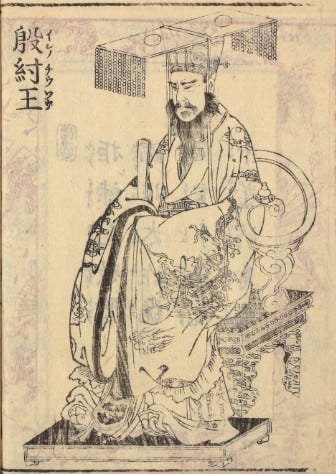
The cool thing about a blog like this is that I can take my time to go slowly and explain things that might otherwise be difficult to understand.
If you’re new to the Chinese language, don’t worry. I’ll do my best to help all of this make sense to one extent or another.
The Chinese language is filled with four character phrases which we generally refer to as “idioms” in English. “Idioms” is correct, though it’s a little bit confusing, since there are also common Chinese idiomatic phrases that are five characters, six characters, or sometimes even entire phrases or quotations from classical poetry. All of those technically count as “idioms,” though the four letter idioms are special.
These idioms are referred to as 成語 (chéngyǔ) in Chinese. This word literally means something like “set phrase.” They’re differentiated from other set formulaic expressions (熟語) - stuff like two part allegorical sayings (歇後語), proverbs (諺語), and colloquial phrases (慣用語).
I cannot overstate how important it is to learn these phrases if you want to learn Chinese. I also cannot exaggerate just how hard it is to learn these phrases so well that they’re always on the tip of your tongue. Native speakers, particularly educated native speakers who grew up in mainland China, seem to have a particular flair for this kind of expression. Foreigners, however, tend to struggle with it - and we sadly tend to use far too many words to express a simple concept that a quick phrase could solve.
Now, the other formulaic expressions are also important. I remember spending weeks frantically studying the colloquial phrases when I was preparing to take the HSK (China’s equivalent of the TOEFL) about 15 years ago. Actually, when I look back at my notes from that time I’ve got to laugh. A lot of the things and concepts I struggled with at the time seem natural now, not because I spent a lot of time studying them, but because I’ve spent a lot of time in a Chinese language environment.
But the 成語 brand of idioms are different. You can guess other things from the context. You can’t really do that with idioms - which is why it’s always good to slow down and actually learn what you’re studying.
Anyway, we saw an idiom in yesterday’s translation post that is pretty confusing. The four letter phrase 助紂為虐 literally means “help Zhou abuse others.” And, if you have a dictionary that isn’t complete enough to contain this idiom for some reason, you’re going to wind up stuck.
Sometimes you can cut up Chinese idioms and analyze them to figure out what’s going on. In this case, 助 means to help, 為 means to do, and 虐 means to abuse or maltreat.
The problem is 紂, of course. 紂 literally refers to the part of a saddle that is looped under the tail of a horse to stop the saddle from slipping off. Of course, that doesn’t make any sense at all in this context. The only other way that 紂 could mean anything understandable in this phrase is in the sense of King Zhou, the last king of the Shang Dynasty of China, who passed away somewhere around 1046 BCE.
Now, the Wikipedia page I linked to for King Zhou is actually kind of funny. There’s a long paragraph in there arguing that he wasn’t quite as cruel as later dynasties made him out to be, and that modern day historians believe that he was actually a fair and intelligent leader. That might be the case, but it’s not going to help us learn this idiom - and it’s entirely unsourced, of course.
Anyway, there are reports in the 史記, or Records of the Grand Historian, of King Zhou spending his time swimming in a huge pool filled with wine and surrounded by artificial trees with branches made of roasted meat skewers.
There was also a report in the same historical document of Zhou employing a method of torture that involved forcing prisoners to hug a large, hollow bronze cylinder that was stuffed with red hot burning charcoal, making them hold on until they perished. This form of punishment was called 炮格.
Anyway, if you’re interested in learning more about this controversial figure, the best source I’ve been able to find online is at chinaknowledge.de. That article at least seems to be free of the speculation that mars the Wikipedia article.
In the end, “helping Zhou abuse others” or however you want to translate the idiom means helping an absolutely evil person do horrible things to other people.