


Homosexuality and Masculinity
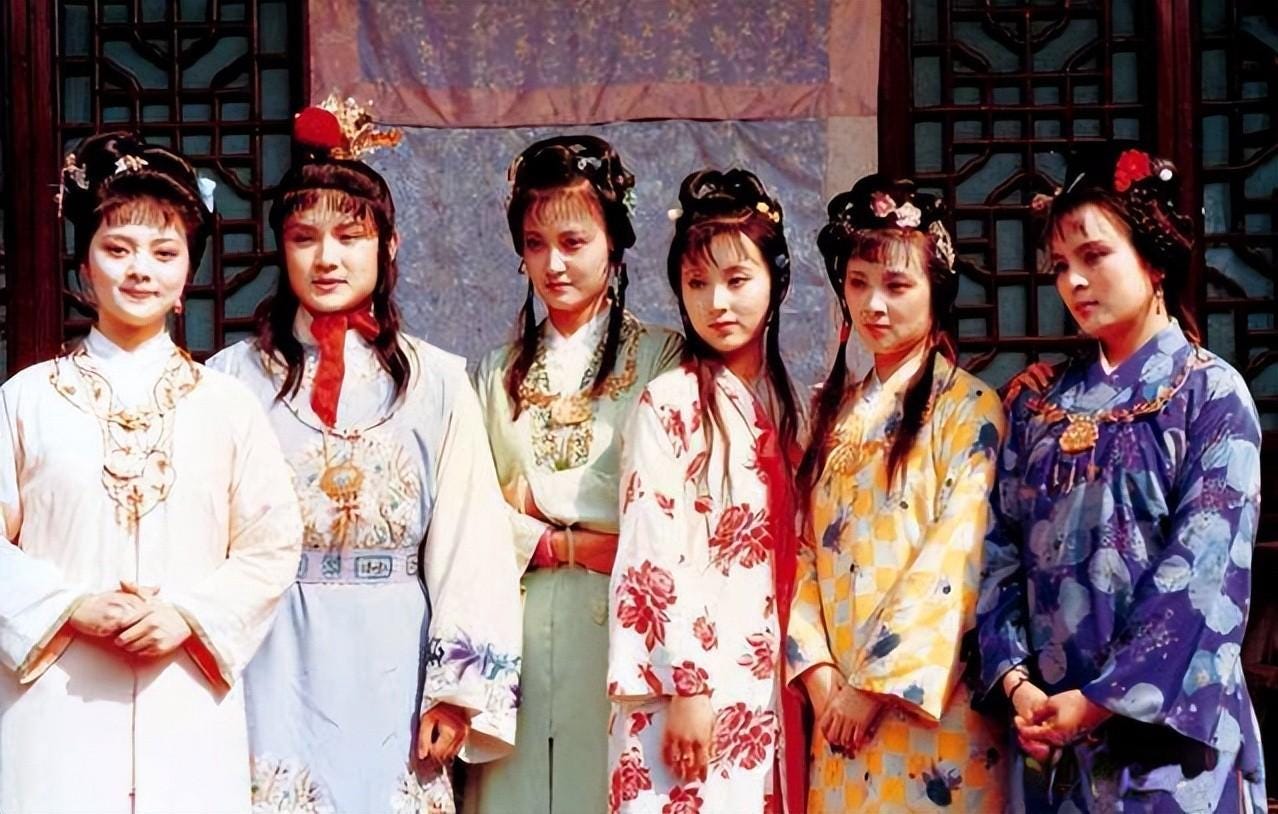
This is an awkward topic, sure, but I’m going to have to talk about it eventually. Now is as good a time as any.
Chapter 9 of Dream of the Red Chamber is notorious for its frank depictions and comments on homosexual activity. Now, we know that the majority of the boys in this chapter are not exclusively homosexual. In fact, the focus of the book as a whole is Jia Baoyu’s conflict between the two women he has fallen in love with, not two men or one woman and one man.
Having said that, there is undoubtedly more than a strong bond between Jia Baoyu and Qin Zhong. The language used when Qin Zhong is described from Jia Baoyu’s perspective is undeniably feminine - feminine to an extreme, actually.
Now, I’m honestly far from an expert on this part of Chinese literature, and my collection of books on the subject remains largely unread and hopelessly scattered. However, I have been able to find a few scholars who have said a thing or two to help us understand what is going on in this chapter.
Back in 2017, Professor I-Hsien Wu wrote a book called Eroticism and Other Literary Conventions in Chinese Literature: Intertextuality in The Story of the Stone. You can’t go wrong with a name like that, right? Anyway, despite the lack of a punchy book name, it’s an interesting study, and includes this nice and terse description of the relationship between Jia Baoyu and Qin Zhong:
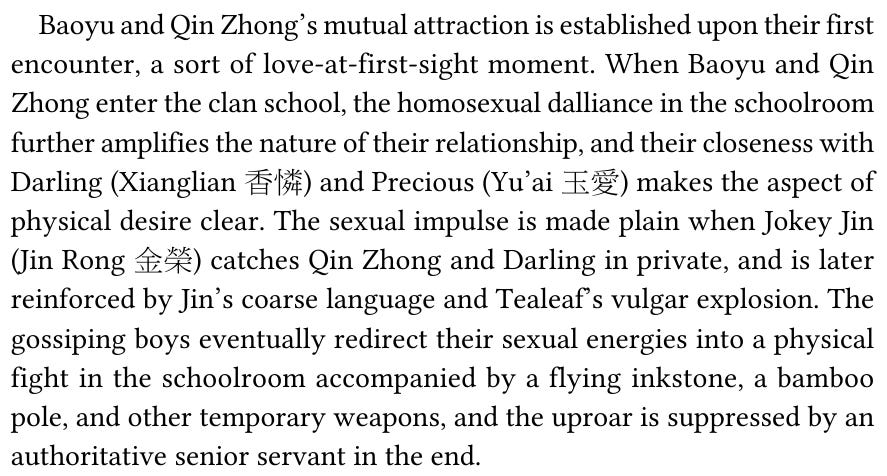
I hope you don’t mind the fact that Professor Wu has used David Hawkes’ terms for the names of the characters. Anyway, Professor Wu goes on to describe how the homoeroticism here is largely an echo of homoeroticism in other contemporary works of Chinese fiction:
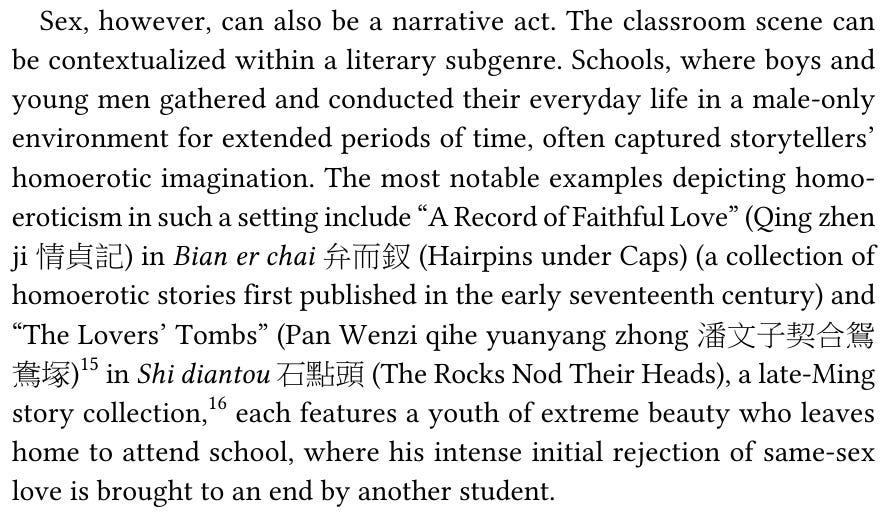
And, you know, the nice thing about reading these scholarly studies is that the scholars tend to do the hard work for the rest of us. I can always just take Professor Wu at her word instead of trying to track down these collections of homoerotic stories that she’s citing.
But, if you’ve been reading my musings on this subject for a while, you know that I’m a major proponent of comparing Dream of the Red Chamber to the “才子佳人” (great scholar and beautiful woman) genre of classical Chinese romantic fiction. In other words - I probably wouldn’t wind up looking into the homoerotic stories that Professor Wu cites. Instead, I’d look towards the tradition of heterosexual Chinese romantic fiction for examples of this kind of homoerotic description.
You know what’s crazy? It’s the fact that you actually can find homosexual circumstances and discourse in those undeniably heterosexual stories.
The Fragile Scholar: Power and Masculinity in Chinese Culture is probably the best source on this phenomenon. You can tell from the title that this is all about the concept of “masculinity” in China and how it has changed over time. Professor Song Geng is talking about the exact problem we see in this book.
After going into a discourse on the ying-yang theory that I won’t get into here (in part because I don’t fully understand it myself), Professor Song describes what he calls “male favoritism:”
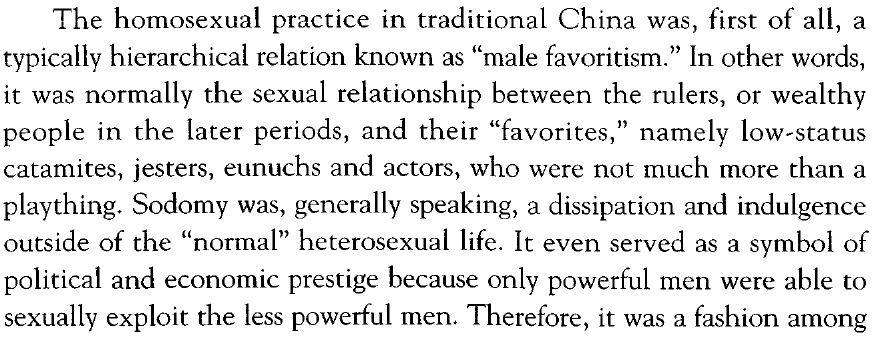

In other words - the homosexuality we’re seeing in chapter 9 of this book is likely connected more closely with the hierarchical nature of Jia Baoyu’s society than some sort of extension of the homoerotic desires of the author:
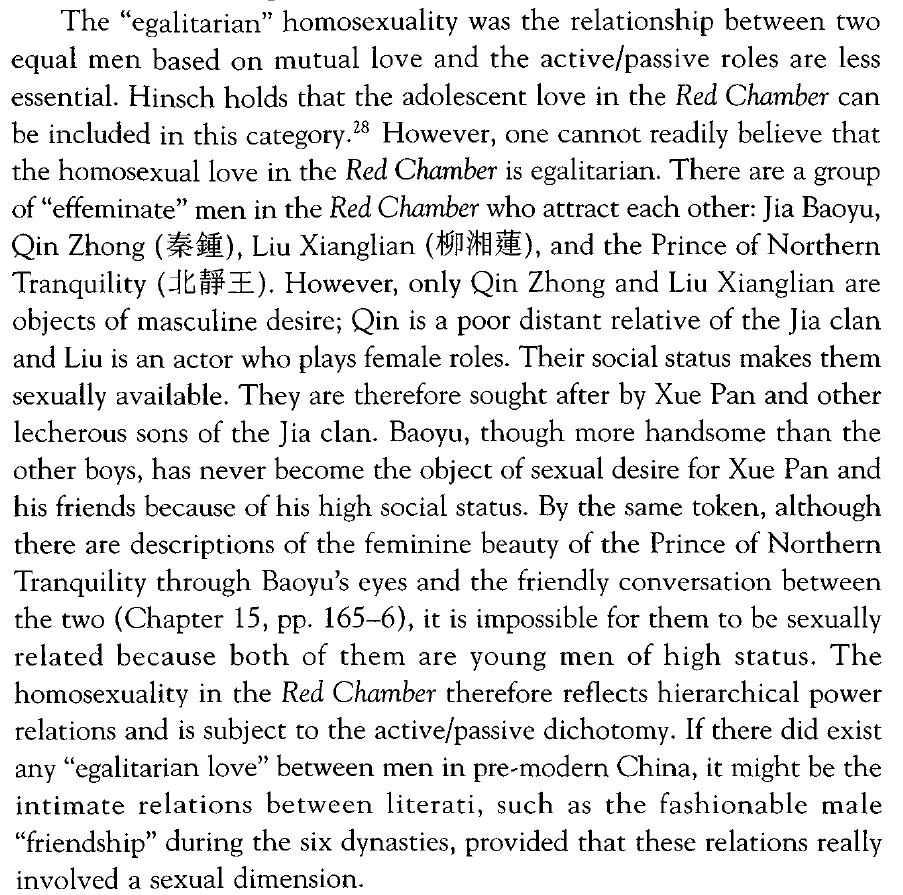
If you think about it a little bit, this certainly doesn’t say anything positive about Jia Baoyu. Remember that his fascination with Qin Zhong from the start was more closely connected with Qin Zhong’s socioeconomic status than anything else. Perhaps Jia Baoyu’s unceasing desire to be with women is also connected with their social status?
The other thing to remember is that the male protagonist in the “great scholar and beautiful women” stories was also often described in feminine terms, and sometimes engaged in homosexual behavior:
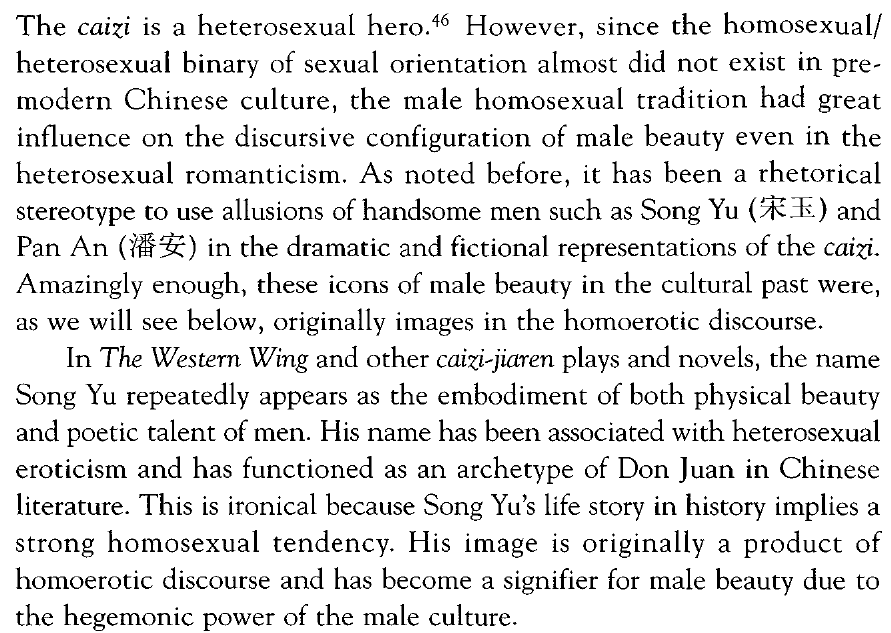
I’m not sure if we should say from a modern perspective that they were all bisexual. Honestly, I think the right interpretation here is to look instead at the socioeconomic statuses of the various characters, and to think more in terms of how they relate with each other than about what their sexual desires might be.
One more “queer” note. It’s actually common in the “great scholar and beautiful woman” stories to see women who aspire to be like men. This comes from Chloe F. Starr’s excellent Red-light Novels of the late Qing:
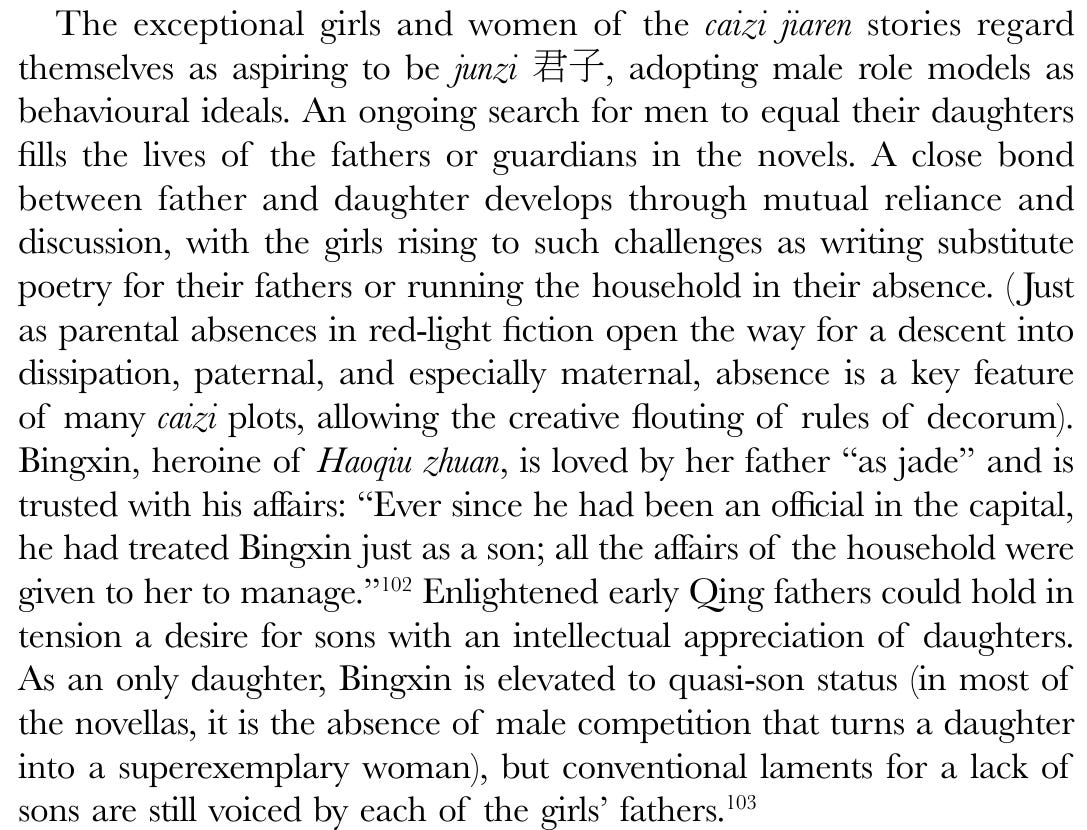
And it goes even further than just hoping to be considered as a son:
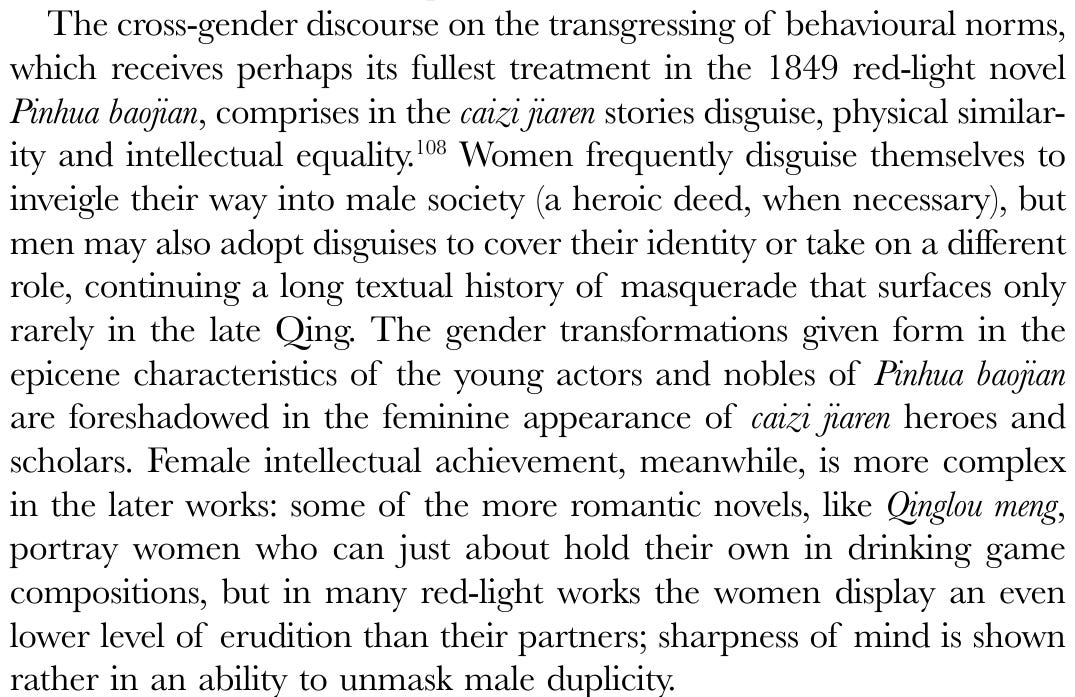
I’m not sure if any of this really fits into modern narratives of transgenderism. However, it’s certainly clear that the reason these old books feel so modern to us is that they constantly play on themes relevant to our current political discourse.
Anyway, keep this in mind when you read about how literate women in the literary world of the Ming and Qing dynasties were held in such high esteem. It feels like there was a general wave of societal subversion in that literary world - a desire to turn the established order upside down.
Personally, I think all of this means that we’ve got to be careful when we read these old books and talk about them. We naturally use stereotypes and absolutes when talking about other cultures, strange languages, and people in the distant past. However, if nothing else, all of this gender bending and fungible sexuality shows us that imperial Chinese society was anything but predictable.