


Ignored Tea And Abandoned Chess
Jia Baoyu’s brilliance is on display again today. This is a pretty complex and dense passage, and I probably should have split it up into two or three posts. Enjoy today’s long translation post and complex explanation!
My Translation
The group then left the pavilion, went across the pond, and were careful to examine every hill, every rock, every flower, and every tree along their way. After a while, when they raised their heads, they suddenly saw a row of whitewashed walls surrounding several tall rooms, partially shaded by a dense grove of countless green bamboo trees. “What an excellent spot!” everybody exclaimed as they entered.
After they entered through the gateway, they found themselves walking along a winding covered walkway. There was a path paved with small pebbles below the steps which led onward to a tiny building with three rooms: two bright rooms with windows and one darker inner room. Every piece of furniture inside, including couches, tables, chairs, and desks, had been custom built to fit the exact proportions of the rooms. A small door led out from the inner room to a garden in the back, where large pear trees and broad-leaved plantains grew, along with two small paths leading to the outside of the compound.
There was a narrow opening at the bottom of the rear garden wall that enclosed a stream of spring water. There was a shallow channel, about a foot wide, that carried the water under the wall. This channel wound around the steps, enclosed the house, flowed out into the front courtyard, and went in and out of the bamboo trees before finally draining away.
“This really is a nice area,” said Jia Zheng with a smile. “If you could come here on a moonlit night to read by these windows, surely your life would not be lived in vain!” He glanced over at Baoyu as he said these words.
Baoyu was startled and quickly dropped his head. The others intervened with some casual chatter to smooth things over.
“We really ought to find four characters for the plaque by this scene,” spoke two of the scholars.
“Which four characters?” asked Jia Zheng with a smile.
“How about ‘The Legacy of the Qi River?’” suggested one scholar.
“That’s too obvious,” replied Jia Zhen.
“What about ‘The Relics of the Sui Garden?’” asked another scholar.
“That’s also too common,” replied Jia Zheng.
Jia Zhen was standing nearby, and he spoke up. “Maybe we should let Baoyu come up with one here.”
“Before he comes up with his idea,” said Jia Zheng with a hint of frustration, “he should find fault with what the others have said first. Then we can see how flippant and arrogant he really is.”
“But his criticisms are correct,” replied the scholars. “We really can’t help it.”
“Don’t indulge him so much,” replied Jia Zheng hastily. He then turned to Jia Baoyu. “Today I’ll let you speak as wildly and recklessly as you like. However, you may only compose your own title after you’ve given us your criticism. Now, among the suggestions you just heard, is there any that you think we could use?”
“None of them seem quite right,” said Baoyu after thinking about Jia Zheng’s question.
“Why aren’t they quite right?” asked Jia Zheng with a cold smile.
“This is the very first place for the imperial visit,” said Jia Baoyu. “The inscription needs to extol the imperial presence above all. And besides, if we’re going to use a four character plaque here, why make a new one when perfectly good ancient models already exist?”
“Wait,” replied Jia Zheng. “Don’t you realize that ‘Qi River’ and ‘Sui Garden’ come from ancient sources?”
“Yes,” said Baoyu, “but they are too stiff and predictable. It would be much better to use the phrase ‘The Phoenix Arrives In Ritual Splendor.’”
“Absolutely brilliant!” exclaimed all the scholars.
“You little beast,” said Jia Zheng as he nodded. “You’ve only got a shallow and limited view of the whole thing. Now let’s see you come up with a matching couplet poem to go along with it.”
Baoyu composed this poem:
In the precious kettle, the tea sits idle, and the steam is green;
By the quiet window, the chess game is abandoned, and the fingers are cold.
“Nothing remarkable at all,” muttered Jia Zheng as he shook his head. And he then led the party out.
Translation Critique
Hawkes
Hawkes describes that Jia Zheng’s “glance happened to fall on Bao-yu, who instantly became so embarrassed that he hung his head in shame.” This makes no sense at all in this context. Instead, Jia Zheng looked at Jia Baoyu deliberately because his phrase about studying beside the window on a moonlit night was intended to test Jia Baoyu’s literary abilities. It’s not necessarily a mistranslation; however, if you only read The Story of the Stone, you’re going to be very confused by this passage.
Thankfully, David Hawkes gives us a direct quotation to explain what 淇水遺風 (“Where Bends the Qi”) means:
“‘Where Bends The Qi’” said one of them, no doubt having in mind the song in the Poetry Classic which begins with the words
See in that nook where bends the Qi,
The green bamboos, how graceful grown!
I honestly wish Hawkes would have done this more frequently with the other literary allusions in this book.
Unfortunately, the Sui Garden reference doesn’t work quite as well:
“‘North of the Sui’” said the other, evidently thinking of the ancient Rabbit Garden of the Prince of Liang in Suiyang – also famous for its bamboos and running water.
This kind of works, except that it misses the point. The point is that the 睢園 was also a famous literary gathering place that served pretty much the same role that this garden will serve as we continue through Dream of the Red Chamber. However, Hawkes says nothing here about the literary role of that garden.
Hawkes also explains Jia Baoyu’s suggestion to a certain extent:
This is the first building our visitor will enter when she looks over the garden, so there ought to be some word of praise for the Emperor at this point. If we want a classical reference with imperial symbolism, I suggest “The Phoenix Dance,” alluding to that passage in the History Classic about the male and female phoenixes alighting “with measured gambollings” in the Emperor’s courtyard.
I was confused about this when I first read it several years ago, especially the “gambollings” part. To gambol means to frolic or move about playfully. Unfortunately for David Hawkes, this is actually a mistranslation of 簫韶九成,鳳凰來儀, where the phoenix comes in to perform a ritual. The problem is that 儀 means to perform a ritual, not to dance or rest or play around or whatever.
Hawkes translates the poem like this:
From the empty cauldron the steam still rises after the brewing of tea.
By the darkening window the fingers are still cold after the game of Go.
The problem with this translation is that the steam isn’t green. It needs to be green. If the steam isn’t green, then there is no allusion at all to the bamboo, and the poem doesn’t make any sense.
The other problem is that the cauldron is not “empty.” It’s “precious” (寶). In fact, the cauldron is not really empty. The tea is ready and is cooling off, but the person inside is not paying any attention because of the amazing scene outside the window.
Note as well that the original poem implies that the game of chess has been ignored as much as the tea sitting in the cauldron. Your fingers wouldn’t be cold after a game of chess or Go. Your fingers would be warm. Your fingers would only be cold if the game never took place to begin with, which is what this poem actually means.
Yang
The Yangs have Jia Baoyu hang “his head in confusion” after his father makes the comment and looks at him. This is not a correct translation. Jia Baoyu understands what his father expects of him, but is hanging his head because it’s not really his place right now to come up with some spectacular poem on the spot.
The Yangs translate the first suggestion as “Shades of the River Chi,” with a note explaining that “According to the Book of Songs, the area around the River Chi, in the northern part of present-day Honan, abounded with bamboo in ancient time.” This is sort of correct, but it misses the point of the reference to 淇奧. The point here is the comparison between the bamboo and an upright gentleman – which is actually also why this name is inappropriate, as Jia Baoyu correctly points out.
The second name is translated as “Traces of the Sui Garden,” which is explained in a footnote as “Garden of Prince Hsiao of Liang in the Han Dynasty.” That’s correct, of course. However, as was the case with David Hawkes’ translation, the problem is that no context or explanation is given. Actually, the Sui Garden is an excellent foreshadowing of what this garden is going to become as this book continues.
They translate Jia Baoyu’s title as “Where the Phoenix Alights,” which is okay, but not entirely correct. Remember that 儀 refers to a ritual act, not just arriving.
They translate Baoyu’s poem like this:
Still green the smoke from tea brewed in a rare tripod;
Yet cold the fingers from chess played by quiet window.
They get the “green smoke” or “green steam” image correct. However, as I’ve noted elsewhere, it’s not possible for the chess game to have actually been played if the fingers were cold. Rather, the implication in this poem is that the person inside hasn’t drunk the team or played the game of chess because she is so caught up in the fantastic scene outside the window.
Chinese Text
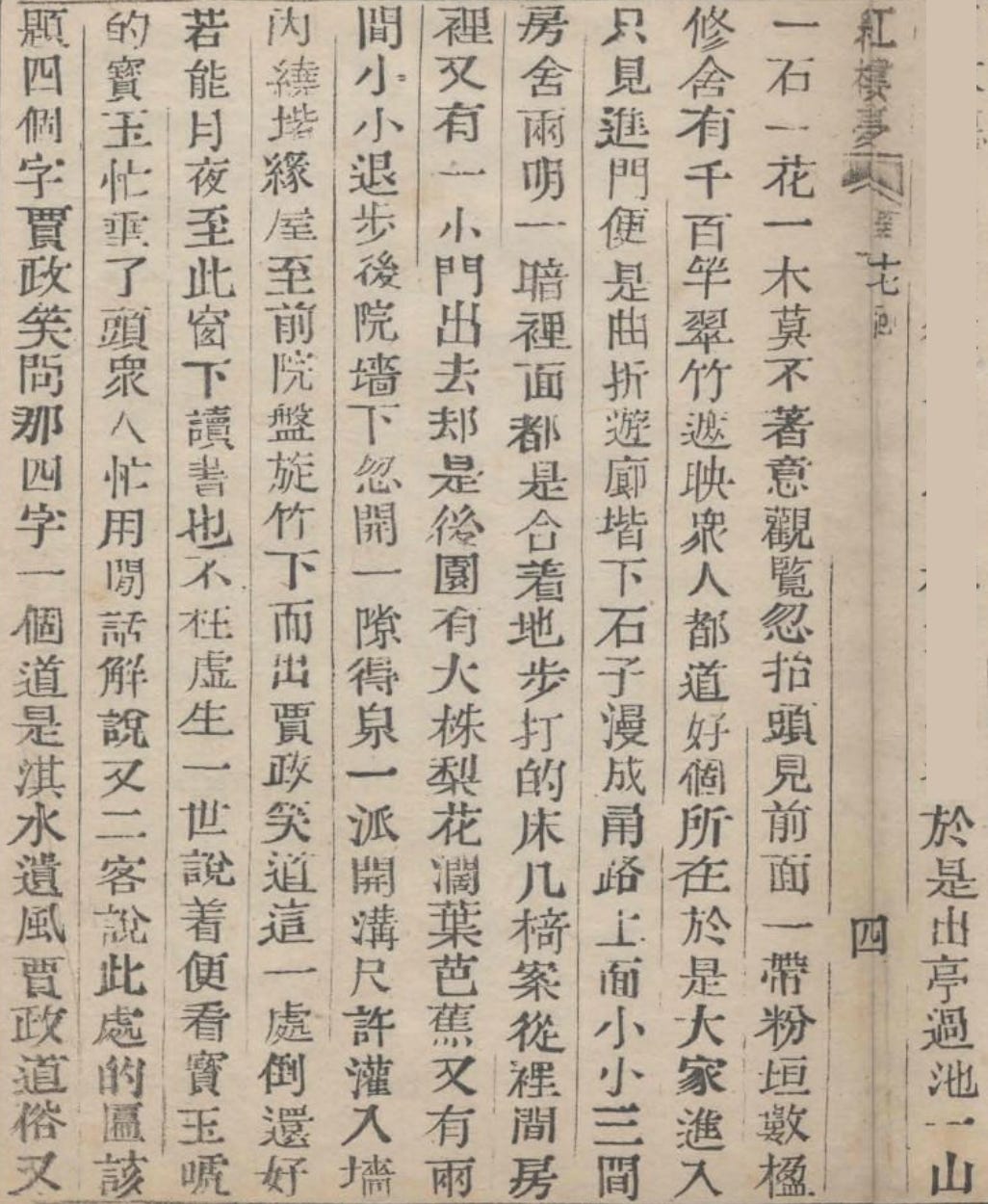
於是出亭過池,一山一石,一花一木,莫不著意觀覽。忽抬頭見前面一帶粉垣,數楹修舍,有千百竿翠竹遮映。眾人都道:「好個所在!」於是大家進入。只見進門便是曲折遊廊,階下石子漫成甬路,上面小小三間房舍,兩明一暗,裡面都是合著地步打的床几椅案。從裡間房裡又有一小門出去,卻是後園,有大株梨花,闊葉芭蕉,又有兩間小小退步。後院牆下忽開一隙,得泉一派,開溝尺許,灌入牆內,繞階緣屋至前院,盤旋竹下而出。
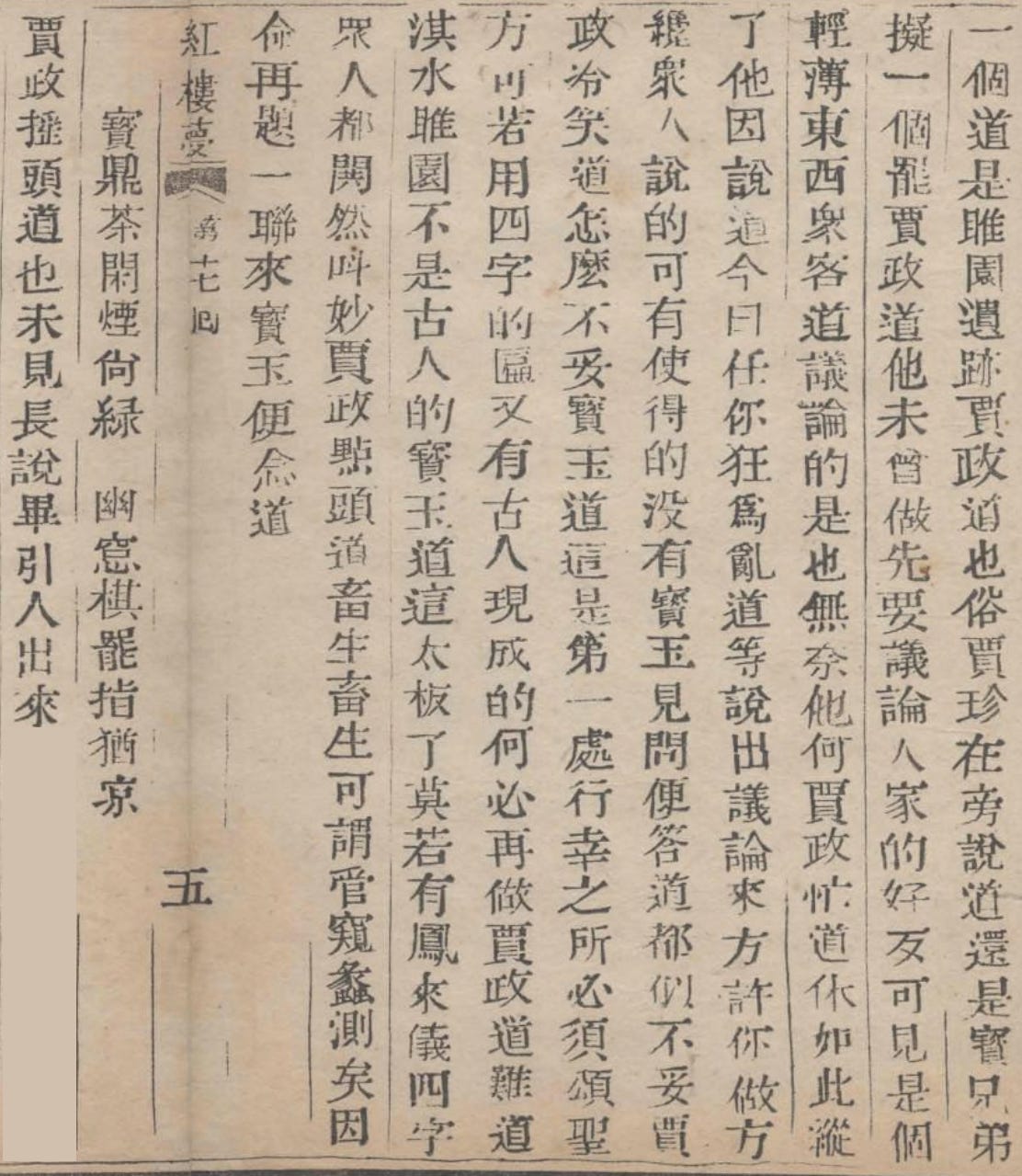
賈政笑道:「這一處倒還好。若能月夜至此窗下讀書,也不枉虛生一世!」說著,便看寶玉,唬的寶玉忙垂了頭。眾人忙用閒話解說。又二客說:「此處的匾,該題四個字。」賈政笑問:「那四字?」一個道是「淇水遺風」。賈政道:「也俗。」又一個道是「睢園遺蹟。」賈政道:「也俗。」賈珍在旁說道:「還是寶兄弟擬一個罷。」賈政道:「他未曾做,先要議論人家的好歹,可見是個輕薄東西!」眾客道:「議論的是,也無奈他何。」賈政忙道:「休如此縱了他。」因說道:「今日任你狂為亂道,等說出議論來,方許你做。方才眾人說的,可有使得的沒有?」寶玉見問,便答道:「都似不妥。」賈政冷笑道:「怎麼不妥?」寶玉道:「這是第一處行幸之所,必須頌聖方可。若用四字的匾,又有古人現成的,何必再做?」賈政道:「難道『淇水』『睢園』不是古人的?」寶玉道:「這太板了,莫若『有鳳來儀』四字。」眾人都鬨然叫妙。賈政點頭道:「畜生,畜生!可謂『管窺蠡測』矣。」因命:「再題一聯來。」寶玉便念道:「寶鼎茶閒煙尚綠,幽窗棋罷指猶涼。」
賈政搖頭道:「也未見長。」說畢,引人出來。
Translation Notes
粉垣 literally means a “powdered wall.” 粉 is frequently used to describe makeup, though in this case it’s referring to a low wall covered with whitewash.
修舍 seems to mean a tall or lofty building. In this case, 修 means “tall,” not “to repair.”
翠竹 means green bamboo
Notice that the water curves and winds under the bamboo trees rather than flowing straight. This was considered to be auspicious because the “vital energy,” or qi (氣), was slowed down by this process. And, of course, it’s more common in nature to see water that flows one way and the other instead of water that moves in a straight line.
This passage shows the expectations Jia Zheng has of his son. When he looks at Jia Baoyu after making his remark about reading by the window, he’s expecting Jia Baoyu to spontaneously produce fascinating poetry. Jia Baoyu isn’t dropping his head because of guilt; rather, it’s because he knows what his father expects. And the response by the men around them is an attempt to lighten the tension a bit and distract Jia Zheng.
淇水遺風 is a direct allusion to a poem in the 詩經, or the Classic of Poetry. More specifically, it is a poem called 淇奥, “The Bamboo Pole,” in the 衛風 or “Odes of Wei” section. This is the beginning of the group of three poems:
瞻彼淇奧,綠竹猗猗。
有匪君子,如切如磋,如琢如磨。
Look at that bend of the Qi River,
Where the green bamboos grow so lush and fair.
There is a man of such refined grace,
As if he were cut, as if he were polished,
As if he were carved, as if he were ground.
The phrase 淇奧 is similarly repeated in the other three poems.
The notable element here is the fact that the rising green bamboo trees along the Qi River are used to praise a man of noble virtue and profound learning.
As you can see, when the scholar says 淇水遺風, the only allusion to the poem is 淇水 itself. 遺風 literally means “handed down wind” or “bequeathed wind,” as if the wind or spirit or feeling of the past were handed down from generation to generation. Basically, the title 淇水遺風 is presumptuous, as if to say that this combination of room and trees were somehow the entire embodiment of the old legacy of the Odes of Wei (衛風).
Jia Zhen replies that it’s “obvious” or “common” (俗) because of how famous the allusion to 淇奧 (the Qi River) was. There’s also a hint here of being a bit presumptuous.
睢園遺蹟 is a historical allusion to a legendary royal garden built during the Weestern Han dynasty. This garden was actually called the 梁園 or Liang Garden. However, it was located in the ancient city of Suiyang (睢陽) in what is now Henan Province. This was a massive garden filled with palaces, pavilions, exotic animals, and huge bamboo groves.
This Sui Garden was known in large part for being the literary and cultural center of its time. Writers lived in the garden, composed poetry, and had numerous intellectual discussions, which itself is a foreshadowing of what we’re about to see in the remaining chapters of Dream of the Red Chamber.
It seems at first glance that the Sui Garden reference is fitting. The problem, however, is that it’s another famous literary cliché, and it is somewhat stiff and pedantic.
It seems a little bit odd that Jia Zheng scolds Jia Baoyu as 輕薄東西 (a flippant, arrogant thing) here before he has said a word. This might be because this entire scene is set up basically as a charade to showcase Jia Baoyu’s literary brilliance. Jia Zheng might be worried that he feels arrogant and might have added in this snide remark to cut Jia Baoyu down to size.
Jia Baoyu’s title 有鳳來儀 (A Phoenix Comes Here In Splendor) is a line taken from the 尚書, or Book of Documents. The original passage described the reign of the legendary King Shun:
簫韶九成,鳳凰來儀。
When the Xiao-Shao music was played in nine movements, the phoenix came and performed its ritual dance.
Note that 儀 literally means to perform a ritual. When I say “splendor” in the translation of the title, what I mean is a type of ritual splendor; the phoenix, or Jia Yuanchun, is coming here to perform an important ritual just as the phoenix that visited King Shun did thousands of years earlier.
The appearance of the phoenix in this context was a sort of cosmic endorsement of the virtue of King Shun. In other words, heaven was so pleased with the moral governance of King Shun that it sent the phoenix as a living symbol of peace, prosperity, and the heavenly mandate.
Baoyu’s use of this phrase is actually brilliant when you think about it. Even though this is a direct classical reference, it’s really forward looking. Instead of talking about the handed down remnants of the Qi River or the relics of the long since destroyed Liang Garden in Suiyang, his reference looks forward to imperial visit.
Remember that the phoenix (鳳) often referred to imperial women, sort of like how the dragon (龍) would refer to imperial men, or to the Emperor. In other words, when Jia Baoyu says that the phoenix is coming here to rest, it is a direct reference to Jia Yuanchun coming to stay in this garden. And the fact that Jia Baoyu has taken a well known classical phrase and has adapted it to an entirely new context is precisely why the scholars praise him so highly.
管窺蠡測 literally means to look at the sky through a bamboo tube and to try to measure the depth of the sea with a water gourd. Jia Zheng is rhetorically criticizing Jia Baoyu as being uneducated and shortsighted. The interesting thing, though, is that he nodded in approval while he said this, which shows that he’s actually quite proud of his son. Jia Zheng is basically caught between wanting to praise his child and the necessity of maintaining his stern and Confucian disciplinarian fatherly image. And that’s probably why he uses such harsh language here.
There’s also a feeling among commentators that Jia Zheng might be criticizing himself with this language, and not his son.
Note that the poem 寶鼎茶閒煙尚綠,幽窗棋罷指猶涼 is a couplet where the grammar follows the exact same pattern in both lines. In other words, 茶閒 (the tea is idle, or the tea has been brewed but nobody is drinking it) and 棋罷 (the chess or go game has been abandoned, or finished) are parallel, the descriptive words 寶鼎 (in the precious kettle) and 幽窗 (by the quiet window) are parallel, and the phrases 煙尚綠 (the steam is still green) and 指猶涼 (the fingers are still cool) are also parallel.
The question, of course, is what precisely is this poem about? The tea has grown cold because it’s idle and the chess game is either over or has been abandoned (note that 罷 usually means “finished,” but probably means “abandoned” in this case). And yet the occupant of the room has not left. Why? This is likely because they are sitting in quiet contemplation, absorbed in the beauty that they see outside the window.
Or, in other words, the scene they saw was so beautiful that they neglected to drink the tea or play the chess game. They are contemplating while sitting in this space, allowing their life to slow down to appreciate the beauty around them. And the thing that they’re obviously observing is the impressive bamboo right outside the window.
It’s almost certainly true that the chess game is abandoned and not finished, even though 罷 usually means “to finish.” The reason why is because the fingers are cold (指猶涼). If you just finished a game of chess, your fingers would be warm, not cold.
Obviously, this does not directly refer to the name 有鳳來儀 (A Phoenix Comes Here To Rest), which is probably why Jia Zheng dismisses the poem outright. But, of course, there is an indirect reference. The phoenix traditionally was believed to dwell in bamboo groves and eat bamboo seeds. Therefore, it would naturally be appropriate for the phoenix to spend her time resting in a place like this, lost in silent contemplation of the world outside the window. It’s a pretty subtle poem, but it’s exciting when you understand it.
The most amazing part about this poem is that Jia Baoyu never actually talks about the bamboo, even though it’s clearly the highlight. The poem says nothing about what lies outside the window. However, the phrase 煙尚綠 (the steam is still green) is the clue. The steam of tea isn’t green, of course. The reason it appears to be green, however, is because of the dense green light that pours into the room and permeates everything around it. That color comes from the dense grove of bamboo trees that lie outside. Just like in the previous poem, Jia Baoyu has managed to find a way to talk about the centerpiece of the scene without actually talking about it.
寶鼎 is odd, of course. 鼎 means a censer, but also referred to tea heating vessels or kettles. By calling this a precious kettle (寶鼎), Jia Baoyu establishes the fact that it is appropriate for an imperial visit, but also places emphasis on just how breathtaking the bamboo scenery outside the window really is. It’s amazing to the point that the person inside the room has completely ignored the precious kettle and the tea inside.
I highly recommend reading Yu Yingshih’s article The Two Worlds of Hunglou meng. This and the next chapter are two of the most rich in hidden meanings, and even Yu only suggests a few of them. What do these interactions hint about Lin Daiyu, who will live in this house? What does Yuanchun, who Baoyu names this house in honor of, think about Daiyu?
It’s interesting seeing how different translations interprets Baoyu’s emotional response to his dad’s glance. The Joly translation (1891) renders this as “so terrified did Baoyu feel that he hastily drooped his head”. This reaction is more extreme than your “startled” and reads very differently than Hawkes’ “embarrassed…shame” and the Yangs’ “confusion”.