


Jia Yuanchun’s Relationship with Jia Baoyu
This is an interesting parenthetical statement in the middle of the chapter. I originally wanted to combine this with the previous and next translation post, but realized pretty early on that there’s a lot of interesting stuff going on here, and so I split them up.
My Translation
Dear reader, you will certainly remember that names like “Smartweed Sandbar and Flower Riverbank,” “The Phoenix Arrives in Ritual Splendor,” and so on were created on the day in the last chapter when Jia Zheng tested Jia Baoyu’s literary gifts. So how is it that these names could be put to serious use?
Think about this. The Jia family had been a literate family for generations. Surely they had one or two accomplished writers who could compose a few inscriptions. How could they allow a child to put forth a feeble effort just to get the task finished?
Here’s the explanation. Before the Imperial Consort Jia Yuanchun entered the palace, she also had been raised by Grandmother Jia. Later, when Jia Baoyu was born, Yuanchun was the older sister, and Baoyu was the younger brother. Yuanchun knew that their mother was older when she had this baby boy, and so Yuanchun doted on him and loved him more than anyone. The two of them would attend to the elders together, and were rarely apart.
Before Baoyu had started to attend school, back when he was three or four years old, Yuanchun had already taught him several books by recitation, and so he carried a few thousand characters in his head before he could even read.
Though they were brother and sister, their relationship was more like mother and child. In fact, after she entered the palace, she often sent messages to her father and brother telling them to “please raise him well in every well. If there’s too little discipline he’ll never amount to anything, and some major misfortune will surely follow. That would only cause Grandmother Jia to worry.” There was not a moment when she didn’t remember him with tenderness.
And so, when Jia Zheng heard Jia Baoyu’s tutor praise his considerable talents a few days earlier, Jia Zheng decided to test him during their tour of the garden. While the results were certainly no match for the works of a famous scholar, they certainly did carry the Jia family flavor with them. Plus, if Jia Yuanchun saw them, she would know that they were the creations of her beloved little brother, which certainly would help her not feel disappointed in his development. And this is why Jia Zheng decidd to use Jia Baoyu’s titles for the inscriptions. The spots that were not filled in during their tour were filled in afterwards with other names.
Translation Critique
Hawkes
David Hawkes marks this section off with the title Stone’s Note To Reader. There’s a question here as to whether the narrator of this book is the stone mentioned in chapter 1 (which is actually Jia Baoyu), or whether the actual narrator is completely disconnected from the book. The book itself never makes this clear. Hawkes also writes the name “Stone” at the end of this passage.
Hawkes credits Jia Baoyu with inventing the inscriptions for the places that remained without inscription. This is not clear in the original; the original merely says that somebody came up with the missing names.
Yang
The Yangs use kind of an odd phrase in their translation: “Why then make shift with phrases tossed off by a boy?” Make shift is a phrase that means “to manage with difficulty,” and is a phrase I honestly don’t remember ever hearing or seeing before. It’s related to makeshift, a much more common noun that means a crude expedient or substitute.
The Yangs add in an odd comment by the unnamed narrator: “Let me, stupid as I am, explain this to you.” This does not exist in the 1792 edition, though I wonder if it might be a translation of some other manuscript version.
The Yangs also credit Jia Baoyu with creating the later inscriptions. Again, this is not clear in the original, which is ambiguous: 那日未題完之處,後來又補題了許多 (there were many places that had no inscriptions after that day, but many of them were created after the fact).
Chinese Text
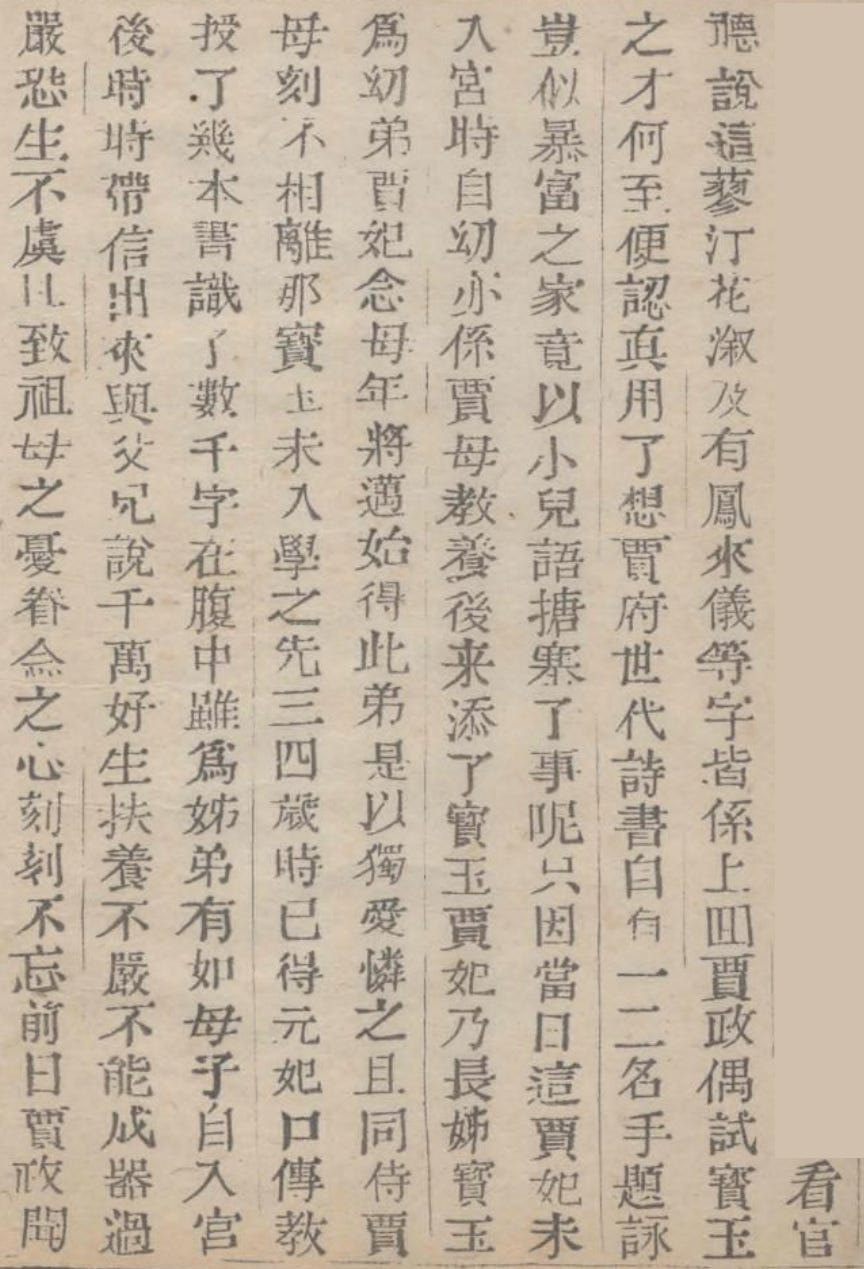
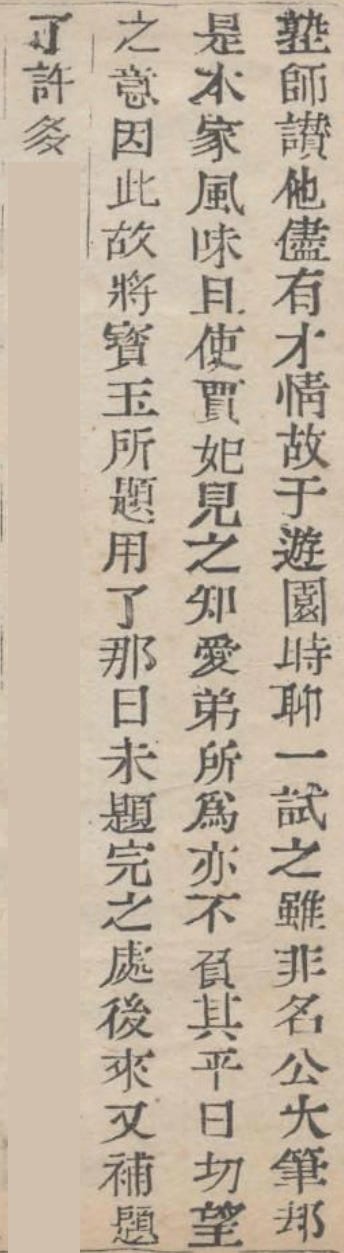
看官聽說:這「蓼汀花漵」四字及「有鳳來儀」等字,皆繫上回賈政偶試寶玉之才,何至便認真用了?想賈府世代詩書,自有一二名手題詠,豈似暴富之家,竟以小兒語搪塞了事呢?只因當日這賈妃未入宮時,自幼亦系賈母教養。後來添了寶玉,賈妃乃長姊,寶玉為幼弟,賈妃念母年將邁,始得此弟,是以獨愛憐之。且同侍賈母,刻不相離。那寶玉未入學之先,三四歲時,已得元妃口傳教授了幾本書,識了數千字在腹中,雖為姊弟,有如母子。自入宮後,時時帶信出來與父兄,說:「千萬好生扶養:不嚴不能成器,過嚴恐生不虞,且致祖母之憂。」眷念之心刻刻不忘。前日賈政聞塾師贊他盡有才情,故於遊園時聊一試之。雖非名公大筆,卻是本家風味。且使賈妃見之,知愛弟所為,亦不負其平日切望之意,因此,故將寶玉所題用了。那日未題完之處,後來又補題了許多。
Translation Notes
搪塞 means to do a perfunctory job or to go through the motions.
Jia Yuanchun is referred to as 賈妃, or The Imperial Consort Jia throughout this passage. However, this leads to some pretty awkward sentences in English, which is why I’ve chosen to use her personal name instead. She is also referred to as 元妃 in this paragraph, or The Imperial Consort Yuan.
Remember that Jia Yuanchun is Jia Baoyu’s biological older sister. This comes from this somewhat boring post way back in chapter 2:

第二胎生了一位小姐,生在大年初一,就奇了。不想隔了十幾年又生了一位公子,說來更奇:一落胞胎,嘴裡便銜下一塊五彩晶瑩的玉來,還有許多字跡。你道是新聞不是?
Lady Wang’s second child was a daughter who was born on New Year’s Day, which was certainly a strange omen. And yet, a decade later she gave birth to a boy whose birth defied all reason. When he left the womb, he held in his mouth a lustrous, five-colored jade stone which was inscribed with cryptic characters. Isn’t that incredible news?
This passage is difficult because the identity of 賈母 is ambiguous. Usually this refers to Grandmother Jia in this book. However, it’s clear from the context that Jia Yuanchun decides to dote on Jia Baoyu because her mother (i.e. Lady Wang) is advanced in age, not because Grandmother Jia is advanced in age. I’ve tried to straighten things out in the translation, though I’m still not entirely sure I’ve got it right.
口傳教授 means to teach through one’s mouth, or to teach orally. I’ve translated this as “teaching by recitation,” and the image I get in my mind is of the end of Fahrenheit 451 where books are completely banned and where the learning of the past has survived only as an oral tradition.
才情 means ability, talent, or skill. Note that the word used here is 情, not something like 才能 (which means the same thing).
长姐如母,长兄如父。