


Jia Zhen Buys Jia Rong A Title
Today Jia Zhen figures out a way to buy a title for his son Jia Rong.
My Translation
And so the family and all the household staff followed their proper rites in the funeral proceedings, ensuring that there was no disorder.
Jia Zhen, however, was concerned. “Jia Rong only has a low ranking honorary title from the Imperial College,” he thought to himself. “It wouldn’t look good if that’s all that was written on his spirit banner. Besides, a title like that would limit the number of attendees.” This made him feel very worried.
It just so happened that this was the fourth day of the first seven day mourning period. Early that morning, Dai Quan, the Chief Imperial Eunuch of the highest level of the palace, sent someone ahead with sacrificial offerings. He then arrived in a large sedan chair, preceded by people who beat a gong to clear the way, and presented his sacrifice personally. Jia Zhen hurried over to greet him and invited him to have tea at the Bee-Enticing Pavilion.
Jia Zhen had decided ahead of time what he wanted, and so he took advantage of the opportunity. He asked directly about the possibility of purchasing an official rank for Jia Rong.
Dai Quan understood at once. “I imagine this is to add some brightness to the funeral?” he asked with a smile.
“You’ve understood it exactly, Sir,” replied Jia Zhen.
“It just so happens that this an opportune time,” replied Dai Quan. “There’s a great vacancy at the moment. Currently out of the three hundred positions of the Dragon Imperial Guard, two are unfulfilled.
“Yesterday, the third brother of the Marquis of Xiangyang came to me with a request. He had already delivered 1500 taels of silver to my home. You know how it is; we’re old friends. Anyway, out of respect for his grandfather, I casually agreed.
“There is still one vacancy remaining, but I was approached by the Military Governor of Yongxing, named Feng, who wanted to buy it for his son. I just haven’t had time to reply for him.
“Anyway, since we’re talking about possibly giving it to your son, please write up a resume for him.”
Jia Zhen quickly ordered someone to prepare a resume for Jia Rong written on red paper. Dai Quan read it. This is what it said:
Jia Rong, Senior Licentiate of Jiangning County, Yingtian Prefecture, Jiangnan, 20 years old. Great Grandfather is Jia Daihua, formerly Military Governor of the Capital Garrison, Hereditary First Class Majestic Spirit General. Grandfather is Jia Jing, Palace Graduate of the Bingchen cycle. Father is Jia Zhen, Hereditary Third Rank Majestic Ferocity General.
Dai Quan looked it over and then handed it back to a personal attendant who was standing nearby. “Take this back to Old Zhao, the Director of the Ministry of Revenue,” he said. “Tell him that I respectfully request that he issue a certificate for a Fifth Class Imperial Guard of the Dragon, along with an official warrant. Then fill in his resume. I’ll come by tomorrow to deliver the silver.” The attendant acknowledged the order.
Dai Quan then got up to leave. Jia Zhen unsuccessfully tried to persuade him to stay, after which he escorded Dai Quan out to the main gate of the house.
Just as Dai Quan was about to board his sedan, Jia Zhen asked him, “Should I deliver the silver to the Ministry, or should I send it to Your Excellency’s residence?”
“If you deliver it at the Ministry, you’ll end up ruining it,” replied Dai Quan. “It’s better to simply weigh out a thousand taels of silver and send it straight to my home. That will take care of everything.”
Jia Zhen thanked him profusely. “Once the mourning period is over,” he said, “I will personally bring my son to your residence to to express our gratitude.” And Dai Quan left after that.
Translation Critique
Hawkes
Hawkes refers to Jia Zhen’s problem here in a way that kind of plays it down: “the insignia to which Qin-shi was entitled would make a very poor showing when borne in the funeral procession.” Actually, the real problem is that Jia Zhen’s lavish funeral plans wouldn’t work because of his son’s low status. It’s not just that this would look strange; it would actually go completely against the social norms of Chinese funerals.
Hawkes has Dai Quan give a name to the younger brother of “Lord Xiang-yang.” The name is “Sannikins.” I’ve got no idea what this is supposed to mean, though I suppose “Sannikins” might refer to the fact that this brother is called 老三 (the third child in the family) in the original text. 三 is pronounced “san.”
Yang
The Yangs ignore the obvious “咱們的孩子” (our child) reference, and instead have Dai Quan asked “if your boy wants it.”
Chinese Text
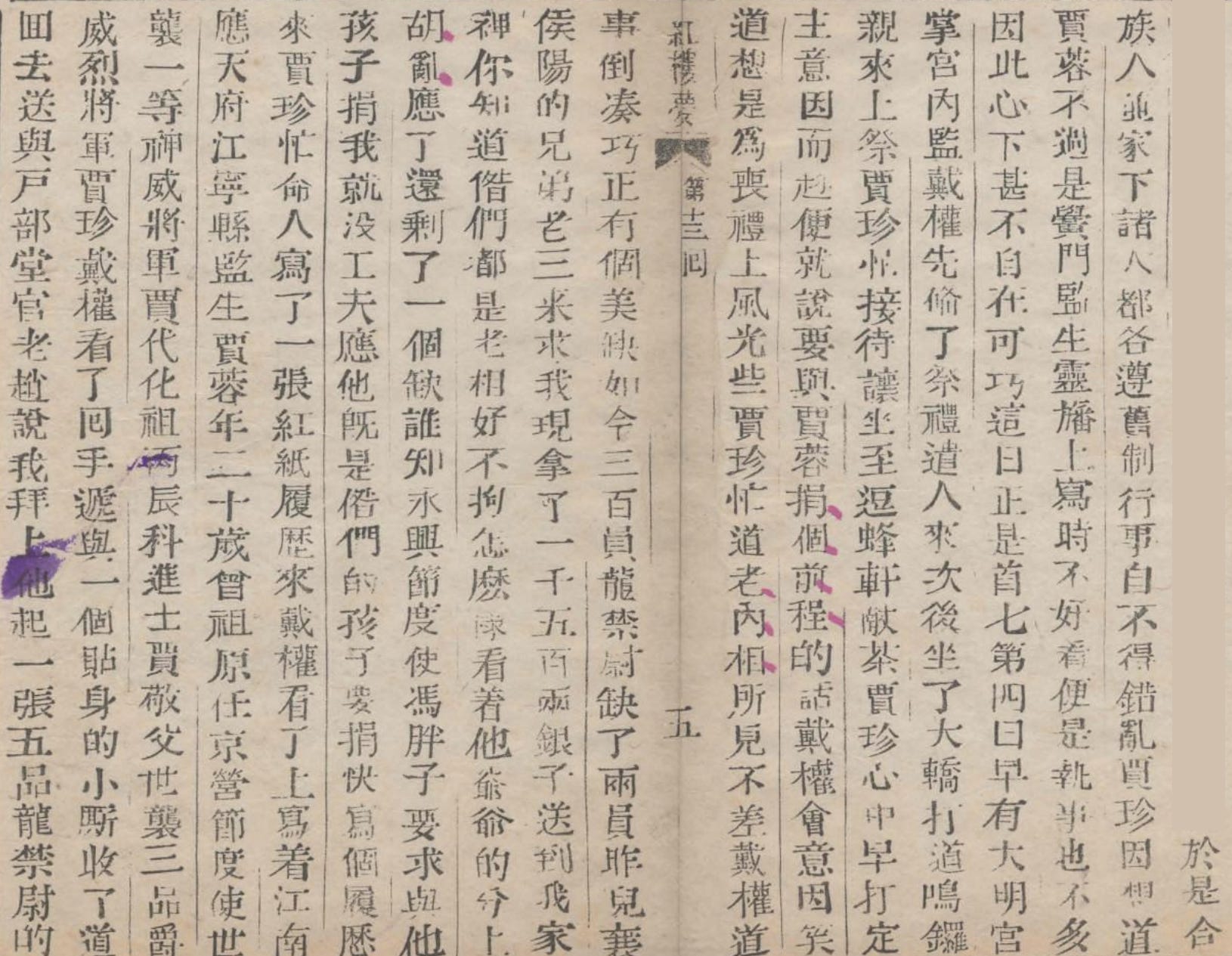
於是合族人並家下諸人都各遵舊制行事,自不得錯亂。賈珍因想道:「賈蓉不過是黌門監生,靈幡上寫時不好看。便是執事也不多。」因此,心下甚不自在。
可巧這日正是首七第四日,早有大明宮掌宮內監戴權,先備了祭禮遣人來,次後坐了大轎,打道鳴鑼,親來上祭。賈珍忙接待,讓坐至逗蜂軒獻茶。賈珍心中早打定主意,因而趁便就說要與賈蓉捐個前程的話。戴權會意,因笑道:「想是為喪禮上風光些?」賈珍忙道:「老內相所見不差。」戴權道:「事倒湊巧,正有個美缺。如今三百員龍禁尉缺了兩員。昨兒襄陽侯的兄弟老三來求我,現拿了一千五百兩銀子送到我家裡,你知道,咱們都是老相好,不拘怎麼樣,看著他爺爺的分上,胡亂應了。還剩了一個缺,誰知永興節度使馮胖子要求與他孩子捐,我就沒工夫應他。既是咱們的孩子要捐,快寫個履歷來。」
賈珍忙命人寫了一張紅紙履歷來。戴權看了,上寫著:
江南應天府江寧縣監生賈蓉,年二十歲。曾祖,原任京營節度使世襲一等神威將軍賈代化。祖,丙辰科進士賈敬。父,世襲三品爵威烈將軍賈珍。」
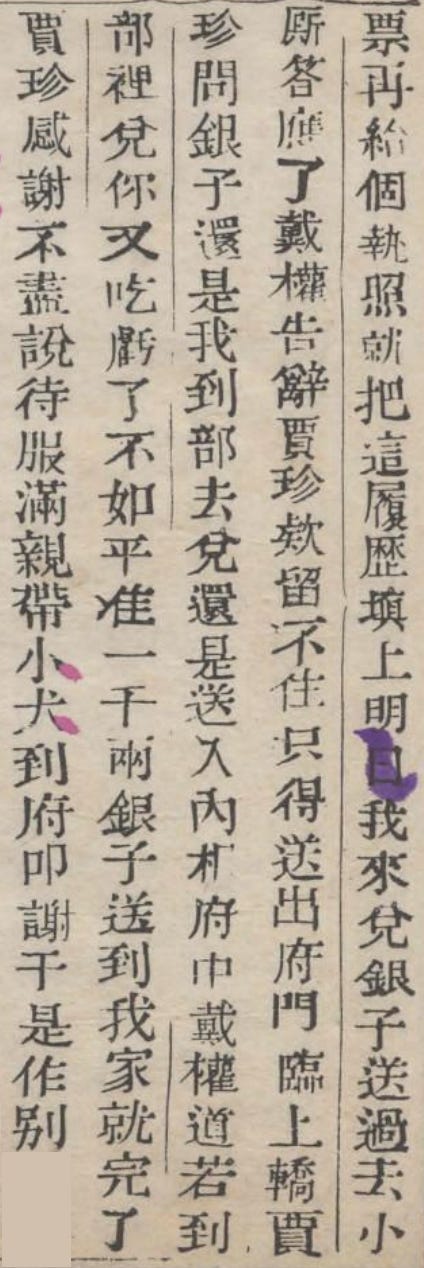
戴權看了,回手遞與一個貼身的小廝收了,道:「回去送與戶部堂官老趙,說我拜上他起一張五品龍禁尉的票,再給個執照,就把這履歷填上,明日我來兌銀子送過去。」小廝答應了。戴權告辭,賈珍款留不住,只得送出府門。臨上轎,賈珍問:「銀子還是我到部去兌,還是送入內相府中?」戴權道:「若到部裡兌,你又吃虧了;不如平準一千兩銀子送到我家就完了。」賈珍感謝不盡,說:「待服滿,親帶小犬到府叩謝。」於是作別。
Translation Notes
黌門 means school. In this case, it seems to represent the Imperial College (國子監). Meanwhile, 監生 is an honorary title; you can read more about it on this page. Basically, Jia Rong only had an honorary title from the Imperial College that could easily be bought. Jia Zhen is concerned that the formal extravagance around Qin Keqing’s funeral does not match up with Jia Zhen’s official standing.
A 靈幡 was a spirit banner or funeral streamer; this was a tall vertical banner placed beside the coffin during a funeral. This would display the name of the deceased, as well as their title and status. Jia Zhen is concerned that the formal title Qin Keqing would qualify for does not fit the extravagance of her funeral.
執事 means an attendant; here it refers to attendants at the funeral. This seems to have been a reflection of funeral protocol during this time. The number of people who could attend and items that could be used would be naturally limited by the level of Qin Keqing’s husband’s title.
首七第四日 means the fourth day of the first seven day mourning period. As you might remember from a translation post a few days ago, the plan was to use seven periods of seven days to mourn the death of Qin Keqing.
大明宮 means the Daming Palace, which was the imperial residence of the Tang dynasty. In this case, it refers to the upper echelons of the imperial household, and not necessarily to the original building.
掌宮內監 means the chief eunuch. The 大明宮 part before means the highest level of the imperial residence. In other words, Jia Zhen is talking with an eunuch who has some very strong political connections.
戴權 (Dai Quan) is an interesting name. It literally means “to wear power.”
打道鳴鑼 refers to an old practice of having people with gongs go in front of an imperial carriage, beating on the gong to clear the way.
逗蜂軒 literally means “Bee Enticing Pavilion.” This seems to be a symbolic name, where bees could represent a swarm of petitioners or social climbers.
前程 means a scholarly honor or scholarly career.
會意 means to comprehend or understand
風光 literally means face or dignity. Dai Quan is asking in a somewhat roundabout manner if Jia Zhen is hoping to see Jia Rong receive a higher status for Qin Keqing’s funeral.
老內相 is a very respectful term for a high ranking eunuch.
龍禁尉 seems to be a fictional title, and literally means something like “Dragon Imperial Guard.”
馮胖子 literally means “Fatso Feng.” It’s a somewhat demeaning term, used by Dai Quan to hint at contempt.
Dai Quan refers to Jia Rong as 咱們的孩子 (our child), implying that his relationship with Jia Zhen is as close as family. This is likely to encourage him even more to give the bribe for the government position.
履歷 means a resume.
執照 means a license or permit
When Dai Quan says “Tomorrow I’ll bring the silver over” (明日我來兌銀子送過去), he’s adding another hint to Jia Zhen that he will need to pay up. While this is technically an illegal bribe, Dai Quan is treating this like a normal transaction.
小犬 literally means “puppy.” Here it’s a humble way to refer to one’s own son.
Great post as always.
This is a good place to express something that has been increasingly clear to me as your translation has gone on: Hawkes was writing (and taking considerable poetic licence) to create a translation that reads approximately like a British novel written around the time that the Chinese text was.
"Sannikins" is an excellent example of this.
Calling someone their name or nickname with "-ikins" on the end evokes a kind of affectionate contempt, where the person is definitely junior in status (hence the childish, diminutive nickname - see "manikin", little man) but still one of the boys (needless to say, always boys) for whom favours are done. Perhaps someone who was a few years behind you at Eton and is a third son of a marquis who will probably never amount to much. But he still went to Eton and is the brother of a marquis.
I expect "Sannikins" is a loose way of translating Dai Quan's statement that he is a personal friend, extrapolating what the relationship probably is from Dai Quan's obvious importance.
PS: I'm a bit sad that there is no actual Chinese expression in the text meaning Sannikins. ☹️ Seriously, though, I'm learning so much!
“The Yangs ignore the obvious “咱們的孩子” (our child) reference, and instead have Dai Quan asked “if your boy wants it.””
Here I'd go with Yang's translation just to avoid any confusion. It was a common 場面話, as their relationship was more likely not very close.
------
"龍禁尉 seems to be a fictional title, and literally means something like “Dragon Imperial Guard.”"
Interestingly in Chapter 53, it seems Jia Rong was merely a imperial guard "in waiting" (「某年月日龍禁尉候補侍衛賈蓉當堂領訖」).