


Li Gui Recites A Poem
Here we see Jia Zheng’s attitude towards Confucian learning and the art and poetry that Jia Baoyu loves so much.
My Translation
Seeing that Baoyu had gone off, Jia Zheng asked “who will go with him?”
From just outside the door came a prompt affirmative answer. In came three or four burly servants, each of whom dropped to one knee in a salute.
Jia Zheng saw that the one in front was the son of Baoyu’s old wet nurse, a man named Li Gui.
“All of you attend him every day when Baoyu studies” Jia Zheng said to him. “So what in the world has he been studying? It seems to me that he’s filled his head with a bunch of nonsense and foolish chatter, succeeding only in learning the most artful forms of mischief! Once I’ve got a little bit of time to spare, I’ll have the skin flayed off your hide first, and then I’ll settle accounts with that good for nothing son of mine!”
Li Gui was terrified. He immediately dropped to both knees, took off his cap, and knocked his head on the ground, saying “Yes sir!” repeatedly.
And then he elaborated. “Sir, the young master has already studied as far as the third volume of The Book of Poetry. He recently learned:
You you the deer cry
Lotus leaves and duckweed.
“I wouldn’t dare lie to you.”
The entire room exploded with laughter at the sound of this. Even Jia Zheng couldn’t help but smile.
“Even if he studied thirty more volumes of The Book of Poetry,” replied Jia Zheng, “he’d still only be burying his head in the sand. He’s only trying to fool everybody else, after all.
“Go to the school before he gets there, and send my regards to the teacher. Tell him that he absolutely should not go through the motions of learning The Book of Poetry and other ancient essays. The most urgent task for Baoyu is to have him thoroughly understand and memorize The Four Books first. That is the most important thing.”
“Yes, sir!” responded Li Gui quickly. Seeing that Jia Zheng had nothing more to say, he rose and backed out of the room.
Translation Critique
Hawkes
David Hawkes translates 打千兒 as “saluted Manchu fashion,” which is something that really bothered me when I read his translation for the first time. I didn’t have the foggiest clue what “saluted Manchu fashion” meant, and it’s repeated several times in his translation. It’s difficult to translate that kind of salute into English, since there’s really no concept of that particular kind of salute (though it might seem familiar if you’ve seen a lot of kung fu movies). It would have been nice to have an explanatory footnote somewhere.
Hawkes quotes the mangled poem like this:
Hear the happy bleeding deer
Grousing in the vagrant meads…
I actually had to read that a few times to see all the little textual puns. This is a good translation, though it might go over your head if you’re reading quickly.
Yang
The Yangs quote the poem exactly as it’s written in the original:
Yu-yu cry the deer,
Lotus leaves and duckweed.
The problem, of course, is that the average English reader wouldn’t understand any of this without knowing the poetic context. And, sadly, the Yangs neglect to include an explanatory footnote.
Chinese Text
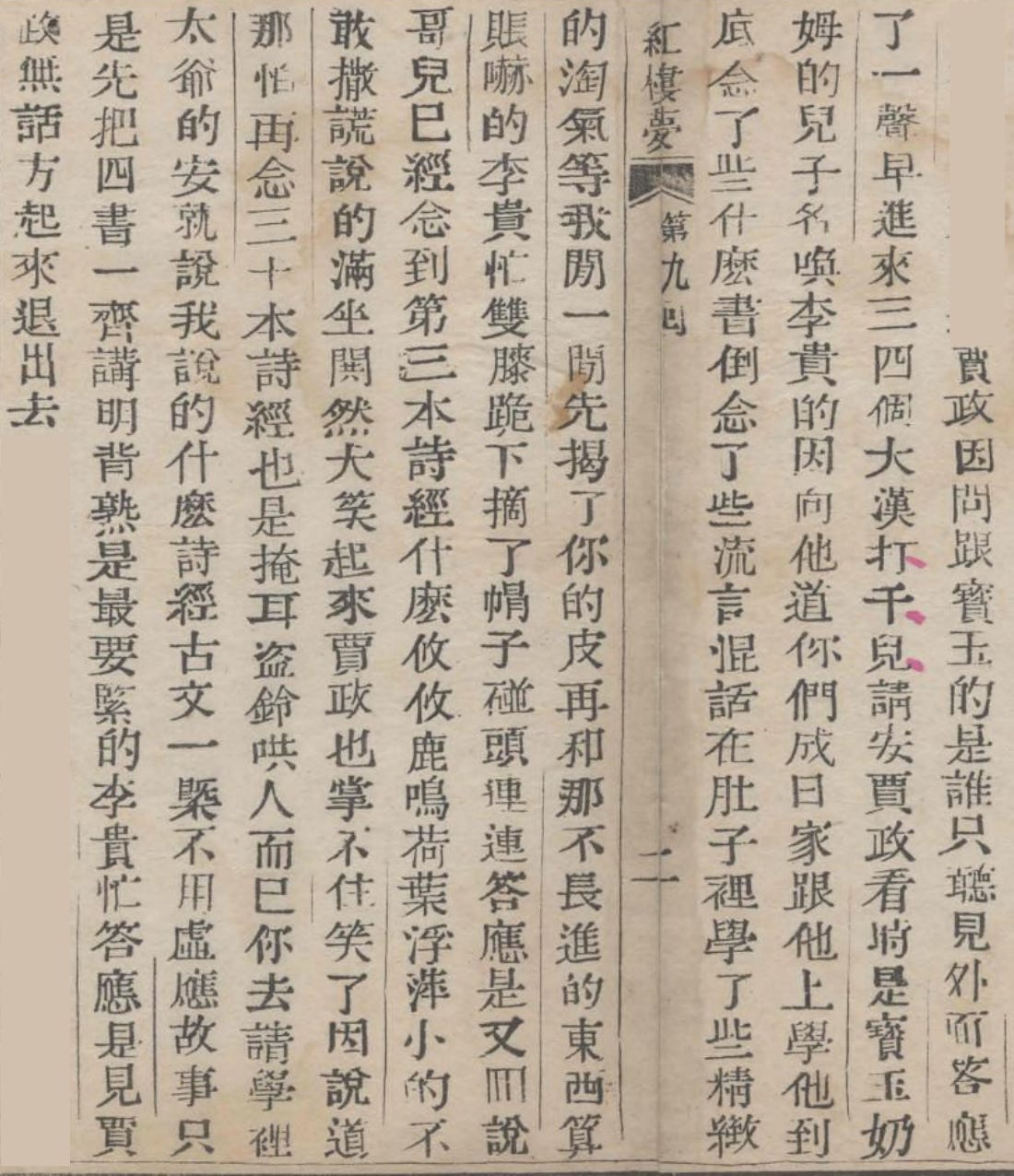
賈政因問:「跟寶玉的是誰?」只聽見外面答應了一聲,早進來三四個大漢打千兒請安。賈政看時,是寶玉奶姆的兒子,名喚李貴的。因向他道:「你們成日家跟他上學,他到底唸了些什麼書?倒唸了些流言混話在肚子裡,學了些精緻的淘氣!等我閒一閒,先揭了你的皮,再和那不長進的東西算賬!」嚇的李貴忙雙膝跪下,摘了帽子碰頭,連連答應「是」,又回說:「哥兒已經唸到第三本《詩經》,什麼『攸攸鹿鳴,荷葉浮萍』。小的不敢撒謊。」說的滿座鬨然大笑起來。賈政也掌不住笑了,因說道:「那怕再念三十本《詩經》,也是『掩耳盜鈴』,哄人而已。你去請學裡太爺的安,就說我說的:什麼《詩經》、古文,一概不用虛應故事;只是先把《四書》一齊講明背熟,是最要緊的。」李貴忙答應「是」,見賈政無話,方起來退出去。
Translation Notes
When Jia Zheng asks 跟寶玉的是誰, it seems that he’s not asking who is going with Baoyu, but rather which servant will go with him to attend to him. 跟 usually just means “with,” but here it is a verb that means “to follow.” The context indicates that it’s a servant following him to attend to him.
打千兒 is a kind of formal salute used by men during the Qing dynasty. They would go down on the right knee and reach down with the right hand.
Notice that Jia Zheng says that Jia Baoyu has 唸了些流言混話在肚子裡, or “filled his stomach with a bunch of empty talk and foolish chatter.” The word 肚子 means stomach, not head. It’s almost like he’s saying that Baoyu decided to fill his gut with garbage instead of filling his mind with truth.
Li Gui remembers the poem incorrectly. 攸攸鹿鳴,荷葉浮萍 should actually be 呦呦鹿鳴、食野之蒿 as written in The Book of Poetry. These are the mistakes he makes:
He says 攸 (which describes water gently flowing) instead of 呦 (the sound of deer bleating). Both are pronounced yōu, which makes this pun even more interesting. If you imagine Li Gui actually saying these lines, the word yōu would sound right; it’s only a mistake when it’s actually written as the character 攸 instead of 呦.
He inserts 荷葉 (the lotus leaf) at the beginning of the second line, and adding in 浮萍 (duckweed) to form a nonsensical combination. The original says 食野之蒿 (eating the sagebrush of the fields). In this case, the two lines sound nothing like each other.
鬨然 means bellowing up with a major disturbance.
掩耳盜鈴 literally means to cover one’s ears while stealing a bell. It means to fool oneself, or to bury one’s own head in the sand.
哄人 means to fool people or deceive people.
四書 refers to The Four Books, or the Confucian classics: The Great Learning, The Doctrine Of The Mean, The Analects, and Mencius. This was the core of what scholars needed to master in order to pass the civil service examinations.
不用虛應故事 means “there is no need to go through the empty motions” of studying these texts. The “studying these texts” part is implied and not explicitly stated. 故事 here means something like “established practice” or “the old routine of doing things.” Jia Zheng is basically saying that Jia Baoyu should only learn the most formal aspects of Confucianism and not spend any time with anything more flowery or colorful.
講明 means to explain carefully, and 背熟 means to thoroughly memorize. To be successful in the civil service examinations, scholars would have to completely memorize The Four Books and be able to succinctly answer difficult philosophic questions by writing in a conventional (and clichéd) essay format.
Jia Baoyu's future depends on being able to write a cliched essay? Some things just never change I guess. Li Gui being Nanny Li's son makes me interested in seeing what happens with him.