


Lin Daiyu Returns
In this passage Lin Daiyu refuses a gift that Jia Baoyu gives her on her return. This is pretty significant; there’s more about this coming in tomorrow’s post.
My Translation
Fortunately, Jia Lian and Lin Daiyu were coming back. They had sent a messenger ahead to report that they would be arriving home the next day.
When Jia Baoyu heard this, he felt a bit happier. And, when he asked for more details, he learned that Jia Yucun was coming to the capital for an imperial appointment.
Thanks to Wang Ziteng’s repeated recommendations, Yucun had been summoned to wait for a vacancy in the capital. Because he was related to Jia Lian and because he had once worked as Daiyu’s tutor, he naturally chose to travel together with them.
Meanwhile, Lin Ruhai had been buried in the family cemetery, and all his affairs had been properly settled.
Under normal circumstances, Jia Lian would have traveled stage by stage from one post station to the next. He would not have returned until after the beginning of the next month. However, when he heard the good news about Jia Yuanchun being promoted, he was so excited that he decided to travel both day and night. The entire journey had been safe.
Baoyu only asked about how Daiyu was doing. He wasn’t interested in anything else.
It seemed to take forever, but the next day finally came. There was a report early that afternoon that “Jia Lian and Lin Daiyu have arrived at the mansion.” When Baoyu and Daiyu met again, their feelings were a mixture of sorrow and joy. They inevitably cried quite a bit, which was followed by words of consolation and celebration.
Baoyu looked closely at Daiyu. She had grown much prettier while she was gone. Daiyu had also brought quite a few books along with her. After settling in, she busied herself with cleaning her bedroom and arranging her belongings. She also gave out writing brushes and paper as gifts to Baochai, Yingchun, and Baoyu.
Baoyu carefully took out the fragrant prayer bead bracelet that the Prince of Beijing had given to him, and offered it to Daiyu.
“Why would I want something that a stinking man has handled?” asked Daiyu. “I don’t want this!” And she gave it back and refused to take it.
Baoyu had no choice but to take it back. And nothing more was said for the time being.
Translation Critique
Hawkes
Hawkes is careful to note that Jia Yucun was “a cousin (albeit a remote one) of Jia Lian.” This implies that Jia Yucun is not actually related to Jia Lian, but rather likely falsified his family background to try to ride the coattails of the Jia family’s success.
Hawkes also gives us one of the worst examples of an unnecessary run-on sentence I’ve seen so far:
Lin Ru-hai having been laid with his ancestors in the family burying-ground and his obsequies duly concluded, they would, if they had proceeded to the capital by the usual stages, have been arriving back some time in the following month; but when Jia Lian heard the news about Yuan-chun’s elevation, they had decided to make greater speed, travelling by night as well as by day.
There’s no reason at all for all of this to be a single sentence. You’ve got three different ideas here: the burial of Lin Ruhai, the fact that they normally would have taken a month to return, and the news about Jia Yuanchun being promoted. You need three sentences, not one.
Hawkes translates 越發出落的超逸了 as Jia Baoyu reognizing “the same ethereal quality he had always known in her.” Ethereal means something that transcends the world, almost like something spiritual or airy or light. The problem, of course, is that 出落 refers to a young girl becoming more beautiful as she goes through puberty.
Hawkes describes Lin Daiyu “arranging various objets d’art around” her room. Objects d’art is a French phrase that means artistic works.
Yang
The Yangs also describe Jia Baoyu noticing that Lin Daiyu “was looking even more ethereal.”
Chinese Text
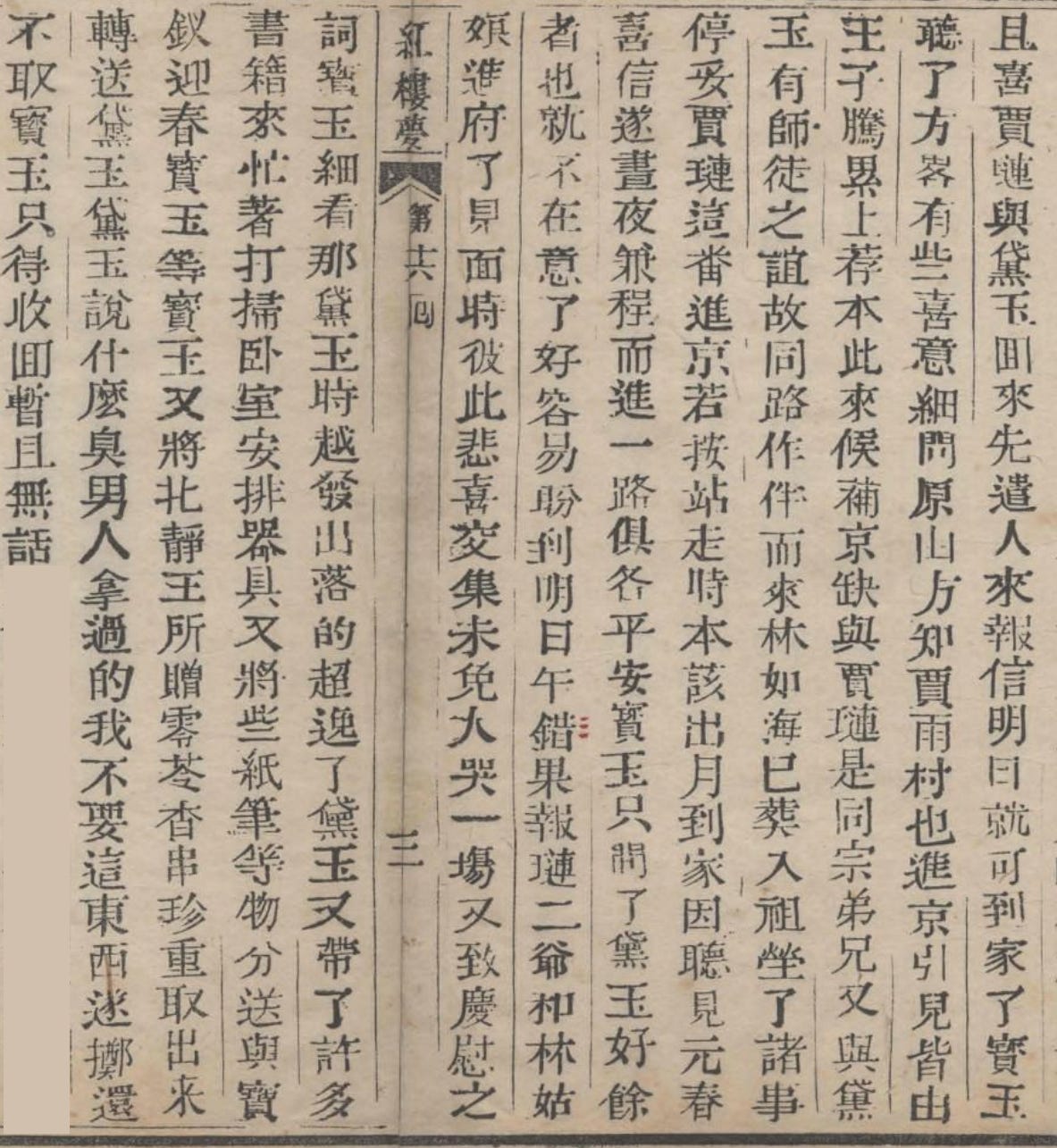
且喜賈璉與黛玉回來,先遣人來報信,明日就可到家了。寶玉聽了,方略有些喜意。細問原由,方知賈雨村也進京引見,皆由王子騰累上薦本,此來候補京缺。與賈璉是同宗弟兄,又與黛玉有師徒之誼,故同路作伴而來。林如海已葬入祖塋了,諸事停妥。
賈璉這番進京,若按站走時,本該出月到家;因聽見元春喜信,遂晝夜兼程而進,一路俱各平安。寶玉只問了黛玉好,餘者也就不在意了。好容易盼到明日午錯,果報:「璉二爺和林姑娘進府了。」見面時,彼此悲喜交集,未免大哭一場,又致慶慰之詞。
寶玉細看那黛玉時,越發出落的超逸了。黛玉又帶了許多書籍來,忙著打掃臥室,安排器具;又將些紙筆等物分送與寶釵、迎春、寶玉等。寶玉又將北靜王所贈蕶苓香串,珍重取出來,轉送黛玉。黛玉說:「什麼臭男人拿過的,我不要這東西!」遂擲還不取。寶玉只得收回,暫且無話。
Translation Notes
In this case, 候補 means to be given a temporary post or assignment while waiting for an official assignment to open up. Jia Yucun seems to have been summoned to the capital in order to wait for his actual official assignment to open up.
塋 means grave or tomb.
停妥 means something like “concluded satisfactorily.”
若按站走時 can be a little bit difficult to understand. 站 here refers to certain post stations that were maintained by the government along main travel routes. These were places where travelers could change horses, rest, and get supplies. Normally travelers would go from one 站 to the next each day; however, Jia Lian and the others were excited and decided to travel faster than normal.
午錯 means the period of time just past 午. 午 generally refers to the period of time between 11 AM and 1 PM. 午錯, therefore, would be a brief period of time right around 1 PM.
悲喜交集 means mixed feelings of grief and joy
越發出落的超逸了 is a little bit complicated. It means that Lin Daiyu had grown prettier (出落) in a way that defied worldly conventions (超逸).
I think Hawkes/Yang in using "ethereal" are trying to evoke the "delicate" association of that word to capture the frailty of Daiyu and the fragility of youth. It could also just be them simply resorting to a stock phrase to describe beauty (you'll often "ethereal" throw in haphazardly in fashion advertising). As an aside, the Joly translation (1891) uses the phrase "surpassingly handsome" which reads quite odd to me.