


Lin Daiyu’s Emotions
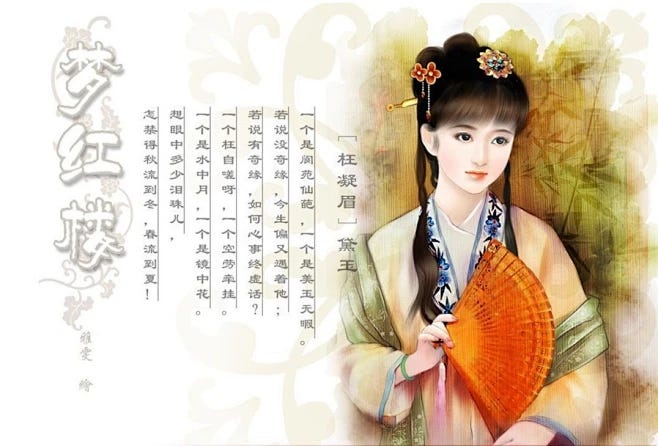
When I first read Dream of the Red Chamber all the way through a few years ago, I was convinced that Lin Daiyu was simply emotionally unstable.
Yesterday’s translation passage is actually a pretty good example of her uncontrollable emotions. Her reaction to Jia Baoyu being forcibly robbed of everything that was on him was really over the top:
黛玉聽說,走過來一瞧,果然一件沒有,因向寶玉道:「我給你的那個荷包也給他們了?你明兒再想我的東西,可不能夠了!」說畢,生氣回房,將前日寶玉囑咐他沒做完的香袋兒,拿起剪子來就鉸。
Daiyu heard what Xiren said and went over to take a look. Sure enough, every single piece was gone. She turned to Baoyu and asked, “Did you give them the pouch I made for you as well? If you ever want me to make you anything ever again, you can forget about it!”
Daiyu then marched back into her room angrily. She picked up an unfinished fragrant bag that Baoyu had asked her to make a few days earlier, grabbed a pair of scissors, and began cutting it into pieces.
We’re going to see this come up over and over again in this book. However, Lin Daiyu doesn’t act this way because she is emotionally immature or out of control or anything like that.
Rather, the reason Lin Daiyu finds herself so caught up in the moment is because her emotions (the 情 we keep talking about) define her character at the most basic level.
Emotion, or 情, is a concept that comes up over and over again in Dream of the Red Chamber. Most English translators call 情 something like “lust” or “passion,” but the truth is that it’s a much more basic concept in this book than those nouns would indicate. Both Jia Baoyu and Lin Daiyu are defined by their emotions, and both characters seem completely incapable of suppressing the way that they feel in favor of the way that they need to act in any given situation.
Emotion, of course, is a significant part of this book going back to the very beginning, as I mentioned a little over a year ago:

And the interesting thing is that this emotion is never really defined as a “good thing” or a “bad thing” in this story. Sometimes it’s good, and sometimes it’s so bad that it’s blamed for the entire downfall of the family, as I noted here:

In fact, this concept of emotion (情) is also one of the most important things that the famous commentary of Zhiyanzhai (脂硯齋) teaches us:

But, in yesterday’s small translation snippet, we actually see emotion at work. Rather than telling us that Lin Daiyu is emotional, Cao Xueqin does a masterful job of showing us just how strong her emotional response can be.
It’s not out of the question for a girl to feel jealous or frustrated or upset at her boyfriend, like Lin Daiyu did yesterday. However, it is at least a little bit over the top for her to decide to suddenly destroy precious things she has been painstakingly creating just to express her emotions. You’ve got to wonder why she couldn’t just write a poem or go for a walk or sing a song or punch a pillow instead.
I bet Daiyu is thinking to herself, they probably took everything except that one thing they would never be allowed to take, the jade that matches Baochai’s gold. Her fragrance pouch seems to be a token of affection for Baoyu, but she still thinks she can’t compete with Baochai.
I think part of the strength of this book’s realism comes from the fact that characters distinctly have emotions and thoughts behind their actions, but we the reader have to figure out what they are. I still don’t think I have Xiren figured out, for example. Daiyu is interesting to follow because she changes so much throughout the book, especially as she finds an emotional outlet in writing poetry.