


Maiden Crabapple
We’re not quite out of the woods yet. Today our group takes a look at more scenery, most notably a beautiful, solitary crabapple tree. There’s a lot of literary allusion going on here that can be difficult to understand.
My Translation
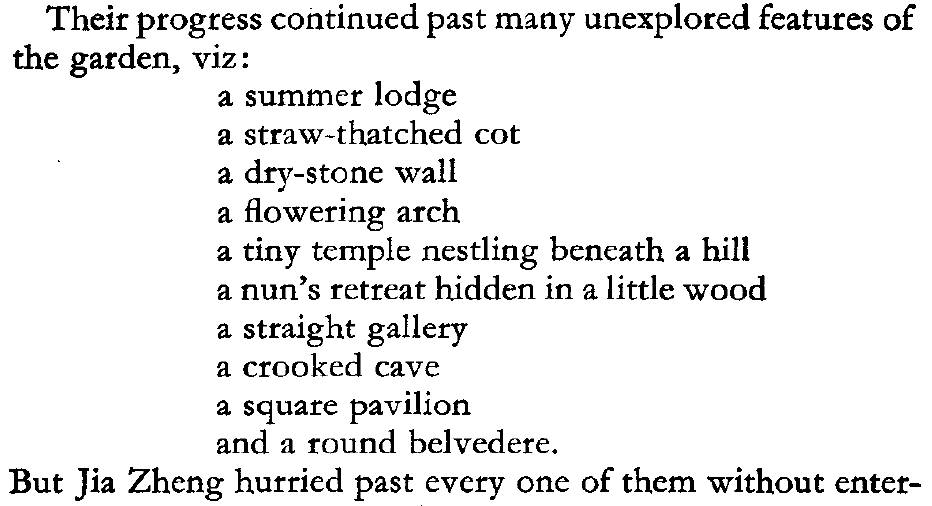
The group continued on their way. They passed by refined hallways, by thatched cottages, by walls of piled stones, and by gates made up of interlocking branches. In the hills below they caught a glimpse of a secluded Buddhist nunnery; deep in the woods a Taoist retreat for female Taoist nuns. Here there were long, winding covered walkways and twisting caves; there you could see square summer pavilions and rounded kiosks.
But Jia Zheng didn’t enter any of them. He hadn’t rested at all that day, and his legs were absolutely aching.
As they walked along, a courtyard residence came into view ahead. “Let’s go inside here and rest,” said Jia Zheng. And so he led the party into the residence.
They walked around the flowering peach trees and through a rustic moon gate fence made of woven bamboo and covered with flowering vines. That led them to a small enclosure surrounded by whitewashed walls, with green willows hanging down each side.
Jia Zheng led the party through the gate. There were corridors running on both sides connecting one area to the next, and the center of the courtyard contained a few artistic rock structures to complement the scene. On one side were several plantain trees, and on the other stood a single crabapple tree, with its branches spread out like an umbrella, with golden stamens hanging down like tassels, and with petals decorating the scene like cinnabar.
“What beautiful flowers!” exclaimed the men. “We’ve seen crabapples before, but we’ve never seen any as beautiful as these!”
“This is called a ‘Maiden Crabapple,’” replied Jia Zheng. “It’s a foreign variety. According to legend, it comes originally from the Kingdom of Women. That supposedly explains why it has such lush and abundant blossoms. Of course, that’s nothing but a preposterous rumor.”
“But this flower is different!” exclaimed the scholars. “Perhaps there is indeed some truth to the story of the Kingdom of Women.”
“I think,” said Jia Baoyu, “that the scholars and poets in old times called this ‘Maiden’ because it is red like powdered rogue, and because its frail and delicate appearance looks like a beautiful and sickly woman leaning on her attendant for support. The whole thing has the feeling of a woman’s bedroom. As time went on, the name spread by word of mouth. There’s no need to take it literally.”
“We stand corrected,” said the gentlemen. “What a brilliant explanation!”
Translation Critique
Hawkes
As usual, David Hawkes treats the poetic description of the passages the group goes through as a poem itself:
Hawkes removes Jia Baoyu’s reference to a beautiful and sickly woman entirely:
“‘Surely,’ said Bao-yu, ‘it is much more probable that poets and painters gave it the name of “maiden crab” because of its rogue-like color and delicate, drooping shape, and that the name was misunderstood by ignorant, literal-minded people, who made up this silly story to account for it.’”
Actually, if you read carefully and compare this section with the original text, you’ll see that it’s an entire mistranslation. Yes, Jia Baoyu does speculate that the “Maiden Crabapple” name spread from person to person, and that the reference to “the Kingdom of Women” should not be taken literally. But, no, Jia Baoyu doesn’t criticize people who believe in the literary version of the story as being “ignorant” or “literal-minded.”
But the most important omission here is the lack of any translation of 弱如扶病. It’s incredible to me that this obvious reference to Lin Daiyu is entirely missing in the Hawkes translation.
Yang
The Yangs have the scholars ask “how did the name come to be handed down,” instead of arguing with Jia Zheng that there might be some truth to the story of “the Kingdom of Women.”
They also have Jia Baoyu refer to the tree as being “as frail as a delicate girl,” which, again, is a mistranslation. The Chinese original clearly refers to the girl being sick.
Chinese Text
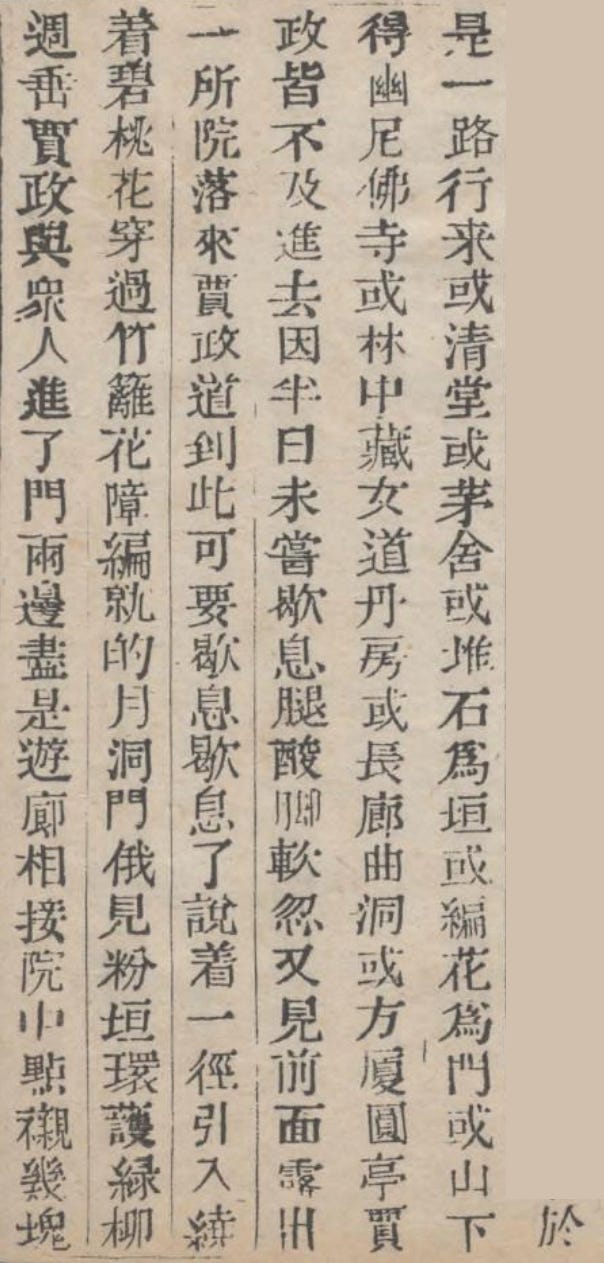
於是一路行來,或清堂,或茅舍,或堆石為垣,或編花為門,或山下得幽尼佛寺,或林中藏女道丹房,或長廊曲洞,或方廈圓亭。賈政皆不及進去。因半日未嘗歇息,腿痠腳軟,忽又見前面露出一所院落來,賈政道:「到此可要歇息歇息了。」說著,一徑引入。繞著碧桃花,穿過竹籬花障編就的月洞門,俄見粉垣環護,綠柳周垂。賈政與眾人進了門。兩邊盡是遊廊相接,院中點襯幾塊山石。一邊種幾本芭蕉;那一邊是一樹西府海棠,其勢若傘,絲垂金縷,葩吐丹砂。
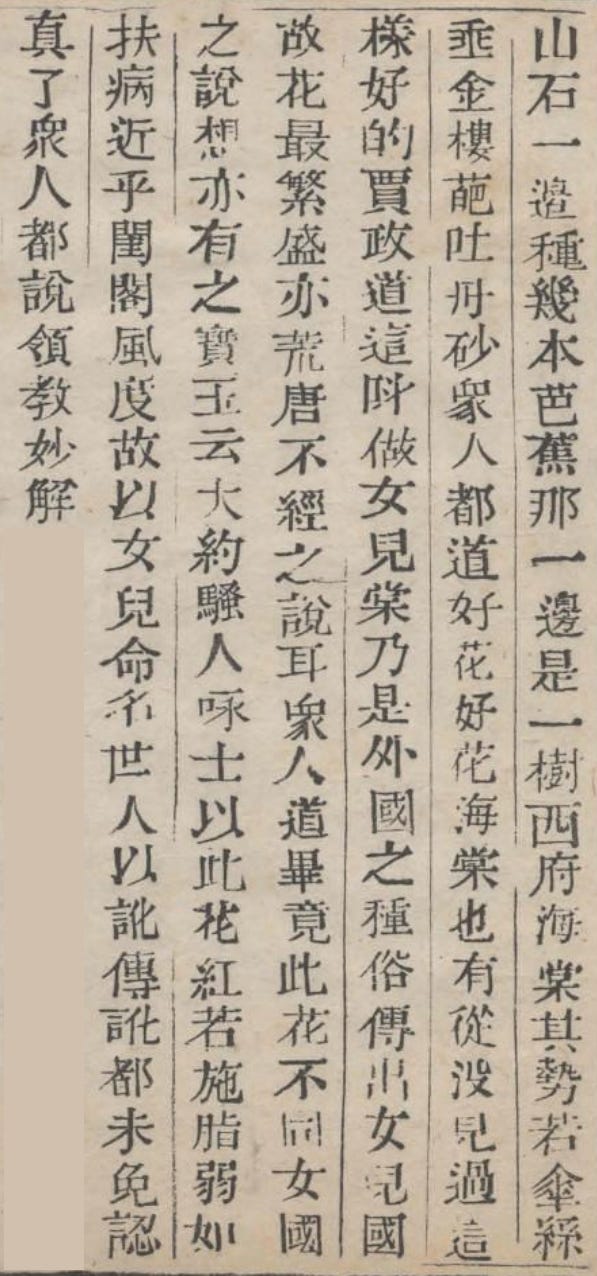
眾人都道:「好花,好花!海棠也有,從沒見過這樣好的。」賈政道:「這叫做『女兒棠』,乃是外國之種。俗傳出女兒國,故花最繁盛,亦荒唐不經之說耳。」眾人道:「畢竟此花不同!女國之說想亦有之。」寶玉云:「大約騷人詠士以此花紅若施脂,弱如扶病,近乎閨閣風度,故以女兒命名。世人以訛傳訛,都未免認真了。」眾人都說:「領教。妙解!」
Translation Notes
丹房 actually means a room for refining elixirs. This refers here to a place for Taoist priests to live and cultivate their daily life together. Since we’re talking about female Taoist priests, this section refers to Taoist nuns. And note, of course, the mention of both Buddhist nunneries and Buddhist nuns.
碧桃花 looks like it means “jade-green peach trees,” but that’s not entirely accurate. It seems that the 碧 here refers to the trees flowering and being in bloom.
院中點襯幾塊山石 is pretty difficult to translate. 點襯 means that the rock structures were placed in the center of the courtyard as a sort of visual foil to the other surrounding elements. It was common in extremely high end classical Chinese architecture to use structures of stones as a sort of natural contrast to the other elements of a residence or courtyard.
The best way to understand the Chinese crabapple tree is to look at a picture of one, assuming you haven’t seen one before:
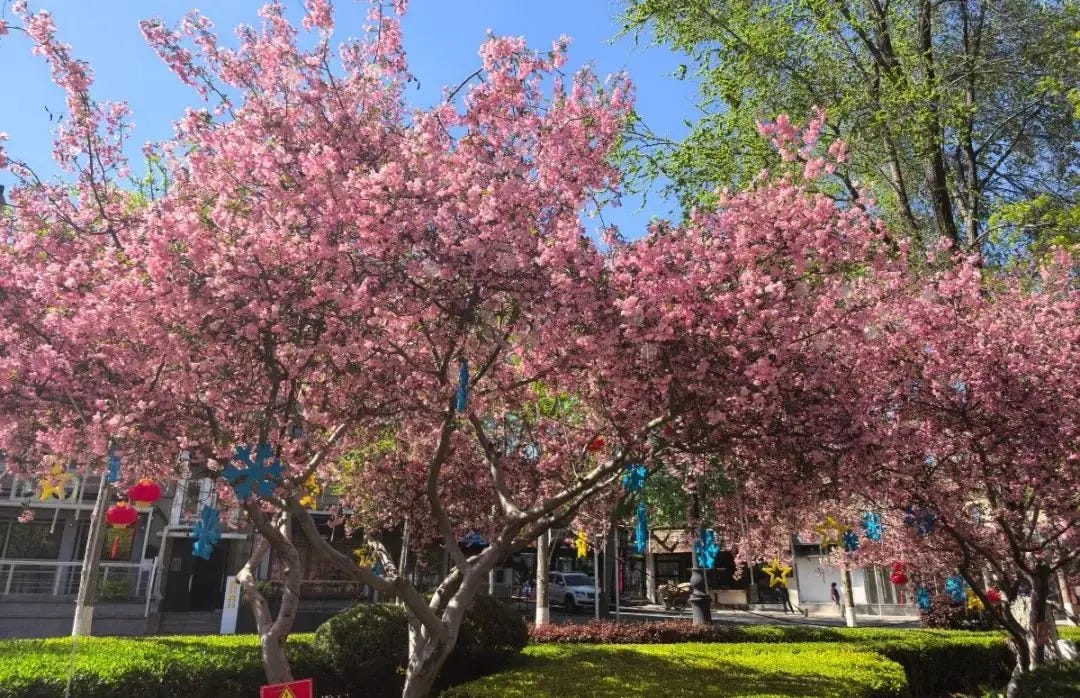
We’ve got close friends who own a farm filled with crabapple trees in Pingtung County, Taiwan. If you’ve seen those trees in full bloom, you’ll understand what Cao Xueqin is talking about here. The trees do feel like an umbrella or a canopy covering everything underneath them. In this section it’s almost like the trees form a sort of delicately sculpted and crafted work of art. This also seems to reflect the personalities of the delicate girls who are symbolically alluded to in chapter 17.
女兒國, or The Kingdom of Women, is an allusion to chapter 54 of Journey to the West (西遊記). If you’ve never read Journey to the West before, it’s worth reading the entire book just for this one chapter, which is filled with hilarious commentary on the nature of Chinese society during the Ming dynasty.
Jia Zheng refers to the rumor that the tree comes from The Kingdom of Women as 荒唐不經, or utterly ridiculous and unrealistic. This is a reflection of his by-the-book Confucian attitude towards things. Notice that Jia Zheng can never seem to appreciate the aesthetic beauty of the things around him. He’s like somebody who stops reading poetry and fiction in favor of scientific journal articles.
騷人 literally means something like “sorrowful person,” and refers to poets and scholars. This reference seems to come from the long poem 離騷 (Encountering Sorrow) by Qu Yuan (屈原), though the word 騷人 doesn’t actually appear in the poem. 騷人 also shows up in the idiom 遷客騷人, which refers to exiled government officials and scholars.
The image that Jia Baoyu conveys of a beautiful but sickly woman resting on her attendant for support (弱如扶病) is obviously a reference to Lin Daiyu here. It’s also a reference to the classical Chinese idea of 病態美, in which a woman’s physical weakness was equated with spiritual refinement. This is part of the cultural aesthetic at the heart of Lin Daiyu’s character and personality.
Remember, of course, that Xue Baochai is also sick and needs to take pills to battle her own sickness. This is often forgotten when we talk about passages like these.
Hawkes seems to have gotten "ignorant, literal-minded people" from the Gengchen (or another) manuscript, which uses the phrase 世間俗惡. The later print edition you are using has removed a good deal of wording in this paragraph. This unfortunately happens often.
I agree that "weak as though nursing an illness" is a term commonly applied to Lin Daiyu. You might compare this passage to a similar one in chapter 78.