


Plant World
The obscure plant names in this passage are a nightmare to translate. There are certain words here that are almost impossible to translate and that need to be transliterated, as you’ll see below.
Meanwhile, the description of the scene in front of the group is absolutely fantastic, as if Cao Xueqin were describing the process of creating a painting.
My Translation
Jia Zheng then went over to a water gate connected to the irrigation system. “Are there any boats?” he asked Jia Zhen.
“There are four lotus picking boats,” replied Jia Zhen, “as well as a larger boat, but none of them have been finished yet.”
“What a pity!” smiled Jia Zheng. “We can’t go in through the water.”
“We could also enter by following the winding path up the hill,” replied Jia Zhen. Having said this, he went ahead to lead the way.
The whole party went along, clutching vines and steadying themselves against trees. As they went, they saw that there were more and more fallen blossoms on top of the water. The water itself had become more clear, and was flowing in broad, rippling waves as it curved around. There were rows of weeping willows along both banks that were interspersed with peach and apricot trees. The tree branches were woven together like a canopy that blotted out the sky, and there was not a speck of dust in sight.
As they went along, they suddenly saw a deep red plank bridge that went along the surface of the water in a zigzag manner. When they had crossed the bridge, they discovered that there were paths leading off in every direction.
And then they saw a cool, bare-tiled structure in front of them, with walls of smooth and polished brick, flower borders on those walls, and clear gray tiles on the top. The veins of the mountain the building was built on ran straight through the brick wall, almost as if the mountain had penetrated the wall.
“This building here is simply tasteless,” remarked Jia Zheng.
And then, as he stepped into the doorway, he suddenly noticed a huge, sky-piercing bolder of exquisitely perforated rock, surrounded on all sides by clustered masses of stones of every shape, so that they completely screened out all of the inside rooms from his view. There were also no flowering trees or shrubs in sight; rather, there was a profusion of unusual herbs and plants. Some plants trailed behind as clinging vines, some stretched out with creeping tendrils, some hung down over the mountain ridges, some threaded through the feet of the rocks, some dangled from the eaves, coiled around the pillars, wound around the masonry, and twined up the steps. Some of the plants drifted like streamers of jade-green silk, some twisted like coils of golden rope, some bore berries as red as cinnabar, and some bloomed with flowers like tiny golden cassia. Their fragrance was dense and intoxicating, far beyond anything that common flowers could match.
“Amazing!” exclaimed Jia Zheng. “However, I don’t recognize most of those flowers.”
Somebody in the group suggested that there might be creeping figs and wisteria vines.
“But how could creeping figs and wisteria vines have such an extraordinary fragrance?” asked Jia Zheng.
“You’re right; those are the wrong plants,” spoke up Baoyu. “Among the many plants here, there are indeed some creeping figs and wisteria vines. However, the fragrant ones are pollia and wild ginger. That one over there is probably sweet angelica. And this kind is probably golden kudzu vine. That one is golden lantern grass, this one is jade-dew vine, the red ones are naturally purple rue, and the green ones are certainly blue angelica.
“If I remember right, among the strange plants mentioned in On Encountering Sorrow and Selections of Refined Literature, there are plants called ‘huona’ and ‘jianghui,’ and others called ‘lunzu’ and ‘zijiang.’ There are also varieties like the stone-sail coral, water-pine, and betel-pepper vine, which appear in Zuo Taichong’s ‘Rhapsody on Wu.’ And then there’s the green elm-grass, as well as Sichuan peppercorn, lovage, and wind-lotus, which appear in his ‘Rhapsody on Shu.’
“Now, as the years have gone by and times have changed, people no longer recognize those names. And so in every case they seize upon the visible shape of the plants and use the wrong name, gradually giving the plants incorrect titles; it’s really a problem.”
Before he could finished, Jia Zheng shouted, “Who asked you?!”
Startled, Baoyu recoiled and didn’t say another word.
Translation Critique
Hawkes
We’re going to need to pull out the dictionary for this one.
Hawkes describes that the group sees the stream as they climb up the hill. They see that the stream up there “was wide and deep and distorted by many anfractuosities.” Anfractuosity is one of those high level vocabulary words that makes you despise the person who said it. It means a winding channel or crevice, in particular one that occurs in the depths of the seas or in the mountains.
And, as you probably guessed, that isn’t the end of the unusual words that David Hawkes uses here. I’ll give you a quick rundown of what these words refer to.
Birthwort is the common name of Aristolochia, which is a major species of plant.
Actinidia seems to be an Italian word for kiwifruit.
Agastache means a giant hyssop.
Eulalia is commonly referred to by names such as “dwarf maiden grass,” “zebra grass,” “porcupine grass,” and so on.
Eglantine is a kind of Eurasian rose with prickly stems and fragrant leave.s
Amaranth was originally the name of an imaginary flower that does not wither; these days it refers to any plants of the genus Amaranthus.
Xanthoxylon refers to a certain tree.
Anemone refers to plants like the windflower.
Phellopteron really confuses me, since it seems to be a kind of fly.
Hawkes decides not to translate the book names Li sao and Wen xuan. That’s just as well, since they really aren’t that important. Also, I recommend not getting too hung up on which characters translate to which plant name here, as I think Hawkes decided to come up with the most obscure plant names he could find.
Yang
The Yangs have given us a bunch of difficult plant names as well.
Dolichos refers to a certain type of plant in Africa and Asia.
Glycyrrhizai is another general genus of plant.
The Yangs then keep the more difficult plant names in transcribed Chinese: huona, chiangtan, tsulun, chiangtzu, shihfan, shuisung, fuliu, luyi, tanchiao, miwu, and fenglien. There are no explanatory notes for any of these transliterations, which I take as a sign that the Yangs honestly didn’t know what plants Jia Baoyu was referring to.
Chinese Text
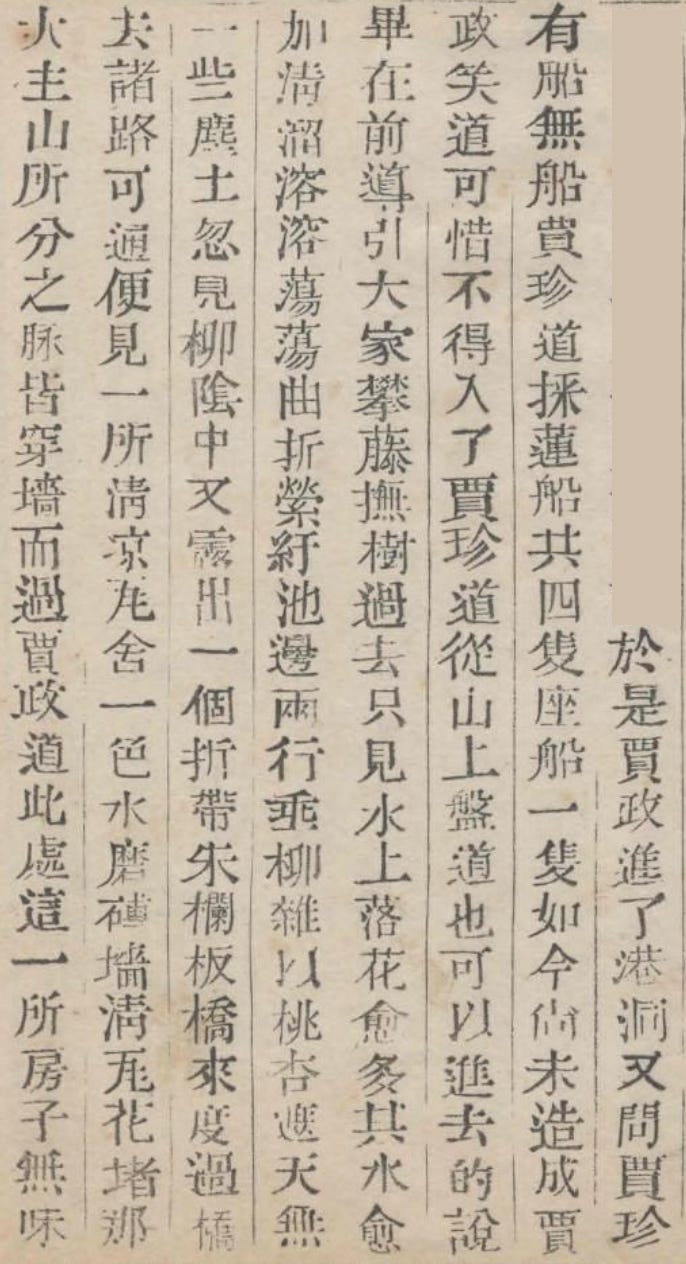
於是賈政進了港洞,又問賈珍:「有船無船?」賈珍道:「採蓮船共四隻,座船一隻,如今尚未造成。」賈政笑道:「可惜不得入了!」賈珍道:「從山上盤道,也可以進去的。」說畢,在前導引。大家攀藤撫樹過去。只見水上落花愈多,其水愈加清溜,溶溶蕩蕩,曲折縈紆。池邊兩行垂柳,雜以桃杏遮天,無一些塵土。忽見柳陰中又露出一個折帶朱欄板橋來,度過橋去,諸路可通,便見一所清涼瓦舍,一色水磨磚牆,清瓦花堵。那大主山所分之脈皆穿牆而過。
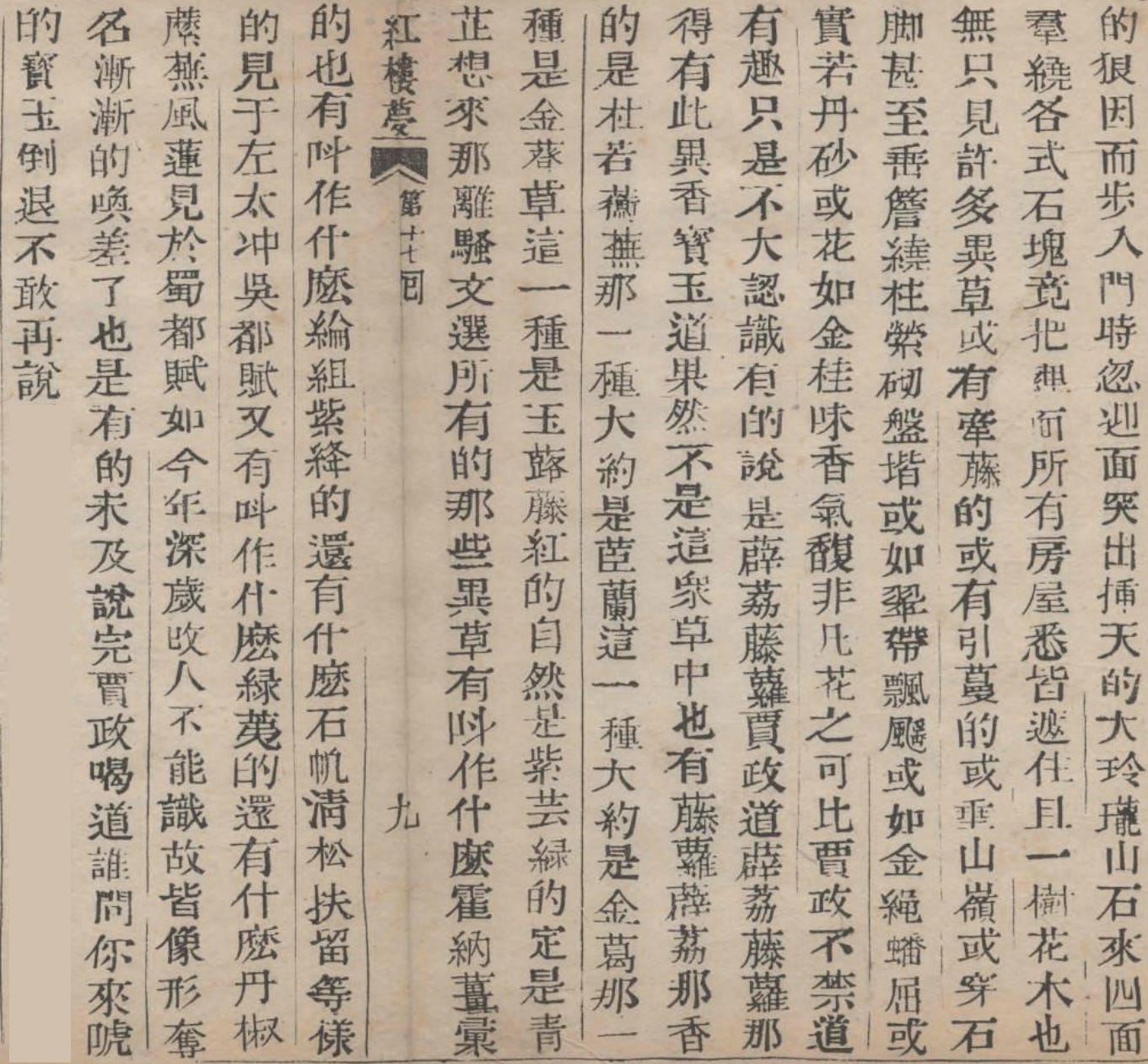
賈政道:「此處這一所房子,無味的很!」因而步入門時,忽迎面突出插天的大玲瓏山石來,四面群繞各式石塊,竟把裡面所有房屋悉皆遮住。且一樹花木也無,只見許多異草,或有牽藤的,或有引蔓的,或垂山嶺,或穿石腳,甚至垂簷繞柱,縈砌盤階,或如翠帶飄颻,或如金繩蟠屈,或實若丹砂,或花如金桂。味香氣馥,非凡花之可比。
賈政不禁道:「有趣!只是不大認識。」有的說是薜荔藤蘿。賈政道:「薜荔藤蘿那得有此異香?」寶玉道:「果然不是。這眾草中也有藤蘿薜荔。那香的是杜若蘅蕪。那一種大約是茝蘭。這一種大約是金葛。那一種是金䔲草,這一種是玉蕗藤。紅的自然是紫芸,綠的定是青芷。想來那《離騷》《文選》所有的那些異草:有叫作什麼藿納姜匯的,也有叫作什麼綸組紫絳的;還有什麼石帆、清鬆、扶留等樣的,見於左太沖《吳都賦》;又有叫作什麼綠荑的,還有什麼丹椒、蘼蕪、風蓮,見於《蜀都賦》。如今年深歲改,人不能識,故皆像形奪名,漸漸的喚差了,也是有的」未及說完,賈政喝道:「誰問你來?」唬的寶玉倒退,不敢再說。
Translation Notes
港洞 was an artificial grotto or a water gate at the entrance of the water system of the Grand View Garden. This would have been a rather large water gate, big enough for a boat to fit through (which is why he asks Jia Zhen about boats).
採蓮船, or a “lotus picking boat,” is a small pleasure boat created for leisurely passing around the lotus plants.
座船 was a larger boat with seats.
溶溶蕩蕩 describes a body of water that is broad and gently rolling and surging. I think of this as having light rippling waves.
曲折縈紆 means twisting or winding
板橋 is more than an ordinary bridge. This is a “plank bridge,” which was a flat wooden bridge that would have looked like a kind of sash or belt on top of the water. The bridge is described as 折, or folded. The idea here is that the bridge was deliberately made in a zigzag manner, one that almost looked like it was folded. This was for artistic effect, and would have forced anybody crossing it to take their time instead of going quickly.
Note how quickly Jia Zheng’s attitude towards the house changes. The reader is able to understand the overall artistic value of the building through his sudden shift of opinion.
薜荔 means creeping fig and 薜荔 means Chinese wisteria. These are relatively common plants in China.
杜若 is known as East Asian pollia, and is a plant with white flowers and a subtle, clear scent. It is a symbol of pure virtue.
蘅蕪 means wild ginger, and is a low-growing plant with a leaf shaped like a heart and a spicy fragrance.
茝蘭 means sweet angelica, and is a tall, aromatic parsley herb used in traditional Chinese medicine.
金葛, or golden kudzu vine, is a fast growing exotic vine with golden yellow roots, which is why it’s called “golden.”
金䔲草 is an obscure ancient name; we’re going to have more of those. This is likely a kind of grass with golden seedheads that look like lanterns.
玉蕗藤 is another unknown species, and was probably a vine with leaves that looked like jade.
The names 金䔲草 and 玉蕗藤 are both pretty obscure, and there seems to be a reason they are used here. This particular phrasing seems to refer to the poem Immortals at the Magpie Bridge (鹊桥仙·纤云弄巧) by the Song dynasty poet Qin Guan (秦觀):
金風雨露一相逢,便卻勝人間無數
When the golden wind meets the jade dew a single time, it surpasses countless unions in the mortal world.
In Dream of the Red Chamber, there’s a pretty common symbol of a bond between gold and jade (金玉良緣). This generally refers to the romance between Xue Baochai and Jia Baoyu. As you may recall, Jia Baoyu has a piece of jade around his neck, while Xue Baochai wears a golden lock that a Buddhist monk gave her.
In contrast, the wood-stone vow (木石前盟) refers to the relationship between Lin Daiyu (originally a flower, therefore referred to as “wood”) and Jia Baoyu (originally a stone).
There is a reason why gold and jade are meeting together at this particular place, though we’ll learn more about that later in the book.
紫芸 means purple rue. This is a strongly aromatic herb with tinges that are slightly bluish-purple.
青芷 means the blue angelica. This is similar to the 茝蘭 (sweet angelica) listed above, except that it’s a blue-green color.
離騷 or On Encountering Sorrow was written by Qu Yuan somewhere around 300 BC. In the book, Qu Yuan drapes himself in orchids and angelicas as a metaphor for his untarnished virtue in a corrupt court. The plants he names are all symbols of moral purity. And, yes, it’s ironic that Jia Baoyu would quote this particular book, out of all possible books, in preparation for the visit of his imperial sister-in-law.
文選, or Selections of Refined Literature, was compiled by Xiao Tong, the Crown Prince of Liang around 530 AD. This important literary anthology canonized a number of older poetic forms and preserved the poems that Jia Baoyu is about to quote. And, yes, it’s very impressive that Jia Baoyu can quote obscure passages from this book at length.
藿納 and 姜匯 (“huona” and “jianghui”) are ancient words from what is now Jiangsu Province. These likely referred to wild gingers and turmeric-like spices that grew in the humid south. We don’t know the actual plants these refer to.
綸組 and 紫絳 (“lunzu” and “zijiang”) are likely different kind of vines. “Lunzu” means “silk cord,” which is probably a vine that looked like a twisted rope. “Zijiang” means “purple crimson,” and, from the context, was probably a vine with red and purple stems.
石帆 is “stone-sail coral,” and is a kind of coral that washes ashore. It’s not a land plant at all. Jia Baoyu is showing off his knowledge of obscure plants in poems.
清鬆 is called the “water-pine.” Despite its name, it’s actually a floating aquatic plant.
扶留 is the betel-peper vine, or a vine with leaves that are chewed along with betel nut.
吳都賦 (“Rhapsody on Wu”) and 蜀都賦 (“Rhapsody on Shu”) are two poems from the three poem series 三都賦 (Rhapsodies on Three Cities) by Zuo Taichong (左太沖, about 250 to 305 AD). These were extremely famous and beloved poems at the time, and are well known today, as Jia Baoyu is demonstrating.
綠荑 means “Green elm-grass,” and is the tender young sprout of the elm tree. It might also refer to a plant that looks a lot like those young sprouts.
丹椒, or Sichuan peppercorn, is the numbing spice that makes Sichuan cuisine famous.
蘼蕪, or lovage, is a fragrant herb mentioned in On Encountering Sorrow as a symbol of separation and longing.
風蓮 is a lotus or water-lily that sways in the breeze. This is a purely poetic flower.
When Jia Baoyu complains about 像形奪名 (people seizing on the shape of an object and usurping the true name), he is alluding to the Confucian teaching that the first step to a harmonious society is to call things by the proper name. Of course, it’s ironic that Jia Baoyu is telling this to his father, which is a direct affront to all Confucian sensibility.
采莲南塘秋,莲花过人头;
低头弄莲子,莲子清如水。
Thank you for taking the time to comb through all of Hawkes’ obscure plant names! The man sure loves his archaic terminology.