


Propriety and Emotion
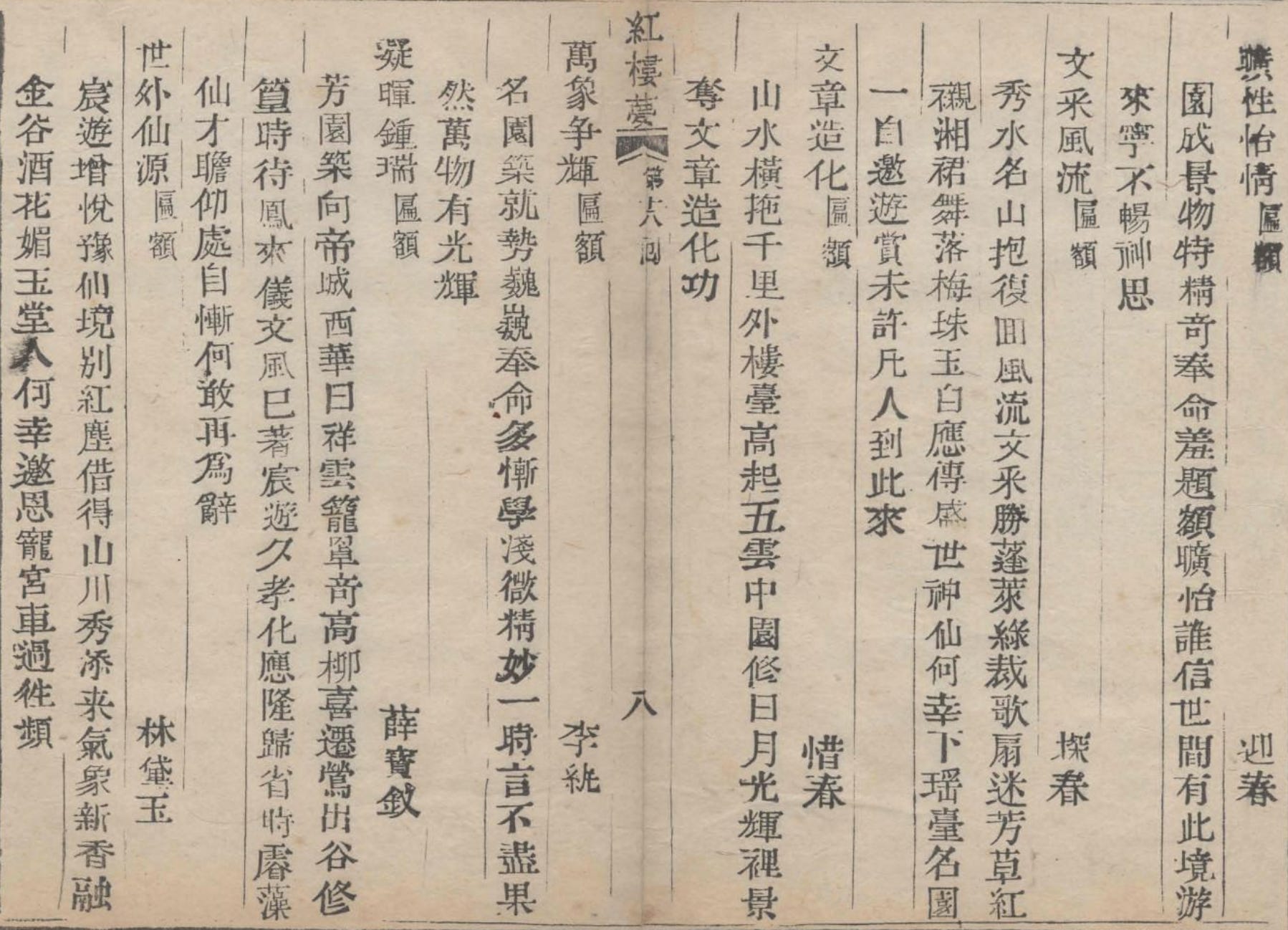
Normally this would be a post for paid subscribers only. However, the poems by Xue Baochai and Lin Daiyu are quite significant when it comes to understanding 紅樓夢, or Dream of the Red Chamber. As a result, I’ve decided to make this post free for all readers. If you enjoy this, please consider a paid subscription to this publication. There’s a lot more like this to come.
There’s a major difference between actually reading a book and just reading about the book.
I’ve spent quite a bit of time in my life reading articles about Dream of the Red Chamber. And one of the things that pops up over and over again is what a genius Cao Xueqin was, especially when it comes to his poetry. In particular, critics and readers tend to praise Cao Xueqin for giving each character their own unique poetic voice.
Of course, this is one of the hardest things to translate. Poetry can never be translated in a one-to-one sense from one language to the other; it simply doesn’t work that way. And so there’s naturally no way you can simply read two poems translated from Chinese to English and see the original author’s brilliance right away.
The best thing we can do is dive into the language and closely analyze things. And so let’s do it. Let’s compare Xue Baochai’s poem with Lin Daiyu’s poem.
We can start off with the most obvious similarities. Both poems, like the poems by the other girls start off with similar general descriptions of the garden.
Here’s Xue Baochai’s first two lines:
芳園築向帝城西,華日祥雲籠罩奇。
The fragrant garden was built west of the Imperial City;
The bright sun and auspicious clouds envelop it magically.
And here’s what Lin Daiyu wrote:
宸遊增悅豫,仙境別紅塵。
The Imperial visit brings us joy,
This fairyland is cut off from the mortal world.
The basic idea in both poems is the same. There are direct references to the imperial visit in both, as well as a sense of some sort of supernatural blessing on the garden itself.
But that’s where you see the difference in the characters of Xue Baochai and Lin Daiyu. Xue Baochai defines the garden in terms of its relationship to the seat of power. For her, it “向帝城西,” or “it lies to the west of the Imperial City.” Xue Baochai uses the seat of political power as a reference.
Lin Daiyu, on the other hand, sees the garden as completely separate from the mortal world. 紅塵 means “red dust,” and is a phrase we’ve seen pop up from time to time. Lin Daiyu talks about the garden as being a mystical realm (仙境) completely separated (別) from the mortal world, or from the “red dust” (紅塵).
The reason for this difference is quite simple. Xue Baochai represents the more practical side of life. She’s the ultimate Confucian girl, concerned with society and focused on making sure that things happen in proper order. Lin Daiyu, on the other hand, wants to exit the society completely and search for a better world apart from the drudgery of mortality.
When we look at the next two lines, we see a similar contrast. Here’s what Xue Baochai writes:
高柳喜遷鶯出谷,修篁時待鳳來儀。
The tall willows rejoice as the orioles leave the valley;
Tall bamboo trees constantly await the ceremonial arrival of the phoenix.
And here’s what Lin Daiyu created:
借得山川秀,添來氣象新。
Borrowing the beauty of the hills and streams,
This place takes on a brand new air.
Of course, this is where the world of English translation completely lets us down.
Xue Baochai is making two weighty literary allusions here.
The first one is the talk about “orioles leaving the valley,” or 鶯出谷. This is a direct quotation from The Classic of Poetry, or the 詩經. The original passage is “出自幽谷,遷于喬木,” or “It comes out from the dark valley and moves to a tall tree.”
This passage is an image of a worthy person rising from obscurity into public prominence. Xue Baochai is comparing Jia Yuanchun leaving the palace to visit with the oriole leaving the valley, and brilliantly alludes to the fact that Jia Yuanchun emerged from relative obscurity to her current imperial position. It’s actually a fantastic literary allusion when you think about it.
The same goes for 鳳來儀, or “the ceremonial arrival of the phoenix.” This is an allusion to the 尚書, or the ancient Book of Documents. It’s a symbol of the arrival of a virtuous sage ruler, one who is blessed by the cosmos for his moral virtues.
The rejoicing tall willows and the tall bamboo trees both point towards the splendor and majesty of the imperial visitor. Or, in other words, nature itself respects Confucian virtue in Xue Baochai’s poetic tongue. And, honestly, her two lines are absolutely brilliant.
Lin Daiyu’s two lines are much simpler. The garden manages to borrow its beauty from its own landscape, and is refreshed by the imperial visitor. There’s no amazing poetic allusion in Daiyu’s two lines; instead, she writes a simple natural description, focusing more on the feeling than on the social order.
The next two lines show the biggest contrast between the two poets. Xue Baochai writes this:
文風已著宸遊夕,孝化應隆歸省時。
The power of literature was clear on the night of the Imperial outing;
The transforming power of filial piety reached its peak with this homecoming visit.
And here is what Lin Daiyu writes:
香融金谷酒,花媚玉堂人。
Its fragrance is blended with the wine of Golden Valley,
The flowers smile up at our noble guests.
Xue Baochai makes direct references to two clearly Confucian concepts: the power of literature (文風) and the “transforming power of filial piety” (孝化). And she describes how the Imperial Consort’s brings about the height of both powers.
Lin Daiyu, on the other hand, makes a reference to 谷酒, or the literary drinking parties of Shi Chong during the Jin dynasty. It’s an intelligent literary allusion, and is combined with the unforgettable sight of the flowers smiling up (媚) at the imperial visitors.
I don’t think there could be any clearer way to distinguish between the mentalities of the two girls. Xue Baochai is focused on decorum and the proper world of Confucianism in these two lines, while Lin Daiyu is focused on personifying nature and making something magical happen.
And then come the final two lines, and both poems have absolutely brilliant final two lines. Here’s Xue Baochai’s:
睿藻仙才瞻仰處,自慚何敢再為辭?
As I gaze up at your immortal literary talent,
I feel so ashamed; what more could I write?
And this is what Lin Daiyu writes:
何幸邀恩寵,宮車過往頻?
How fortunate we are to receive this Imperial grace!
Might the palace carriage return here frequently?
Xue Baochai’s final two lines represent her excellent cultural competence. They are filled with proper praise for the imperial visitor. 睿藻 means something like “brilliant imperial writings” and praises Jia Yuanchun’s literary excellence; 仙才 means “immortal talent” and is another word of praise, and Xue Baochai ends up explaining that she is ashamed and could never write further.
Of course, this is a proper and required gesture of self-effacement, something that is natural for this kind of poem. If you look back, you’ll realize that the other girls also ended their poems on a similar note, though not with quite the same level of literary brilliance.
And this, of course, is where Lin Daiyu’s poem really stands out.
何幸邀恩寵 means something like “How fortunate I am to be favored with such grace.” This isn’t formal language, though. Rather, it feels personal and emotional, as if Lin Daiyu were really writing her heart out on the page.
And the fascinating part about Daiyu’s poem is that 宮車過往頻 line at the end, which is a sincere wish that Jia Yuanchun could come around more frequently.
Lin Daiyu’s final lines are not about giving formal and formulatic praise to the imperial visit. Rather, they read more like a poem written between friends. Daiyu exposes a bit of the emotional reality behind her character with those two final lines.
You can think of it like this. Lin Daiyu’s poem is a direct reflection of who she is, and is almost completely free of convention and self-effacement. Xue Baochai’s poem is filled with ritual and hierarchy, but is curiously lacking in emotion.
That’s not to say that one poem is better than the other. Both are absolutely brilliant, and it’s very rewarding to dive in and see what you can find. They simply represent opposite ends of poetic theory. One is formal and carefully calculated, the other is fully emotional and utterly vulnerable.
I like your comparison of the final couplets in Baochai and Daiyu’s poems. It really does show how Daiyu wants to be close with others, while Baochai always makes sure to keep a respectful distance. Sometimes, however, it feels as though the “real” Daiyu only comes out when she writes poetry. I wonder if you agree.
Regarding poetry translations there is a rather humorous book titled "Nineteen Ways of looking at Wang Wei" in which the author critiques 19 translations of a single 1300 year old 20 character poem. It really gets to the difficulty with keeping the authors voice while trying to present the feeling of it.