


Qin Keqing’s Death Bed
We see a major difference in how Jia Baoyu and Wang Xifeng express emotion as they encounter the sickly Qin Keqing in this passage. This is yet another example of the brilliance of Cao Xueqin’s literary abilities.
My Translation
Meanwihle, Wang Xifeng and Jia Baoyu went together with Jia Rong to Qin Keqing’s residence. They entered the outer room and then quietly went into her bedroom. When she saw them enter, Qin Keqing tried to get up to greet them.
“Don’t get up!” said Xifeng hurriedly. “You’ll get dizzy.”
Wang Xifeng went forward quickly and grasped Qin Keqing’s hands. “Oh, my poor dear!” she exclaimed. “It’s only been a few days since I last saw you, and yet you’ve become so thin!” She sat down next to Qin Keqing, right on top of the same blanket.
Baoyu greeted Qin Keqing and say down on a chair across from the two women.
“Bring some tea,” Jia Rong called out to one of the servants. “Aunt Xifeng and Uncle Baoyu didn’t have any tea when they were in the main room.”
Qin Keqing forced out a smile as she clutched on to Wang Xifeng’s hands. “I’ve just had bad luck!” she said. “In this kind of family, where my father-in-law and mother-in-law treat me just like I was their own daughter, where my husband respects me the same way as I respect him even though he’s still young, where we’ve never had any argument, and where all of my elders and cousins treat me with such respect, especially you, Aunt Xifeng, this family where everybody treats me well and gets along with me – for me to fall ill like this!
“I’m losing my will to move on. I haven’t been able to do my filial duties to my in-laws for a single day. And here you are showing me so much kindness, Aunt Xifeng. Surely if I did ten times as much for you it wouldn’t be enough!
“But it’s too late now. The way I feel now, I doubt I’ll last the rest of the year.”
Meanwhile, Jia Baoyu had been staring at the painting called Crabapple Blossoms in Spring Slumber, with the poem by Qin Taixu:
A tender chill locks away dreams because the spring is cold.
A strong fragrance attacks people; it’s the scent of wine.
His mind automatically went back to the dreamlike vision that he had when he slept in this room, the one that had taken him to the Illusory Realm of the Great Void.
He was lost in these thoughts when he heard what Qin Keqing had said. Her words pierced his heart like a thousand arrows. Despite his best efforts, tears began to fall from his eyes.
Xifeng was extremely sad when she saw this. However, she worried that displaying such sorrow would only make Qin Keqing feel worse, and would defeat the purpose of her visit. “Don’t act like such a little girl!” she admonished Baoyu. “Of course she’ll talk like that; after all, she’s sick. But she hasn’t reached that stage yet. Besides, she’s young; an illness like this will pass away in no time.”
She then turned back to Qin Keqing. “Don’t let your imagination run away with you!” she added. “Aren’t you just asking for the illness to get worse?”
“All she needs to get better is to eat a little bit more,” remarked Jia Rong. “We don’t need anything more than that. If she eats more, we’ll have nothing to fear.”
“Cousin Baoyu,” interrupted Xifeng, “Lady Wang is asking you to go over there right away. You really shouldn’t stay here like this; you’ll only upset poor Qin Keqing. Besides Lady Wang is anxious to see you.”
She then turned to Jia Rong. “Why don’t you take your Uncle Baoyu over there first? I’ll stay here and will spend some more time with Qin Keqing.”
After hearing this, Jia Rong went with Baoyu through the Huifang Garden.
Translation Critique
Hawkes
This is one of those places where the David Hawkes translation becomes confusing. Hawkes refers to both Wang Xifeng and Qin Keqing as “she” several times. For example:
In two rapid strides she was at her side and holding her by the hand.
This one makes sense, of course, because Wang Xifeng was just speaking. But, once she’s holding Qin Keqing’s hand, we have this sentence:
She sat down beside her on the quilt on which she sat propped.
It’s confusing to follow David Hawkes’ pronouns here. But the worst part is that the Chinese original constantly references 秦氏 (Lady Qin) in these instances to avoid this pronoun confusion. I’m not sure why Hawkes has reintroduced all the pronouns; he certainly didn’t have to.
Hawkes translates 這都是我沒福 as “It looks as though I wasn’t meant to be happy.” While it’s certainly a possible translation, I think something more along the lines of “I’ve had bad luck” makes more sense as a translation of 我沒福.
Yang
The Yangs have the same issue with pronouns, though it’s a bit easier to follow here:
She sat down on her mattress, while Pao-yu also asked after his niece’s health and took a chair opposite.
As usual, the Yangs have taken a few sentences of the Chinese original and have condensed them down a bit. However, it’s still not entirely clear whose mattress Wang Xifeng is sitting down on.
The Yangs also took away the references to Qin Keqing being unlucky.
Finally, the Yangs have Wang Xifeng call Jia Baoyu “a regular old woman.” I think it’s probably more appropriate to translate 你忒婆婆媽媽的了 as something like “don’t be such a sissy.”
Chinese Text
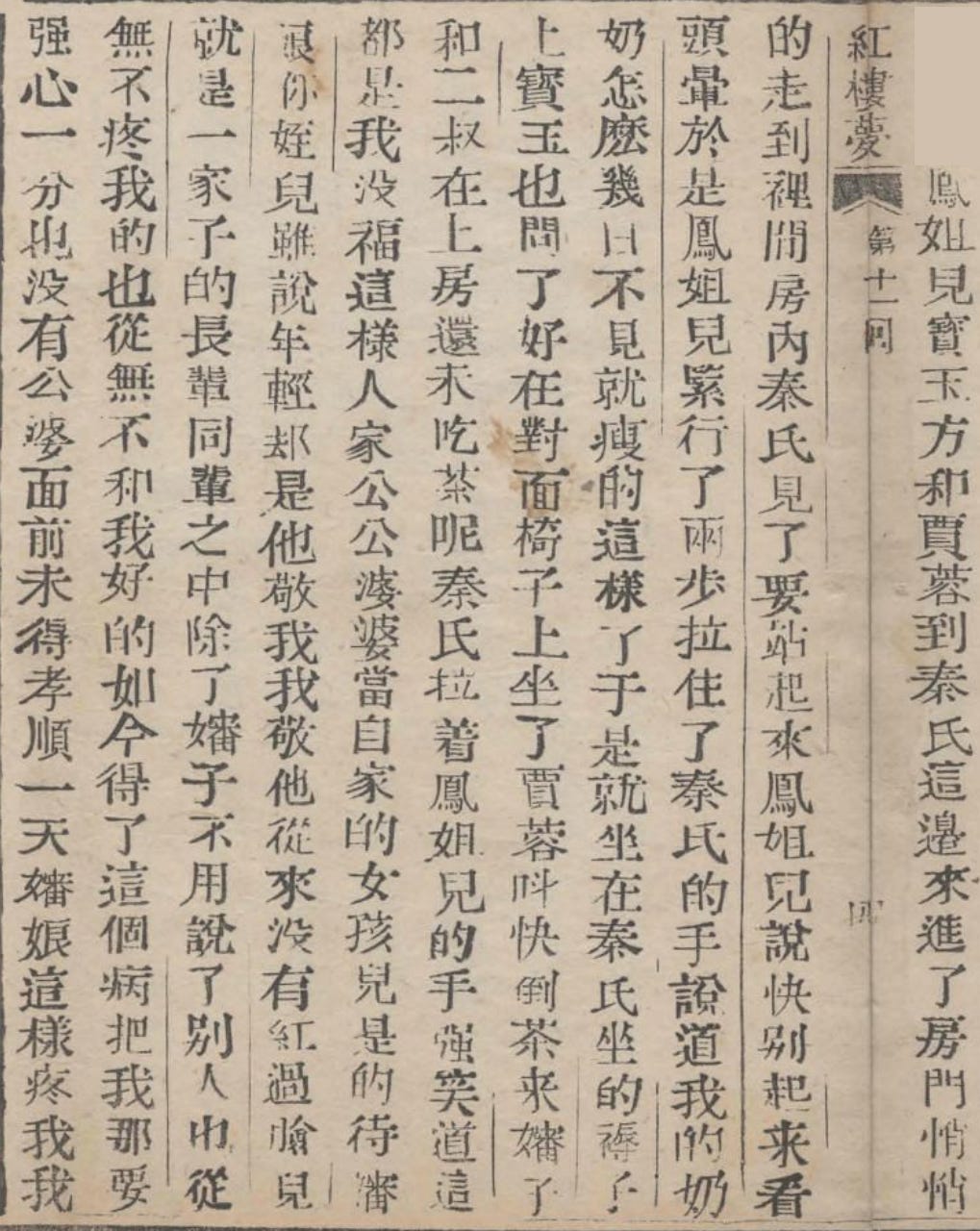
鳳姐兒寶玉方和賈蓉到秦氏這邊來,進了房門,悄悄的走到裡間房內。秦氏見了,要站起來。鳳姐兒說:「快別起來,看頭暈。」於是鳳姐兒緊行了兩步,拉住了秦氏的手,說道:「我的奶奶!怎麼幾日不見,就瘦的這樣了!」於是就坐在秦氏坐的褥子上。寶玉也問了好,在對面椅子上坐了。賈蓉叫:「快倒茶來。嬸子和二叔在上房還未吃茶呢。」秦氏拉著鳳姐兒的手,強笑道:「這都是我沒福!這樣人家,公公婆婆當自家的女孩兒似的待。嬸孃,你侄兒雖說年輕,卻是他敬我,我敬他,從來沒有紅過臉兒。就是一家子的長輩同輩之中,除了嬸子不用說了,別人也從無不疼我的,也從無不和我好的。如今得了這個病,把我那要強心一分也沒有,公婆面前未得孝順一天。嬸孃這樣疼我,我就有十分孝順的心,如今也不能夠了!我自想著,未必熬得過年去!」
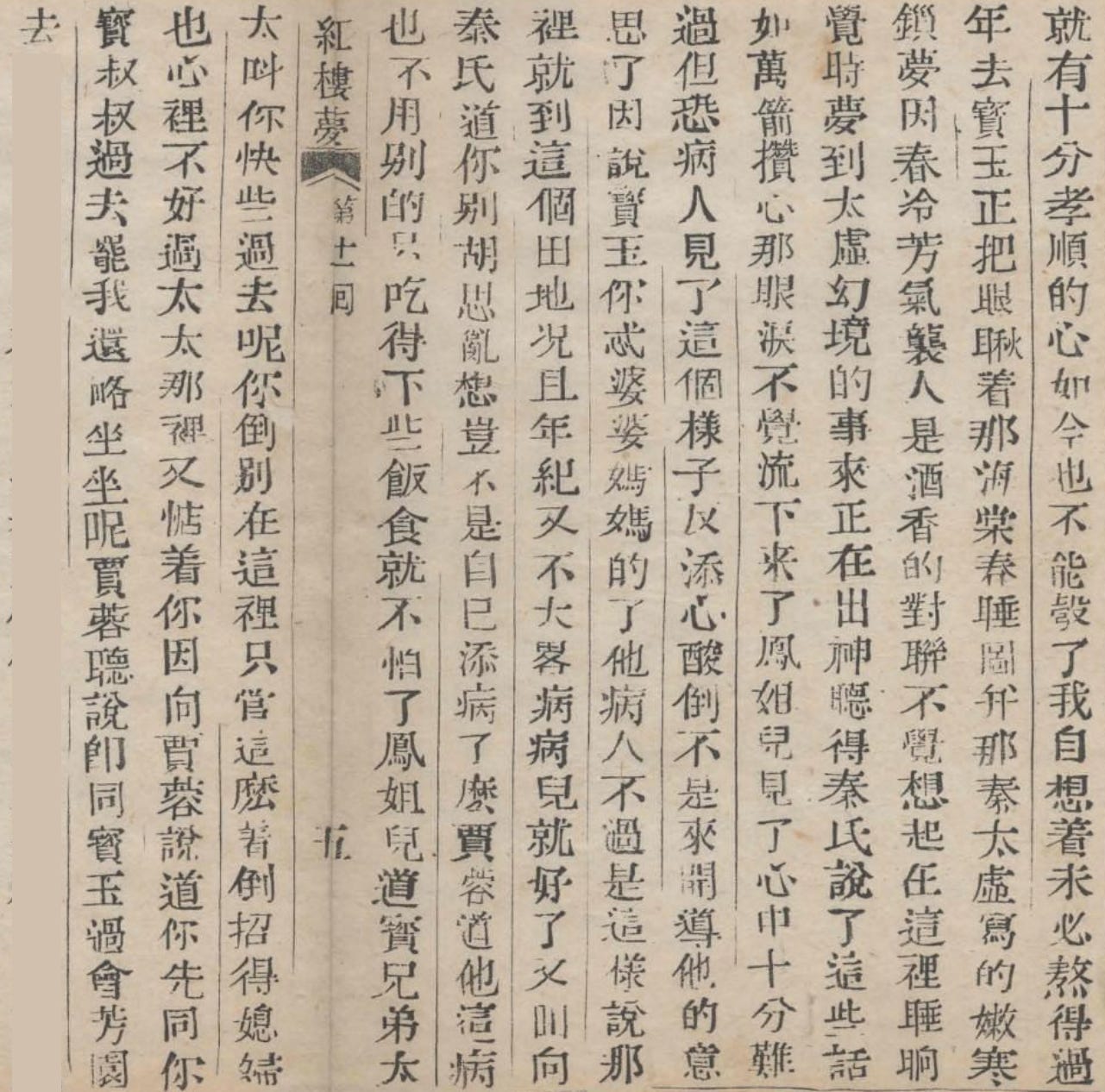
寶玉正把眼瞅著那「海棠春睡圖」並那秦太虛寫的「嫩寒鎖夢因春冷,芳氣襲人是酒香」的對聯,不覺想起在這裡睡晌覺時夢到「太虛幻境」的事來。正在出神,聽得秦氏說了這些話,如萬箭攢心,那眼淚不覺流下來了。鳳姐兒見了,心中十分難過。但恐病人見了這個樣子反添心酸,倒不是來開導他的意思了,因說:「寶玉,你忒婆婆媽媽的了。他病人不過是這樣說,那裡就到這個田地。況且年紀又不大,略病病兒就好了。」又迴向秦氏道:「你別胡思亂想,豈不是自己添病了麼?」賈蓉道:「他這病也不用別的,只吃得下些飯食就不怕了。」鳳姐兒道:「寶兄弟,太太叫你快些過去呢。你倒別在這裡只管這麼著,倒招得媳婦也心裡不好過。太太那裡又惦著你。」因向賈蓉說道:「你先同你寶叔叔過去罷,我還略坐坐呢。」賈蓉聽說,即同寶玉過會芳園去。
Translation Notes
In this context, 我的奶奶 does not mean “oh my grandmother” the way you probably think. 奶奶 is occasionally used in certain southern Chinese dialects to mean “lady” or “madam.”
We already read about the painting called 海棠春睡圖 (Crabapple Blossoms in Spring Slumber) in chapter 5:

I’ve tried to keep the translation here the same as my translation there for the sake of continuity.
晌 means noon or midday; therefore, 睡晌覺 means to have a nap in the middle of the day.
出神 means to be spellbound or lost in thought
萬箭攢心 is an old classical phrase that is easy to translate literally. It means a thousand arrows penetrate your heart, which, of course, means something that is extremely emotionally painful.
忒 here should be pronounced tuī. It’s a dialectical term that means “excessively” or “too much.” You can find it in languages like Hakka, Shanghainese, Cantonese, and various Wu dialects. Meanwhile, 婆婆媽媽的 means feminine or girly. Wang Xifeng is telling Jia Baoyu that he needs to man up and stop crying.