


Qin Keqing’s Lavish Funeral Arrangements
Today’s passage is a closer look at the rites Jia Zhen has created for Qin Keqing. They’re ostentatious, sure, but there’s actually something much deeper going on here. Jia Zhen seems to be desperately trying to repent of some misdeed he has committed; more on this tomorrow. This is another relatively short passage, but there’s a lot going on here that you don’t want to miss.
My Translation
While Jia Zhen said this, Qin Bangye, Qin Zhong, Lady You, Lady You’s two younger sisters, and several other relatives arrived. Jia Zhen told Jia Qiong, Jia Chen, Jia Lin, and Jia Qiang to stay with the guests.
Meanwhile, Jia Zhen ordered that the Director of the Imperial Observatory’s Yin-Yang Department be asked to select an auspicious date. The chosen date allowed for the coffin to remain in the mourning hall for 49 days, with the funeral rites starting on the third day after that period, at which time the obituary notices would also be sent out.
During that 49 day period, 108 monks were specially asked to chant the Great Compassion Repentance in the main hall in order to deliver the souls of those who died before and those who will die later.
Jia Zhen also had an altar set up at the Tower of Celestial Fragrance, where 99 Quanzhen Taoist priests would conduct a 19 day penance to resolve grievances and cleanse karmic sins.
The coffin would then rest in the Huifang Garden. In that garden, a group of 50 eminent Buddhist monks and 50 distinguished Taoist priests would maintain separate altars, performing meritorious rites every seven days.
Translation Critique
Hawkes
David Hawkes notes that the 送訃聞, the sending out of official obituaries, apparently indicated that the family was ready to receive official condolence visits. However, his translation here is inaccurate, as he describes this happening within three days. It seems from the original Chinese that this was to take place after the 49 days of ritual.
Hawkes translates 大悲懺 as “Grand Misericordia.” Misericordia is a Latin noun that means “pity” or “compassion.” This is another example of Hawkes “translating” easily understood Chinese terms into foreign languages; we’ve got a lot more of those coming in the future.
Yang
The Yangs also interpret 三日後 to mean that the notices would be sent out “three days after her death” as opposed to three days after the 49 day ceremony. It’s not extremely important either way.
Neither the Yangs nor David Hawkes provide any commentary on how these funeral arrangements compare to what was likely common practice in China at the time.
Chinese Text

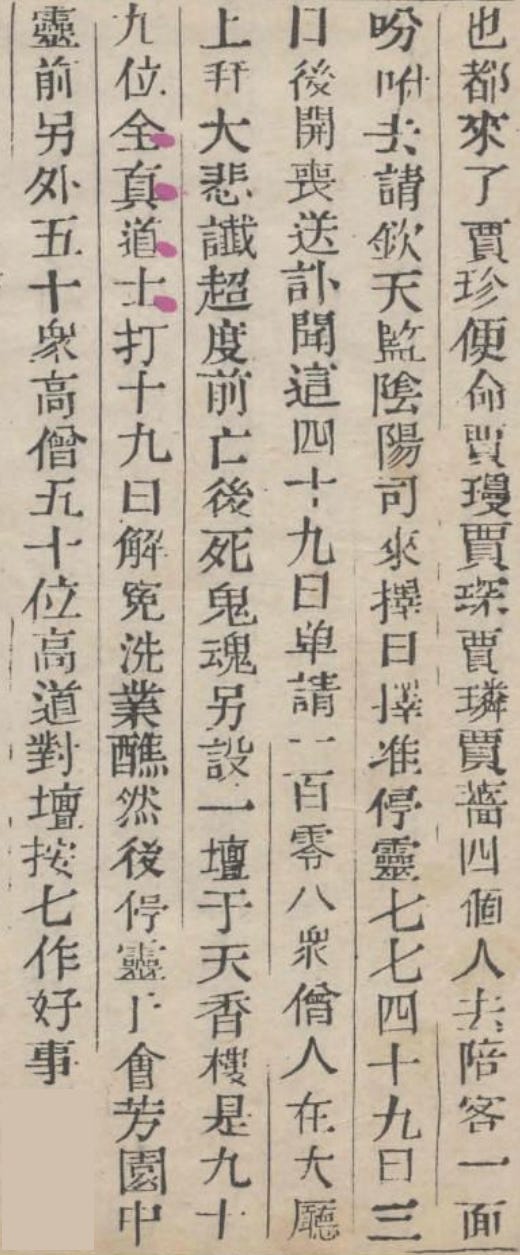
正說著,只見秦邦業、秦鍾、尤氏幾個眷屬,尤氏姊妹也都來了。賈珍便命賈瓊、賈琛、賈璘、賈薔四個人去陪客;一面吩咐去請欽天監陰陽司來擇日。擇准停靈七七四十九日,三日後開喪送訃聞。這四十九日,單請一百零八眾僧人在大廳上拜「大悲懺」,超度前亡後死鬼魂;另設一罈於天香樓,是九十九位全真道士,打十九日解冤洗業醮。然後停靈於會芳園中,靈前另外五十眾高僧,五十位高道,對壇按七作好事。
Translation Notes
欽天監陰陽司 is the name of a department of the Imperial Observatory that was responsible for divination calculations. The idea, obviously, is that this office could help Jia Zhen select the most auspicious date possible.
七七四十九日 is a little bit complex. 七七 really means seven sets of seven days, which, of course, makes 49 days in all. Chinese funeral customs traditionally called for ceremonies to be held every seven days after death until the 49th day after death. In other words, Qin Keqing is being given the full mourning period, not a shortened one. It’s basically the most elaborate funeral possible. We see the concept of rituals performed in 7 day intervals later in this passage when it refers to 七作好事
開喪送訃聞 is actually kind of awkward. 開喪 means to start the funeral rites, while 送訃聞 means to send out the obituary. It seems that none of this would take place until the end of the entire 49 day period.
As explained here, 大悲懺 (the Great Compassion Repentance) is a specific service in Chan Buddhism that is quite popular in Chinese communities. As the name implies, it is a chanting service specific to repentance of past misdeeds.
超度前亡後死鬼魂 (to help deliver the souls of those who died before and those who will die later) is a formulaic and highly formal phrase, almost as if it were taken straight from a funeral liturgy.
天香樓, or the Tower of Celestial Fragrance, is a fictional location in the novel. However, the name 天香樓 is extremely important for the textual criticism of Dream of the Red Chamber; more on that later. This phrase originally comes from the poem 靈隱寺 (Lingyin Temple) by the Tang dynasty poet 宋之問 (Song Zhiwen):
鷲嶺鬱岧嶢,龍宮鎖寂寥。
樓觀滄海日,門對浙江潮。
桂子月中落,天香雲外飄。
捫蘿登墖遠,刳木取泉遙。
霜薄花更發,冰輕葉未凋。
夙齡尚遐異,搜對滌煩囂。
待入天台路,看余度石橋。
The Vulture Peak towers in luxuriant height
Dragon Palace lies in solitude close by.
The temple views the sun up from the sea;
Its gate looks on the tide of Qiantang River.
Laurel seeds fall from the moon in the sky;
Celestial fragrance drifts beyond the cloud.
I climb the mossy slope to the pagoda;
Through hollowed trees I seek the spring afar.
Thin frost makes flowers grow more beautiful;
Light ice won’t wither the leaves on the tree.
Since early days I love far-off wonders;
These scenes calm my vexation and worry.
When I come to the path to Paradise,
Please see me cross over the bridge of stone.
Here, 鷲嶺 (the Vulture Peak), refers to Gridhrakūta, a place the Buddha frequently visited and the site of many of his sermons.
Anyway, the key phrase in this poem is 桂子月中落,天香雲外飄, or “Laurel seeds fall from the moon in the sky; Celestial fragrance drifts beyond the cloud.” That 天香 (celestial fragrance) is the source of the name 天香樓, or the Tower of Celestial Fragrance.
全真道 refers to the Quanzhen (Complete Perfection) School of Taoism, one of the two largest denominations of Taoism in China.
解冤 means to resolve grievances or feelings of being wronged, and is a specific religious concept here. It’s not far away from the concept of “repentance” we just saw in the Buddhist ritual.
洗業 means to clean your karma; in other words, to get rid of any negative karma you built up in your life.
醮 refers to a Taoist ritual in general. The text already indicates that the priests are from the Quanzhen School (全真道士); this character reinforces the fact that they are performing a Taoist ritual, as opposed to the Buddhist one mentioned earlier.
Considering this is after Jia Rui's death which was outright caused by bad karma, I do wonder if the implication is that Jia Zhen did kill Qin Keqing with the taint of his actions even if it wasn't as direct as driving her to suicide. He's certainly acting like he believes that's the case. Almost like a reversal of Wang Xifeng vs Jia Rui, what would have happened if Wang Xifeng didn't fight back.
Is it a bit weird that he has 50 taoists and buddhists perform their version of a ceremony for repentance simultaneously? Seems like a desperate attempt at restoring Qin Kequings dignity which he himself tarnished.