


Qin Keqing’s Origin Story
We’ve finally reached the end of chapter 8, after a little over a month of digging. It’s interesting to see another new character introduced at the end of the chapter, which is something that you wouldn’t expect. Then again, this book is filled with the unexpected.
My Translation
Qin Zhong’s father was named Qin Bangye. By this time he was serving as the Director of the Bureau of Construction. He was now approaching 70 years old, and his wife had passed away some time ago.
When Qin Bangye was around 50 years old, because he didn’t have any children, he decided to adopt a son and a daughter from an orphanage. But, unexpectedly, the son also passed away.
That left him only with his daughter. When she was young, she was named Ke’er. Her formal name was Jianmei. As she grew older, Jianmei’s body became graceful and willowy, and her temperament was charming and sensible. Since the Qin family had longstanding connections with the Jia family, they arranged a marriage for her.
Meanwhile, Qin Bangye fathered a son named Qin Zhong when he was 53 years old. Qin Zhong was 12 years old by this time. His tutor had returned to the south the year before, and he had been spending his time at home reviewing his old lessons. And so his father was planning to discuss with the Jia family the possibility of sending his son to study at the Jia family school.
And so it was a happy coincidence that Jia Baoyu had met with Qin Zhong and had discussed with him the possibility of attending the Jia family school. Jia Bangye also knew that the head of the Jia family school was the venerable old scholar Jia Dairu. And so Jia Bangye was delighted, believing that Qin Zhong’s studies at that school would certainly advance his studies and pave the way for future success and fame.
Qin Bangye’s only problem was that he didn’t have much money. Everybody in the Jia family, of course, heavily valued money, and it would be embarrassing to give an amount that was too small. But this was about his son’s future, and so Jia Bangye scrimped and scraped bits from here and there. In the end he was able to prepare a ceremonial gift of 24 taels of silver for the teacher. And then, taking Qin Zhong with him, he went to visit Jia Dairu at home. After that, they waited for Jia Baoyu to choose an auspicious day to start attending school.
And, from that very moment, troubles began to stir up at the family school.
What happens next? Read the next chapter to find out.
Translation Critique
Hawkes
David Hawkes ignores the fact that Qin Keqing’s given name here is actually “Jianmei.” He refers to her instead as “Ke-qing.” The reason behind this is a little bit complex; we’ll get into that tomorrow. The Chinese text makes it plain that her given name was Jianmei (兼美).
Hawkes also adds in a lot of extra stuff that isn’t in the original text. For example, he has Jia Bangye taking his 24 taels of silver “which he made up into a packet and laid reverently before Jia Dai-ru when he took Qin Zhong to the old teacher’s house to make his kotow.” It’s not inaccurate; in fact, it’s more descriptive than the original text, and can only be seen as an improvement. It’s just not a correct translation of the original text.
Yang
The Yangs translate Qin Bangye’s name as “Chin Yeh,” which is an undertranslation. I’m not sure what the source is for that or why they decided to change his name. They also simply call Qin Keqing by her name Keqing (rendered here as “Ko-ching”), ignoring the reference to Jianmei.
They add in this poem, which is not in the 1792 Chinese edition:
If one knew that in time to come there would be trouble,
Who would send his son to study today?
As is the case with the other poems featured in the Yang translation, there’s a good chance that this comes from one of the manuscript versions of the book that I haven’t read yet.
Chinese Text
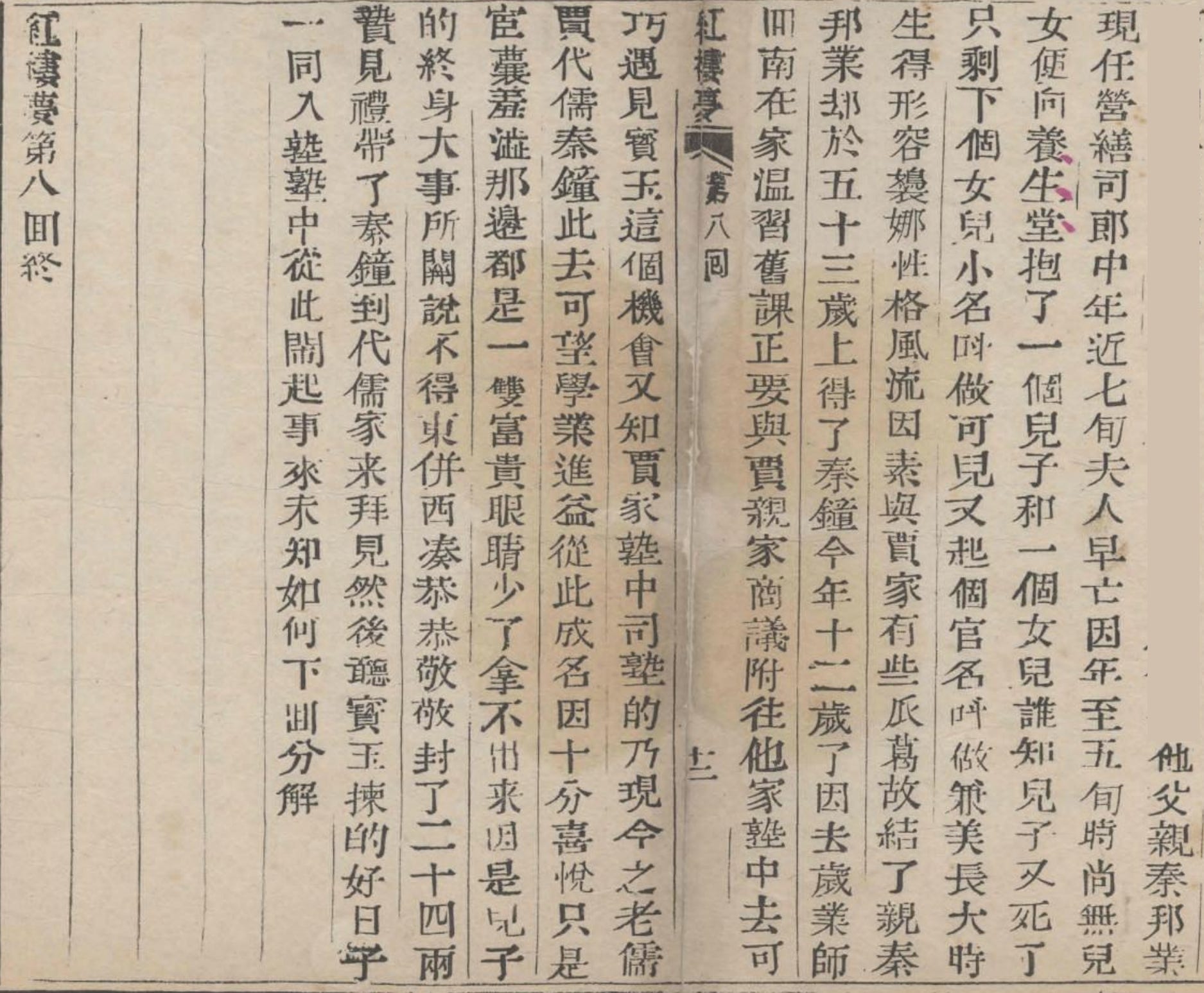
他父親秦邦業,現任營繕司郎中,年近七旬,夫人早亡。因年至五旬時尚無兒女,便向養生堂抱了一個兒子和一個女兒。誰知兒子又死了,只剩下個女兒,小名叫做可兒,又起個官名,叫做兼美,長大時,生得形容嫋娜,性格風流。因素與賈家有些瓜葛,故結了親。
秦邦業卻於五十三歲上得了秦鍾,今年十二歲了。因去歲業師回南,在家溫習舊課,正要與賈親家商議,附往他家塾中去。可巧遇見寶玉這個機會,又知賈家塾中司塾的乃現今之老儒賈代儒,秦鍾此去,可望學業進益,從此成名,因十分喜悅。只是宦囊羞澀,那邊都是一雙富貴眼睛,少了拿不出來,因是兒子的終身大事所關,說不得東拼西湊,恭恭敬敬封了二十四兩贄見禮,帶了秦鍾,到代儒家來拜見,然後聽寶玉揀的好日子一同入塾。塾中從此鬧起事來。
未知如何,下回分解。
Translation Notes
秦邦業 (Qin Bangye) is another character that we’re meeting for the first time here. It’s interesting that we’re meeting this new character at the end of the chapter, something I don’t recall seeing in any other Chinese novels.
營繕 apparently is an older term for construction based on this site.
養生堂 seems to have been something similar to a modern day orphanage – a government run institution that cared for orphans.
可兒 (Ke’er) means “agreeable” or “lovely.” Notice that the two vowels are separated by an apostrophe per the rules of Pinyin; writing something like “Keer” would look confusing to Chinese speakers.
We’ve seen the name 兼美 (Jianmei) before. This is the name of the girl that the Goddess who Dispels Illusion gave to Jia Baoyu during his first sexual encounter, which came at the end of chapter 5:

The name Jianmei means “combined beauty” or “embodying duel beauties.”
瓜葛 here means connections. The literal meaning is “vines and tendrils,” and gives off the impression of long standing and complex ties.
得了 here literally means that Qin Bangye “received” Qin Zhong. Note that it’s not clear who the mother was.
老儒 means an old scholar – “old” being used in a highly respectful sense.
賈代儒 (Jia Dairu) is the name of the teacher of the Jia school. 代 means a generation, but can also mean a representative or substitute for. 儒, meanwhile, is the word used for Confucian or Confucianism. It seems that the author is calling attention to the fact that this teacher is merely a substitute or a stand-in for Confucian thought.
終身大事 means a big event in one’s life. This almost always refers to marriage, though in this case it refers apparently to Qin Zhong going to school.
東拼西湊 means to assemble bits and pieces from all over the place. Here it clearly refers to the act of Qin Bangye finding bits of money here and there to help pay for his son’s schooling.
That mention of auspicious days takes me back to some planning issues the need to wait for one has caused. Notable to me that the scrimping and saving was for what is called a ceremonial gift, the Jia family valuing money is said outright, but this indicates the valuing is from a social status stand point rather than a practical one. Which is probably why they're set for a downfall.