


Qin Keqing’s Warning
This passage at the beginning of chapter 13 is one of the is one of the most profound passages we’ve seen so far. Qin Keqing is doomed to die an early death, but she visits Wang Xifeng to give a fascinating warning.
My Translation
Chapter 13
Qin Keqing Dies And Is Given A Posthumous Title;
Wang Xifeng Starts Managing The Ningguo Mansion
Because Jia Lian had taken Lin Daiyu back to Yangzhou, Wang Xifeng found the days empty and dull. And so she would spend each evening chatting and laughing for a while with Ping’er, after which she would tumble haphazardly into bed to sleep.
On one particular night, Wang Xifeng and Ping’er were sitting close together by the lamp for warmth. Their embroidered quilts had already been covered with warm, perfumed incense on Wang Xifeng’s orders. They soon settled down to go to sleep. The two of them sat there, counting on their fingers the stages of Jia Lian’s journey and guessing how far he might have gone. Before they knew it, they were deep into the night.
Ping’er fell fast asleep quickly. Wang Xifeng could also feel sleep coming on. But then she seemed to faintly see Qin Keqing approaching her room from the outside with a smile on her face.
“My good aunt, you sure can sleep!” smiled Keqing. “I’m going back today, and yet you haven’t seen me off even part of the way on my journey. But, since we’ve been so close, I couldn’t bear to leave you without saying goodbye.
“There is one more thing, an unfulfilled wish, that I need to tell you about. I worry that nobody else will be up to doing it.”
“What wish?” said Xifeng faintly, fighting off sleep. “Whatever you want, I’ll do it.”
“Auntie,” replied Keqing, “you truly are a hero among women. Even those men who gird their belts and don their hats can’t match you. But how is it, then, that you can’t understand a simple common saying?
“They say that ‘the full moon can only become dimmer, and water brims only to overflow.’ They also say that ‘the higher you climb, the harder you fall.’
“Our family has enjoyed riches and splendor for almost a full century now. Suppose one day that our ‘extreme joy will lead to sorrow.’ And, if we experience that old proverb, ‘when the tree falls the monkeys scatter,’ wouldn’t our family’s long, cultured reputation all be in vain?”
Xifeng felt extremely sad when she heard these words. She was also awestruck. “Your concerns are correct,” she replied. “But isn’t there some way to protect us forever from such misfortunes?”
“Oh aunt, you are so foolish!” laughed Keqing coldly. “As they say, ‘extreme adversity marks the beginning of fortune.’ Since ancient times, fortune and humiliation have followed each other in an endless cycle. How could humans manage to achieve lasting prosperity?
“But, if you can prepare for the coming decline when you’re in a time of prosperity, then it is possible to preserve for the long term.
“At the moment, all the affairs are in order except for two matters. If these two things could be settled in this certain way, the future could be secured with no worries.”
“What things?” asked Xifeng.
“First of all,” replied Keqing, “although our ancestral tombs receive sacrifices in all four seasons, there is no fixed amount of money set aside for this. Second, although our family school has been established, there is no permanent money to fund it.
“As I see it, in our present state of opulence, it’s easy for us to make sacrifices and educate our children. But, when the family falls in the future, how are we going to pay for these two expenses? I think it would be better to follow my proposal.
“While we still have wealth and honor, let’s buy more farmland, farm houses, and fields near our ancestral tombs. Let the expenses for sacrifices and schools come from these sources, and let our family school also be established there. Draw up regulations that all members of the family agree to, both young and old. And then let every branch of the family take turns managing the lands, funds, sacrifices, and schools, all for one year at a time. If things are circulated this way, there will be no arguments, and there would be no worries about someone pawning it all or similar abuses.
“Even if someone should commit a crime and have their property confiscated by the authorities, these sacrificial estates would not be seized, because the authorities do not take assets like these.
“When our family falls into decline, our descendants could return to study or farm, would have a place of retreat, and the ancestral sacrifices would be mainained forever.
“If we instead believe that our glory and prosperity will never end and we give no thought to the future, then we will have no plan at all. I see that very soon now an extraordinary happy event will occur, like pouring oil on a blazing fire or embroidering a brocade with extra flowers. But you must understand that this event will also be nothing but fleeting glory and a momentary joy. Never forget that ‘even the grandest feast must end!’
“If we don’t prepare for the future soon, I’m worried that we’ll be too late!”
“What is the happy event?” asked Xifeng.
“I cannot reveal the plans of heaven,” replied Keqing. “But since you and I have been such good friends, auntie, let me give you two lines as a parting gift. Make sure to remember these!”
And then she recited this poem:
When the three springs are gone, all the fragrances will fade,
And everybody will have to find their own way.
Translation Critique
Hawkes
David Hawkes translates 封龍禁尉 as “the status of a Noble Dame.” It’s not a particularly good translation of the Chinese original, which refers to something more like an imperial guard.
Hawkes also translates 寧國府 as “a neighbouring establishment,” which kind of ignores the obvious fact that Wang Xifeng is destined to run the Ningguo Mansion, a place the reader is already familiar with.
Hawkes translates 月滿則虧,水滿則溢 this way:
The full moon smaller grows,
Full water overflows.
It’s a perfectly fine translation, except that its meaning in English is extremely obscure. If you read the book in Chinese, you’ll recognize these two well known phrases and will understand immediately that Qin Keqing is referring to the family’s inevitable decline. Hawkes does similar things with the other proverbs, though they are generally easier to understand in English than these two.
Meanwhile, Hawkes does an excellent job with the final poem:
When the Three Springs have gone, the flowering time will end,
And each one for himself as best he may must fend.
Yang
The Yangs translate the final poem this way:
After the three months of the spring, all flowers will fade
And each will have to find his own way out.
Chinese Text
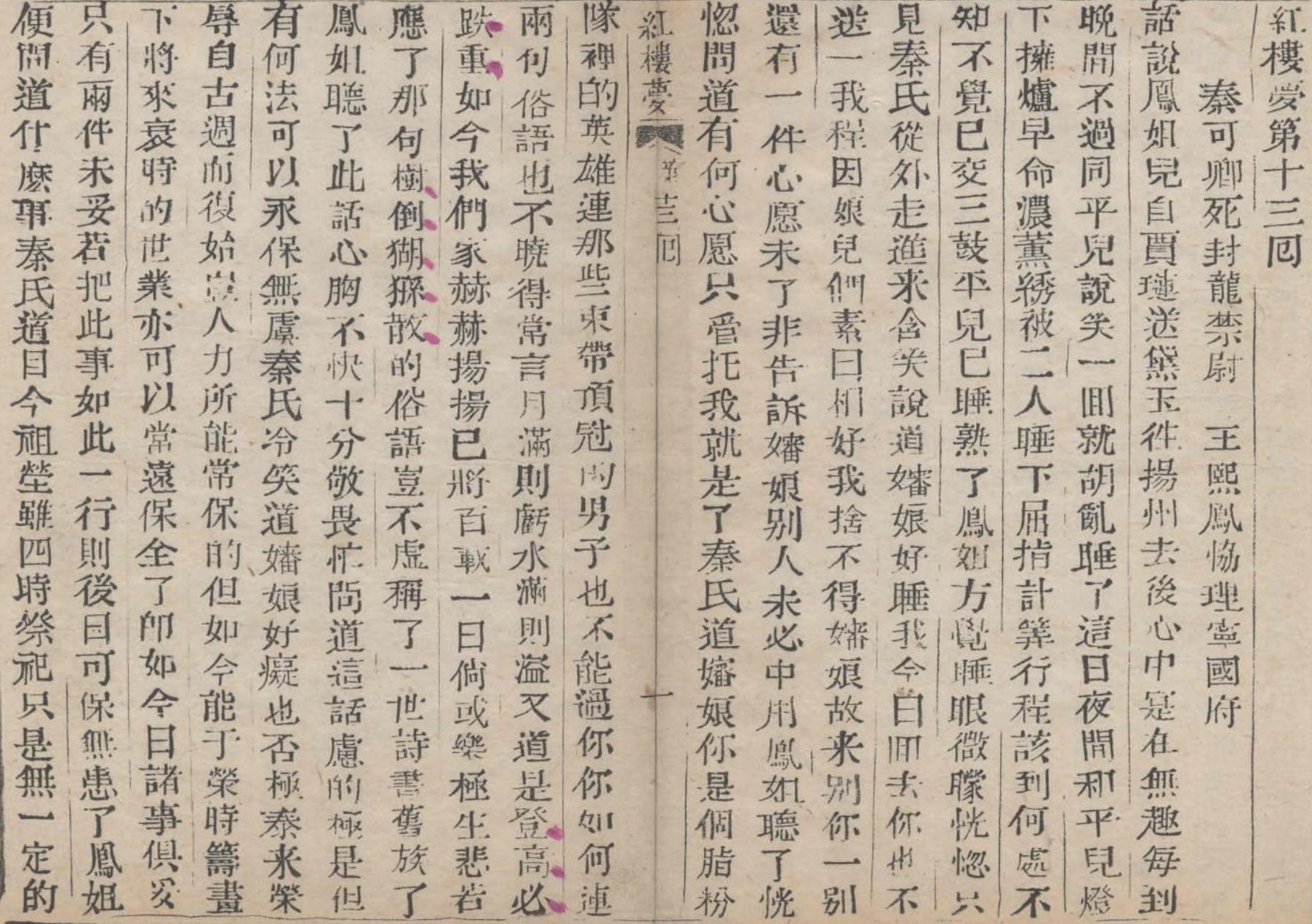
第十三回 秦可卿死封龍禁尉 王熙鳳協理寧國府
話說鳳姐兒自賈璉送黛玉往揚州去後,心中實在無趣,每到晚間,不過同平兒說笑一回就胡亂睡了。這日夜間,和平兒燈下擁爐,早命濃薰繡被,二人睡下,屈指計算行程,該到何處,不知不覺,已交三鼓。平兒已睡熟了。鳳姐方覺睡眼微蒙,恍惚只見秦氏從外走進來,含笑說道:「嬸孃好睡!我今日回去,你也不送我一程。因娘兒們素日相好,我捨不得嬸孃,故來別你一別。還有一件心願未了,非告訴嬸孃,別人未必中用。」鳳姐聽了,恍惚問道:「有何心願?只管託我就是了。」秦氏道:「嬸孃,你是個脂粉隊裡的英雄,連那些束帶頂冠的男子也不能過你,你如何連兩句俗語也不曉得?常言『月滿則虧,水滿則溢』,又道是『登高必跌重』。如今我們家赫赫揚揚,已將百載,一日倘或『樂極生悲』,若應了那句『樹倒猢猻散』的俗語,豈不虛稱了一世詩書舊族了?」鳳姐聽了此話,心胸不快,十分敬畏,忙問道:「這話慮的極是,但有何法可以永保無虞?」秦氏冷笑道:「嬸孃好痴也!『否極泰來』,榮辱自古周而復始,豈人力所能常保的?但如今能於榮時籌劃下將來衰時的世業,亦可以常遠保全了。即如今日,諸事俱妥,只有兩件未妥,若把此事如此一行,則後日可保無患了。」
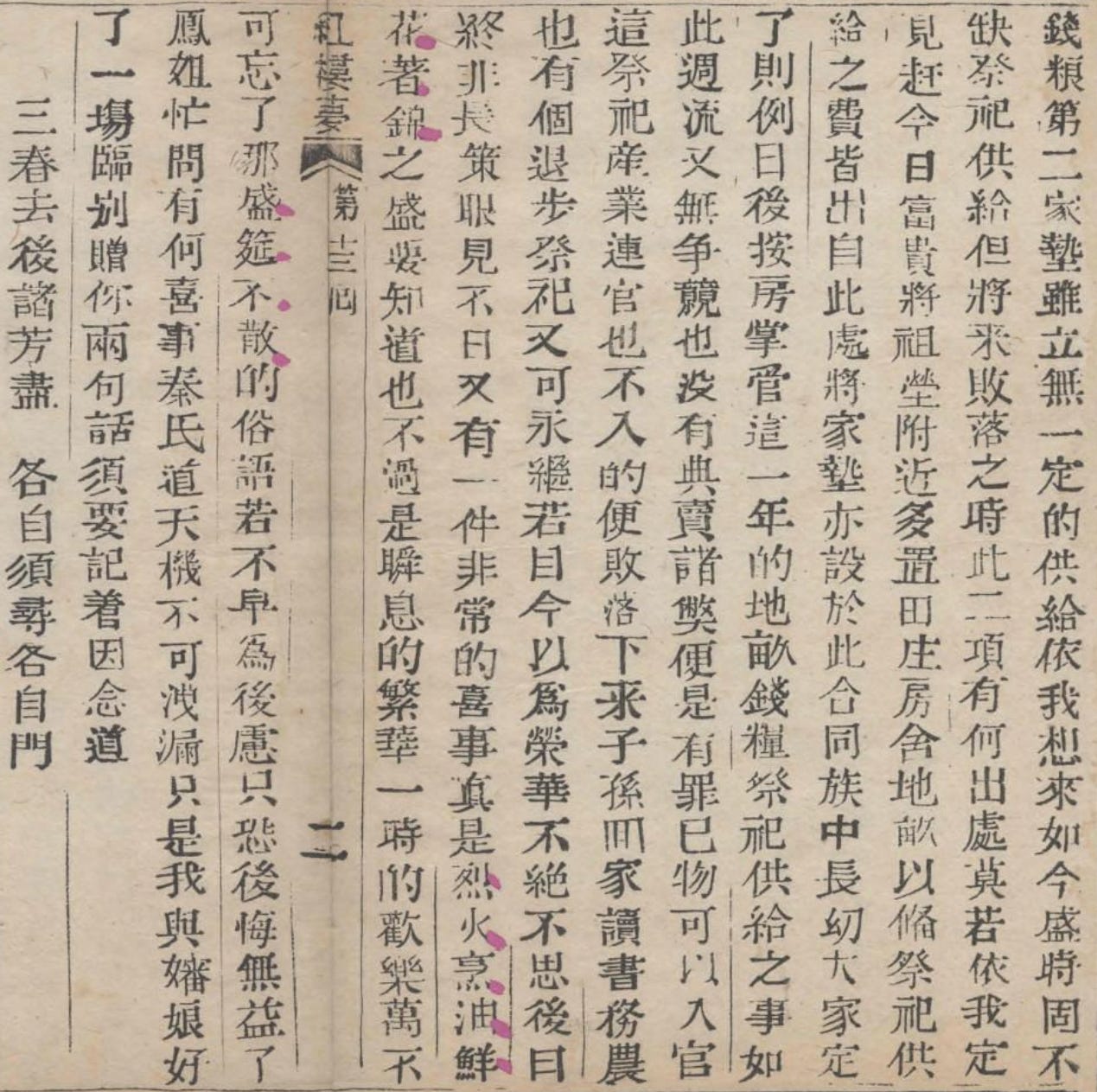
鳳姐便問道:「什麼事?」秦氏道:「目今祖塋雖四時祭祀,只是無一定的錢糧;第二,家塾雖立,無一定的供給。依我想來,如今盛時固不缺祭祀供給,但將來敗落之時,此二項有何出處?莫若依我定見,趕今日富貴,將祖塋附近多置田莊、房舍、地畝,以備祭祀、供給之費皆出自此處,將家塾亦設於此。合同族中長幼,大家定了則例,日後按房掌管這一年的地畝、錢糧、祭祀、供給之事。如此周流,又無爭競,也沒有典賣諸弊。便是有罪,己物可以入官,這祭祀產業,連官也不入的。便敗落下來,子孫回家讀書務農,也有個退步,祭祀又可永繼。若目今以為榮華不絕,不思後日,終非長策。眼見不日又有一件非常的喜事,真是烈火烹油,鮮花著錦之盛。要知道也不過是瞬息的繁華,一時的歡樂,萬不可忘了那『盛筵必散』的俗語!若不早為後慮,只恐後悔無益了!」鳳姐忙問:「有何喜事?」秦氏道:「天機不可洩漏。只是我與嬸孃好了一場,臨別贈你兩句話,須要記著!」因念道:「三春去後諸芳盡,各自須尋各自門!」
Translation Notes
龍禁尉 is a title for an officer of the Imperial Guard, and literally means Dragon Guardsman of the Forbidden City. Qin Keqing’s husband is given this title after her demise in this chapter, which allows the status of her funeral to be elevated.
協理 means to assist in management. However, as we’ll soon see, Wang Xifeng is not merely assisting in managing the Ningguo Mansion.
你是個脂粉隊裡的英雄 literally means “you are a hero among all those who have powdered faces.” 脂粉隊 here clearly refers to women in general.
那些束帶頂冠的男子 (those men who gird their belts and don their hats) is a direct reference back to the first paragraph of the novel, where Cao Xueqin writes 我堂堂鬚眉,誠不若彼裙釵 (though I am a grown man with a mustache and beard, I am truly no match for their skirts and hairpins). Cao Xueqin is well known for using things like clothing to refer to people in general – and, in this case, Qin Keqing is telling Wang Xifeng that she is truly superior to the men around her in the exact same way that Cao Xueqin referred to the women he knew when he was young.
月滿則虧,水滿則溢 are two idiomatic phrases that both mean that the height of one’s power can only be followed by a downfall. 月滿則虧 means that the moon will dim once it’s reached it’s brightest point, and 水滿則溢 means that the water will spill over once it’s reached the top of the container.
登高必跌重 means something similar: the higher the heights you reach, the harder your fall will inevitably be.
赫赫揚揚 is an adjective that means brilliant and magnificent. Here it means that the Jia family has been extremely rich.
樂極生悲 is a relatively straightforward idio. It means that a joyful situation turns sorrowful at its climax.
樹倒猢猻散 literally means that the monkeys scatter when the tree falls. It’s an idiom that figuratively means that the followers of a leader disperse when he loses power.
詩書舊族 means an old family with a reputation for culture. 詩書 means literature when put together, and refers here to culture and learning in general.
永保無虞 means to live forever with no worries.
否極泰來 means that extreme adversity marks the beginning of fortune.
周而復始 means to repeat in cycles continuously.
目今 is an archaic phrase that means “now.”
烈火烹油,鮮花著錦 is another group of two similar idioms. 烈火烹油 means to pour oil on a fire to make it burn more fiercely and faster. 鮮花著錦 means to add ornamentation to something that is already gorgeous. Both of these idioms mean excessive and unsustainable splendor, something that would naturally lead to a decline.
盛筵必散 means that even the most grand banquet has to eventually end
In the poem, 三春 (the three springs) refers to the three Jia girls with 春 in their name who have not yet been married: Jia Yingchun, Jia Tanchun, and Jia Xichun. Similarly, 三春 can also refer to three springs, or three years, after the time that Jia Yuanchun visits the family from the imperial palace, which is an event that will happen soon.