


Qin Zhong’s Deathbed
This is one of the best passages that we’ve seen so far in this book. I’ll let it speak for itself.
My Translation
Since Jia Zheng was so preoccupied with the major events happening in the household, he didn’t have time to worry about Jia Baoyu’s studies. And so Baoyu was extremely pleased.
However, Qin Zhong’s sickness was getting more serious by the day. Baoyu started to get extremely worried about this, and so he wasn’t able to feel truly happy.
On this particular morning, Baoyu got up early and quickly finished washing up and dressing. He was about to go tell Grandmother Jia that he was going to visit Qin Zhong. While he was walking there, he saw Mingyan hovering at the edge of the second gate, nervously looking here and there. When Baoyu saw him, he hurried over and asked, “What’s going on?”
“Young Master Qin is close to death,” replied Mingyan.
This news absolutely shocked Baoyu. “But I just saw him yesterday,” he replied quickly. “He was perfectly lucid! How can he suddenly be close to death?”
“I don’t know either,” replied Mingyan. “Just now one of the older servants from his household told me.”
Once he heard this, Baoyu went straight to Grandmother Jia to tell her the news. Grandmother Jia ordered a few servants to go along with them. “Hurry up and go there to fulfill your duties as a classmate,” she told him, “and come straight back. You must return without delay.”
Baoyu hurried out to change his clothes. When he arrived at the outer courtyard, the carriage was still not ready. He felt so anxious that he started pacing in circles frantically around the hall.
Before long, the carriage had finally arrived. He climbed aboard, with Li Gui, Mingyan, and the others following along.
When they reached the Qin family gate, there was not a soul in sight. They swarmed forward straight into the inner chamber. This was sho shocking to Qin Zhong’s two distant aunts, his sisters-in-law, and several of his female cousins that they all scrambled frantically to hide themselves, just managing to get out of sight in time.
Qin Zhong was on his deathbed and had been in and out of consciousness by this time, and had already fainted two or three times. When Baoyu saw him, he couldn’t help but burst into loud sobs.
Li Gui hurried over to try to stop him. “Don’t cry,” he told Baoyu. “Brother Qin is weak from his illness. He found the kang too hard and uncomfortable, and so we temporarily moved him over here to help him get some relief. Brother, if you cry like this, it will only make his sickness worse.”
Baoyu held back his tears when he heard this. He stepped closer and saw that Qin Zhong’s face was as pale as wax, that his eyes were closed, and that his breathing was shallow as he turned and tossed on his pillow.
“Oh dear brother, Baoyu is here,” said Baoyu. Baoyu said this two or three times, but Qin Zhong didn’t respond. “Baoyu is here,” said Baoyu again.
By this time, Qin Zhong’s spirit had already departed his body, leaving behind only a faint, lingering wisp of breath in his chest. Qin Zhong saw a host of ghastly demons and judges holding summons placards and dragging iron chains, coming over to seize him.
But how could Qin Zhong’s spirit be willing to depart like that? He was still worried about the fact that there was nobody left in his household to manage family affairs, and he was also worried about Zhineng, whose whereabouts were still unknown. And so he begged and pleaded with the ghostly judges in every possible way.
Unfortunately, none of those judges were willing to bend the rules for him. On the contrary, they sharply rebuked him “To think that you consider yourself an educated man!” they scolded. “Have you never heard the common saying that ‘If King Yama summons you at the third watch, who would dare hold you back until the fifth watch?’ Here in the underworld we are completely just and incorruptible. We are not like the world of the living, where people make allowances for feelings and sentiments, and where there are so many entanglements and complications that get in the way!”
With all of this commotion, Qin Zhong’s spirit suddenly heard the words “Baoyu is here.”
Qin Zhong began pleading with the officers again. “Honorable divine officers, please show a bit of mercy and allow me to go back just for a moment to say a word to a dear friend. I’ll come straight back.”
“What good friend is that?” asked the ghosts.
“To be frank with you,” said Qin Zhong, “he is the grandson of the Duke of Rongguo; his childhood name is Baoyu.”
When the presiding judge heard this, he was struck with a sense of panic. He began to berate the lesser ghosts, saying, “I told you to let him go back for a while, but you wouldn’t listen to me! Now you’ve stirred things up until you’ve summoned a person in the midst of prosperity and fortune. What are we going to do?”
When the ghosts saw the judge in this state, they were also confused. At the same time, however, they complained among themselves. “Sir, you were all thunder and lightning just now,” they said, “and it turns out that you can’t even bear the thought of the name ‘Baoyu!’ As we see it, he belongs to the world of the living, and we belong to the world of the dead. What do we have to fear from him?”
This only made the chief judge more frantic, and he began to shout even louder.
Does Qin Zhong live or die? See the next chapter to find out.
Translation Critique
Hawkes
Hawkes has Grandmother Jia tell Jia Baoyu that he can see Qin Zhong “since you have been such good friends.” This seems natural to a Western audience, but is actually a mistranslation. Grandmother Jia specifically refers to fulfilling 同窗之情, or the duties of a classmate. She’s basically telling him that he can pay his respects as a classmate of Qin Zhong, and that he needs to leave as soon as possible – it’s the opposite of referring to their friendship.
Always the scholar, David Hawkes makes a parenthetical reference to local custom: Qin Zhong “in accordance with the Northern custom which forbids a sick man to breathe his last on the kang, had some time since been lifted on to a trestle bed to die.” The lengthy explanation is not in the Chinese original, but it is somewhat helpful to the reader. My only wish is that it weren’t written in such a dry and formal style, since it takes away from the emotion of the event.
When describing how the judges of the underworld reacted to hearing the name Jia Baoyu, Hawkes throws in an inappropriate interpretation:
The trepidation of their leader, who was perhaps thinking more of Bao-yu’s demon-repelling talisman than of its wearer, was far from comforted by this reflection.
This is entirely inappropriate because 運旺時盛 refers to Baoyu being at the height of life and happiness and prosperity in the mortal world. The judges are not worried about the jade or any talisman or anything like this. This is entirely a product of David Hawkes’ imagination.
Hawkes also has Qin Zhong wake up momentarily before the end of the chapter, which might come from an earlier Chinese manuscript.
Yang
The Yangs leave out the references to Chinese customs and the reference to Baoyu’s “demon-repelling talisman” that Hawkes inserts.
However, the end of this chapter in the Yang translation also has Qin Zhong momentarily wake up to speak with Baoyu, which tells me that they’re probably using an earlier Chinese manuscript as well.
Chinese Text
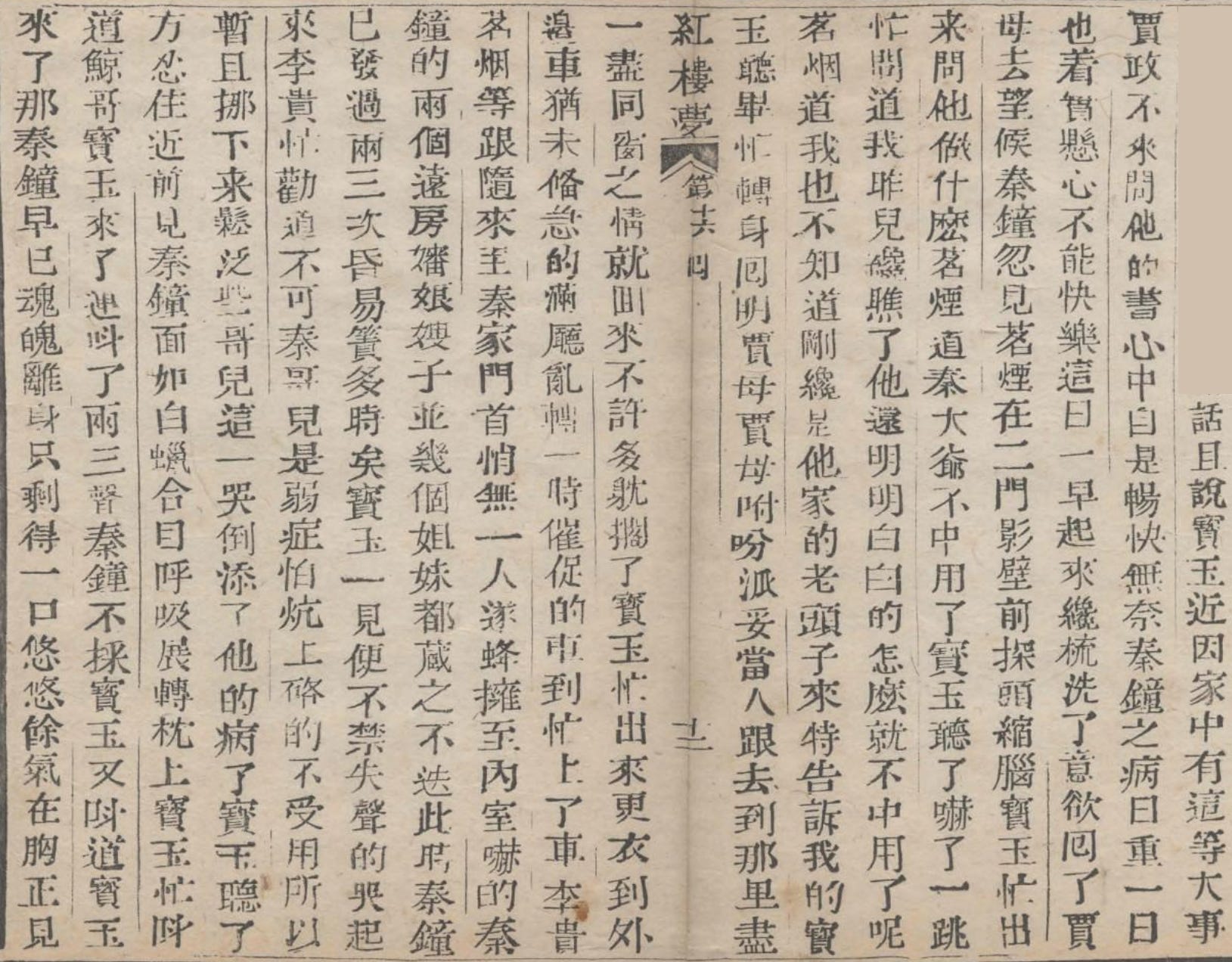
且說寶玉近因家中有這等大事,賈政不來問他的書,心中自是暢快。無奈秦鍾之病日重一日,也著實懸心,不能快樂。這日一早起來,才梳洗了,意欲回了賈母去望候秦鍾,忽見茗煙在二門影壁前探頭縮腦,寶玉忙出來問他:「做什麼?」茗煙道:「秦大爺不中用了。」寶玉聽了,嚇了一跳,忙問道:「我昨兒才瞧了他,還明明白白的,怎麼就說不中用了呢?」茗煙道:「我也不知道,剛才是他家的老頭子來特告訴我的。」
寶玉聽畢,忙轉身回明賈母。賈母吩咐派妥當人跟去,「到那裡盡一盡同窗之情,就回來,不許多耽擱了。」寶玉忙出來更衣,到外邊,車猶未備,急的滿廳亂轉。一時,催促的車到,忙上了車,李貴茗煙等跟隨。來至秦家門首,悄無一人,遂蜂擁至內室。嚇的秦鐘的兩個遠房嬸孃、嫂子並幾個姐妹都藏之不迭。
此時秦鍾已發過兩三次昏,易簀多時矣。寶玉一見,便不禁失聲的哭起來。李貴忙勸道:「不可。秦哥兒是弱症,怕炕上硌的不受用,所以暫且挪下來鬆泛些。哥兒這一哭倒添了他的病了。」寶玉聽了,方忍住,近前見秦鍾面如白蠟,合目呼吸,展轉枕上。寶玉忙叫道:「鯨哥,寶玉來了。」連叫了兩三聲,秦鐘不睬。寶玉又叫道:「寶玉來了。」
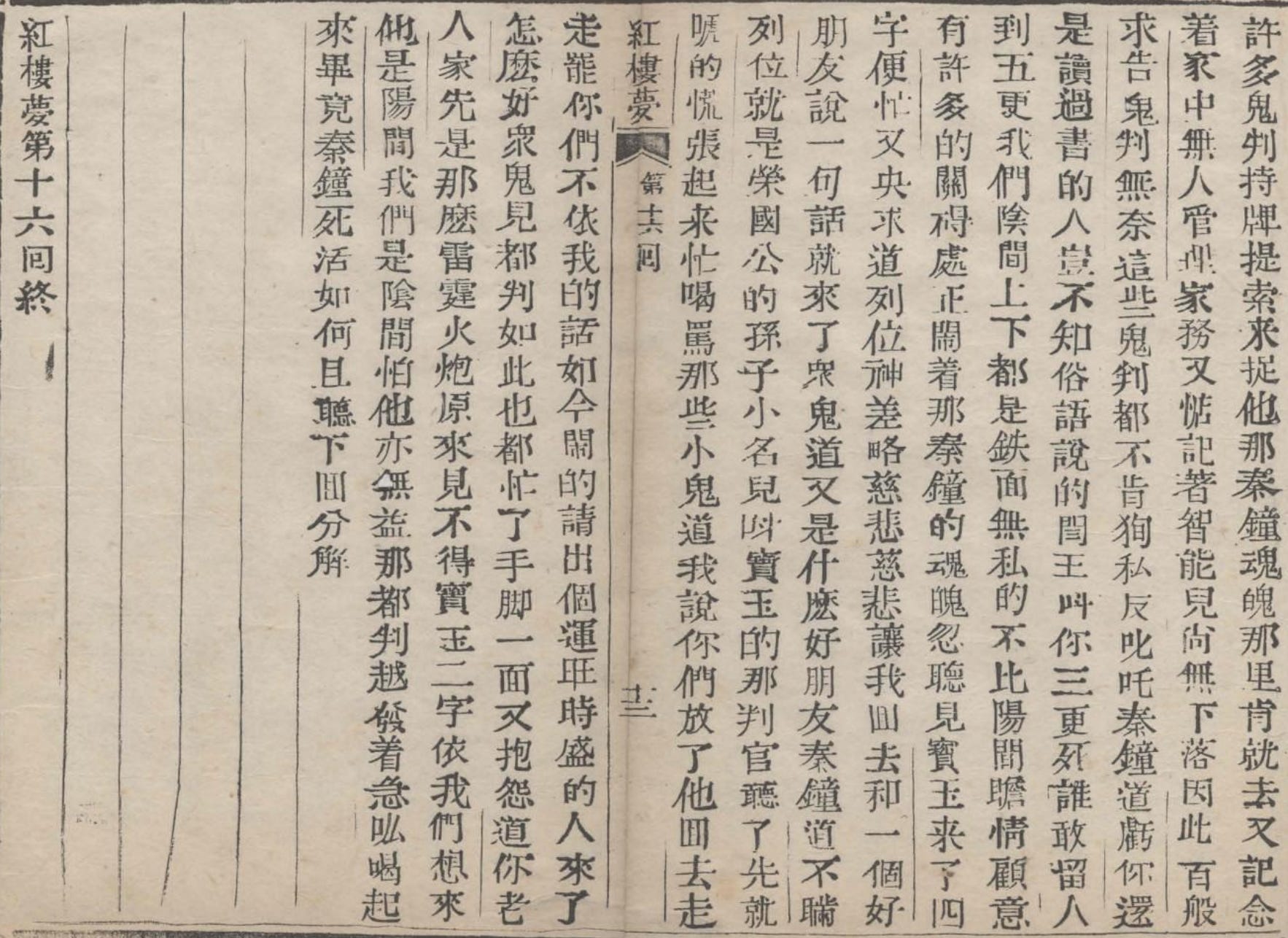
那秦鍾早已魂魄離身,只剩得一口悠悠餘氣在胸,正見許多鬼判持牌提索來捉他。那秦鍾魂魄那裡肯就去?又記念著家中無人管理家務,又惦記著智能兒尚無下落,因此百般求告鬼判。無奈這些鬼判都不肯徇私,反叱吒秦鍾道:「虧你還是讀過書的人!豈不知俗語說的:『閻王叫你三更死,誰敢留人到五更?』我們陰間,上下都是鐵面無私的,不比陽間瞻情顧意,有許多的關礙處!」
正鬧著,那秦鐘的魂魄忽聽見「寶玉來了」四字,便忙又央求道:「列位神差略慈悲慈悲,讓我回去和一個好朋友說一句話就來了。」眾鬼道:「又是什麼好朋友?」秦鍾道:「不瞞列位,就是榮國公的孫子,小名兒叫寶玉的。」那判官聽了,先就唬的慌張起來,忙喝罵那些小鬼道:「我說你們放了他回去走走罷,你們不依我的話;如今鬧的請出個運旺時盛的人來了,怎麼好?」眾鬼見都判如此,也都忙了手腳,一面又抱怨道:「你老人家先是那麼雷霆火炮,原來見不得『寶玉』二字!依我們想來:他是陽間,我們是陰間,怕他亦無益。」那都判越發著急,吆喝起來。
畢竟秦鍾死活如何,且聽下回分解。
Translation Notes
暢快 means carefree and happy. Note that this adjective is contrasted here with 快樂, which also means happy. It seems that 快樂 is used as a more intense form of happiness, which is why I’ve somewhat arbitrarily translated 暢快 as “pleased.”
著實 (pronounced zhuóshí) is an intensifying adverb that means “really” or “very.”
懸心 means to worry or feel anxious
無奈 almost certainly means “however” or “yet” in this context
探頭縮腦 means something like stretching your head out and then shrinking it back. The thing that isn’t being said explicitly here is that the 二門, or the “second gate,” was the gate that separated the outer male quarters from the inner female quarters. Mingyan is Baoyu’s servant, though we haven’t read much about him for a little while. It’s obvious that Mingyan is trying to find Baoyu.
不中用 in this context means dying or approaching death.
When Grandmother Jia talks about 同窗之情, she’s referring to a formal obligation that Jia Baoyu has to his classmate. It feels almost like a Confucian obligation, as if she were telling him to “fulfill the duties of a classmate” instead of telling him to go visit his friend one last time. This is amplified by her admonition that he return right away (就回來,不許多耽擱了), which, of course, means that he should not linger. The irony, of course, is that our favorite word 情 has emerged once again.
易簀多時矣 is a classical Chinese phrase that can be difficult to understand. 易簀 literally means to “change the mat.” It’s an allusion to the Book of Rites that tells the story of the philosopher Zengzi who asked that his mat (簀) be changed on his deathbed. A 簀 literally means a “bamboo bed mat,” and was considered more comfortable than the hard kang (炕) that most people sat on and slept on. By using the phrase 易簀, Cao Xueqin is telling us that Qin Zhong has been in this state for a long time, and is also making a strong classical allusion to Qin Zhong’s pending demise.
鬆泛 is a very specific word that means comfortable in the sense of being relaxed or not tight. 舒服 is the more general term that you’d expect to see. Li Gui is using this particular term to try to calm Jia Baoyu down and to downplay the seriousness of Qin Zhong’s illness.
鯨哥 refers to Qin Zhong’s nickname, which is 鯨 (Jing).
魂魄離身 refers to the traditional Chinese belief in the 魂, which is the intellectual spirit that ascends to heaven upon death, and the 魄, which is the earthly soul that descends to the earth upon death. In this case, Qin Zhong’s spirits have already separated the body, which means that Qin Zhong is truly on death’s door.
Qin Zhong sees 許多鬼判持牌提索來捉他, or many ghostly demons and judges summoning him over and trying to capture him with an iron chain. This refers to the traditional Chinese belief in judgment for the deceased after life. It’s always interesting to note that even the pits of hell were bureaucratic in the ancient Chinese tradition.
徇私 means to act in a biased way or to practice favoritism.
閻王叫你三更死,誰敢留人到五更 is basically a way to say that you can’t delay inevitable death. 三更 and 五更 refer to different hours of the night in the traditional Chinese timekeeping system; one 更 is equal to about two hours. This phrase exists in a very similar form in Journey to the West, which was published several centuries before Dream of the Red Chamber.
陰間 is the afterworld, and is contrasted here to 陽間, or the world of the living.
鐵面無私 means strictly impartial and incorruptible
瞻情顧意 literally means looking to sentiment and caring for personal feelings.
關礙 means to interfere or hinder
The phrase 運旺時盛 (at the height of fortune and prosperity) can be confusing here. It seems that such prosperity and happiness meant that Baoyu was at the height of his worldly (陽間) existence, which meant that their sheer life force meant that the outerworldly and demonic elements of death (陰間) could not harm them. There’s a bit of an implication here that the underworld is subservient to the world of the living. Of course, there is a lot of intentional irony and humor in the fact that the judge of the underworld is frantically berating his servants for a decision that he has already made.
I like the judges immediately contradicting themselves about making no allowances for feelings once Baoyu comes up.