


New Here? This is Chapter 22 of Dream of the Red Chamber, China's greatest novel, translated into modern English one scene at a time. Start with the Start Here guide, or meet the family on the Characters page.
It’s Xue Baochai’s birthday party, and she has just picked a play about a drunk monk who smashes up his monastery. Jia Baoyu thinks it’s noise. She tells him he’s wrong, and that one song in it is the best thing in the whole scene.
Previously: the family picked their plays, and Baochai picked the ones Grandmother Jia would like. (See What Did Grandmother Jia Want To See?)
Today she recites the song. It’s short, and it’s a goodbye: a big, rough man leaving the only home he has with nothing but sandals and a bowl. Watch Baoyu’s face while he listens.
Who’s here: Xue Baochai · Jia Baoyu · Lin Daiyu · Shi Xiangyun (All the characters)
Three Translators, Three Readings. Near the end, the monk asks where he could find a straw cape and a rain hat. David Hawkes has him refuse them: “I ask no goods, no gear to take away.” The Yangs make them the one thing he wants: “My sole wish now / To roam alone in coir cape and bamboo hat.” I read the line a third way. Mine, and why, is below.
The Translation
So Baochai recited it for him:
I brush away a hero’s tears
as I leave the good squire’s house.
Thank you for your mercy,
for shaving my head at the foot of the lotus throne.
But we had no bond of fate,
and in the blink of an eye we’re torn apart.
Stark naked came I, stark naked I go,
with nothing to tie me down.
Where would I find a straw cape and rain hat,
to roll up my bedding and leave?
I’ll just let my straw sandals and broken bowl
beg their way wherever fate leads!
Baoyu was so delighted when he heard it that he slapped his knee and nodded along, praising it over and over. He also praised Baochai, saying there wasn’t a book she didn’t know.
Daiyu curled her lip. “Quiet down and watch the plays. They haven’t even gotten to At the Monastery Gate, and you’re already doing The Madman.”
That made even Xiangyun laugh. Then everyone watched the plays, and the party didn’t break up until evening.
If a monk's goodbye song can say this much in twelve lines, wait until you see what a lantern riddle can do. Sunday's podcast has a real Qing riddle for you to guess before I give the answer, and free subscribers hear that part. Subscribe and it comes straight to your inbox.
The Chinese Text
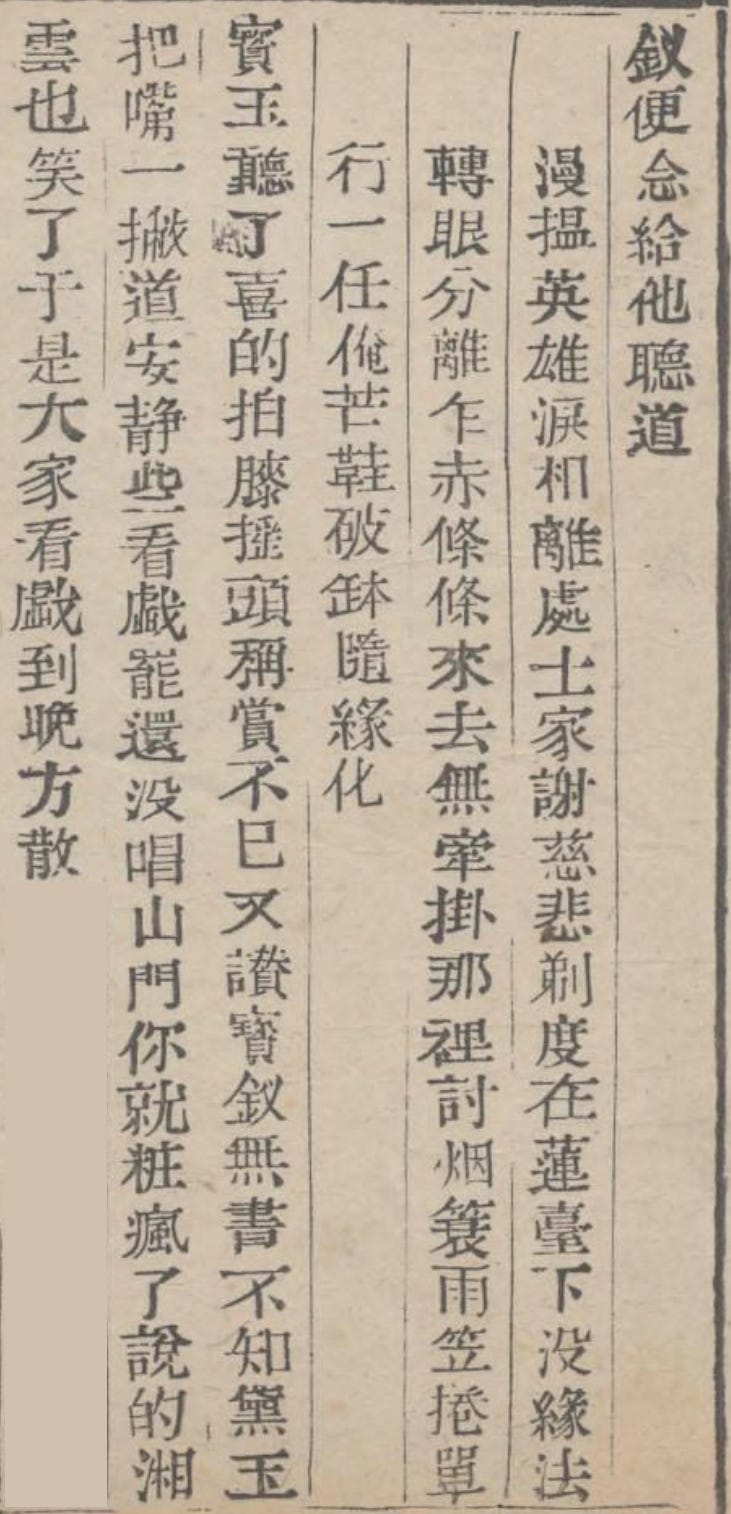
寶釵便念給他聽道:
漫搵英雄淚,相離處士家,謝慈悲,剃度在蓮臺下。沒緣法,轉眼分離乍。赤條條,來去無牽掛。那裡討煙蓑雨笠卷單行?一任俺芒鞋破缽隨緣化!
寶玉聽了,喜的拍膝搖頭,稱賞不已,又贊寶釵無書不知。黛玉把嘴一撇,道:「安靜些看戲罷。還沒唱『山門』,你就『裝瘋』了。」說的湘雲也笑了。於是大家看戲,到晚方散。
Reading Notes
The full line-by-line reading of the aria, with the story behind it, is in tomorrow’s post. These notes cover what you need to follow it today.
處士 (chǔshì). A 處士 is a man of talent who never took an official post. Here it means Squire Zhao (趙員外), the rich man who hid Lu Zhishen after he killed a man, and then sent him to a monastery on Mount Wutai and paid for him to become a monk. “The good squire” is my translation. I tell the whole story tomorrow.
赤條條,來去無牽掛 (chìtiáotiáo, láiqù wú qiānguà). 赤條條 is stark naked, with nothing on at all. 來去 is coming and going: into the world, and out of it. 牽掛 is anything that tugs at you, whether that’s a worry, a person or a possession. This is the most famous line in the aria, and people still quote it. I wrote “Stark naked came I” on purpose, to echo the Book of Job: “Naked came I out of my mother’s womb, and naked shall I return thither.” It’s the same idea. You arrive with nothing, and you leave with nothing.
那裡討煙蓑雨笠卷單行 (nǎlǐ tǎo yānsuō yǔlì juǎn dān xíng). 討 is to ask for, or even beg for, and 那裡討 makes it a rhetorical question: where would he get these things? He has no way to, and the line moves on without them. 煙蓑雨笠 is a straw cape for the mist and a bamboo hat for the rain, the gear any traveler would want. The hard part is 卷單. 卷 stands in for 捲, “to roll up,” and 單 is a monastery word. A wandering monk who stays at a monastery is said to 掛單, “hang up his 單”: his name goes on the roster, and his bedding roll (衣單) goes on a peg. When he leaves, he 捲單, rolls it back up. So 卷單行 means packing up and leaving, specifically as a monk walking out of a monastery. “Roll up my bedding and leave” keeps the bedding but can’t keep the monastery, which is why this note is here. And 那裡討 at the start of the line is one of the padding words I described on Wednesday: extra syllables the tune doesn’t count.
芒鞋破缽隨緣化 (mángxié pò bō suíyuán huà). 芒鞋 are sandals woven from grass, and a 缽 is a monk’s alms bowl, this one battered. 化 is short for 化緣, a monk begging for food or money. Literally it means to make a 緣, a bond of fate, between the giver and the Buddha. 隨緣 means “as fate allows,” or wherever circumstances take you. So he’ll beg his way along wherever he ends up, which is exactly what a monk with nothing does.
拍膝搖頭 (pāi xī yáo tóu). Literally “slapped his knee and shook his head.” In Chinese, swaying your head while you listen is what you do when you’re savoring a line. In English, shaking your head means “no,” so I wrote “nodded along.”
無書不知 (wú shū bù zhī). “There’s no book she doesn’t know.” Baoyu has been on the receiving end of this before. At the Imperial Consort’s visit, Baochai caught him using the wrong word in a poem, gave him the right one from a Tang poem he couldn’t remember, and he called her his “one-word teacher.” (See Green Jade and Green Wax)
『山門』 / 『裝瘋』 (Shānmén / Zhuāngfēng). Daiyu’s joke works because both words are play titles. 《山門》 is the scene Baochai picked, At the Monastery Gate. 裝瘋 means “to act crazy,” and it’s also the title of another stage scene (usually written 《妝瘋》), in which the Tang general Yuchi Jingde (尉遲敬德) pretends to be mad to get out of an order. So Daiyu’s line means: the play hasn’t even started, and you’re already putting on a madman’s act. It’s a quick, sharp bit of wit, and it’s aimed at Baoyu’s enthusiasm for Baochai’s song.
The Other Translations
Hawkes
David Hawkes has Xue Baochai recite the poem in a low voice “so as not to disturb the others,” and notes that “she half-sang, half-recited them.” These seem to be interpretive additions from Hawkes.
Hawkes translates the poem like this:
I dash aside the manly tear
And take leave of my monkish home.
A word of thanks to you, my Master dear,
Who tonsured me before the Lotus Throne:
‘Twas not my luck to stay with you,
And in a short while I must say adieu,
Naked and friendless through the world to roam.
I ask no goods, no gear to take away,
Only straw sandals and a broken bowl,
To beg from place to place as best I may.
Hawkes takes a lot of creative license with this poem, as he usually does. Part of this is to keep a rhyme scheme: tear and dear, home and Throne and roam, you and adieu, away and may. That’s a reasonable choice for an aria, which is meant to be sung, but here the rhyme gets in the way of the meaning.
He also has Lu Zhishen “take leave of my monkish home.” The 處士家 in the Chinese is the house of the squire who sheltered him and paid for his ordination, not the monastery. The Yangs get this right with “my patron’s house.”
Yang
The Yangs translate the poem like this:
Dried are the hero’s tears,
My patron’s house left behind;
By grace divine
Tonsured below the Lotus Throne.
Not destined to stay,
I leave the monastery in a flash,
Naked I go without impediment;
My sole wish now
To roam alone in coir cape and bamboo hat,
And in straw sandals with a broken alms bowl
To wander where I will.
The Yangs are accurate on most points, but their version reads almost mechanically. Lines like “Dried are the hero’s tears” and “By grace divine” sound more like a gloss than a song. The swagger of a drunken monk who just got himself thrown out of a monastery is gone. That flatness runs through all of A Dream of Red Mansions, and we’ll see more of it as we go along.
Both
Three lines show what gets lost in both translations.
赤條條,來去無牽掛. This is the most famous line in the aria. 來去 is coming and going: coming into the world and leaving it. Hawkes has “Naked and friendless through the world to roam,” and the Yangs have “Naked I go without impediment.” Both keep the going and drop the coming. That turns a line about life and death into a line about travel, and it’s why the line feels cut short in both. It’s also why I wrote “Stark naked came I, stark naked I go,” with the Book of Job in mind.
那裡討煙蓑雨笠卷單行? The three translations read this line three different ways. Hawkes makes it a refusal: “I ask no goods, no gear to take away.” He doesn’t want the gear. The Yangs make it a wish: “My sole wish now / To roam alone in coir cape and bamboo hat.” I read it as a man with nothing: where would he even find a straw cape and a rain hat?
Hawkes also turns the cape and hat into “goods” and “gear.” The line is still there, but the most vivid picture in the aria has become an abstraction, and 卷單, rolling up a monk’s bedding to leave the monastery, is gone. The Yangs keep the cape and hat but seem to read 單行 as “traveling alone,” since 單 can also mean “single.” That’s where their “roam alone” comes from. Even professional translators split on this line, which is why the Reading Note on 卷單 is there.
一任俺芒鞋破缽隨緣化! Both translations end on a different note from the original. Hawkes keeps the begging, “To beg from place to place as best I may,” but drops fate. The Yangs drop both, and “To wander where I will” swaps fate for free will, which is the opposite of 隨緣.
The aria uses the same word, 緣, twice. First he had no bond of fate with the abbot (沒緣法), and at the end he leaves his begging up to fate (隨緣). The Yangs keep it the first time (”Not destined to stay”) and lose it the second. Hawkes turns the first into “luck” and leaves out the second. So the shape of the aria, a bond that breaks and a life handed over to fate, doesn’t come through in either one.
This is why I take the poetry slowly. Details like these are easy to miss, and they’re what the aria is about.
Hawkes says the monk doesn't want the cape and hat. The Yangs say it's all he wants. I say he couldn't get them if he tried. Which reading do you buy? Tell me in the comments.
Next in the story: On Saturday, the party winds down, and Grandmother Jia calls two of the young actors in for a closer look.
Go deeper: Tomorrow, who this monk is, why he’s leaving, and why Baoyu can’t stop praising his song.
Meet them: Xue Baochai / Jia Baoyu / Lin Daiyu / Shi Xiangyun / All the characters