


The Apricot Banner
This is the final of Jia Baoyu’s four poems for Jia Yuanchun. Remember that this poem was actually composed by Lin Daiyu.
My Translation
Apricot Banner In Sight
The apricot banner invites travelers to drink;
You can see a mountain villa from here.
The geese swim on water filled with chestnuts and lilies;
The swallows dart through mulberry and elm trees to the rafters.
There is one plot of land with young spring chives,
And miles of fragrant fields with rice blossoms.
In this prosperous age, nobody goes hungry.
Why should one toil at plowing and weaving?
Translation Critique
Hawkes
David Hawkes translates this poem in this way:
The Hopeful Sign
An inn-sign, through the orchards half-discerned,
Promises shelter and a drink well-earned.
Through water-weeds the pond’s geese make their way;
Midst elms and mulberry-trees the swallows play.
The garden’s chives are ready to prepare;
The scent of young rice perfumes all the air.
When want is banished, as in times like these,
The spinner and the ploughman take their ease.
This is a good translation, all in all. Hawkes replaced the second line with a generic line about “a drink well-earned,” but it doesn’t really take anything away from the overall feeling.
Yang
The Yangs translate this poem like this:
APPROACH TO APRICOT TAVERN
A grove of apricots, a tavern-sign
And a hillside hamlet beyond:
Elms, mulberries, swallows on rafters,
And geese on the caltrop pond.
In the fields spring leeks are green;
All round, the paddy flowers scent the breeze;
None go hungry in these good times,
Ploughman and weaver alike can take their ease.
Like the Hawkes translation, this one is perfectly fine. The only real difference is that the second line is translated accurately.
Chinese Text
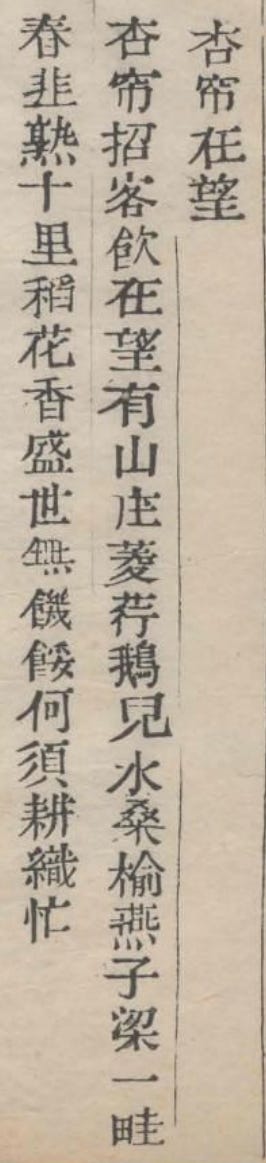
杏簾在望
杏簾招客飲,在望有山莊。菱荇鵝兒水,桑榆燕子樑。
一畦春韮熟,十里稻花香。盛世無飢餒?何須耕織忙。
Translation Notes
菱 means a water chestnut, and 荇 is a kind of water lily. Both of these are plans that grow in slow-moving water.
畦 is a measure word for a plot or bed in a vegetable garden.
韮 means garlic chives or Chinese leeks.
十里 means ten li, which is about 5 kilometers. I simplified this by calling the distance “miles,” since this is likely not intended to be a specific measurement.
The final two lines are a somewhat sarcastic reference to the fact that this particular farm is not really designed for actual farm work. This reflects Jia Baoyu’s earlier criticism of this very building:

寶玉道:「卻又來!此處置一田莊,分明是人力造作成的。遠無鄰村,近不負郭,背山無脈,臨水無源;高無隱寺之塔,下無通市之橋,峭然孤出,似非大觀。那及前數處有自然之理,得自然之趣呢,雖種竹引泉,亦不傷穿鑿。古人云『天然圖畫』四字,正恐非其地而強為其地,非其山而強為其山,即百般精巧,終不相宜。」
“There you go again!” exclaimed Baoyu. “The farm that was placed here is clearly an artificial creation. There are no other villages in the distance, and there are no city walls nearby. The mountain behind it has no connecting ridge, and the water in front of it has no natural source. There’s no pagoda above it to hint at a hidden temple, and there’s no bridge below it to suggest a market town. It’s stark and isolated, and does not belong to any grand view.
“How can this place compare with the place we just saw, which possessed the principle of nature and captured the charm of nature? Though that place had planted bamboo springs and water channels, it was not clearly man made.
“When the ancients spoke of ‘Natural Landscape Painting,’ they warned against exactly this sort of thing: forcing a landscape where it doesn’t belong, and forcing a mountain where it doesn’t fit. After all, even using every kind of craftsmanship in the end will not result in actual harmony with nature.”
We can tell that this poem was composed by Lin Daiyu because it doesn’t have any of the ornate artifice that you usually see in court poetry. It’s direct and insightful.