


The Fairyland Beyond This World
We’ve finally come to the last of the six poems from the various girls. Lin Daiyu’s poem includes a fantastic literary allusion, another fantastic example of personification, and gives us a very sharp contrast to Xue Baochai’s poem the other day. We’ll do a deeper comparison tomorrow.
My Translation
Plaque: A Fairyland Beyond This World
By Lin Daiyu
The Imperial visit brings us joy,
This fairyland is cut off from the mortal world.
Borrowing the beauty of the hills and streams,
This place takes on a brand new air.
Its fragrance is blended with the wine of Golden Valley,
The flowers smile up at our noble guests.
How fortunate we are to receive this Imperial grace!
Might the palace carriage return here frequently?
Translation Critique
Hawkes
Hawkes translates Lin Daiyu’s poem like this:
Lin Dai-yu: The Fairy Stream
To fairy haunts far from the world’s annoy
A royal visit brings double joy.
A thousand borrowed beauties here combined
In this new setting new enchantment find.
Its odours sweet a poet’s wine enrich;
Its flowers a queenly visitor bewitch.
May she and we this favour hope to gain:
That oft-times she may pass this way again!
As usual, Hawkes finds his hands tied by the requirements of the rhyme.
Note, however, that Hawkes flips the first two lines around. I’m not sure why he does this, since he could have easily said “A royal visit brings double joy / to this fairyland far from the world’s annoy” or something similar.
My biggest concern, though, is that Hawkes loses the reference to Shi Chong in line five, and completely misses the personification of the flowers in line six. In other words, the two things that make this a fantastic poem are completely gone in his translation.
Yang
The Yangs translate Lin Daiyu’s poem like this:
A FAIRYLAND FAR FROM THE WORLD OF MEN
Who knows where this illustrious garden lies?
Far from the dusty world this paradise.
Here streams and mountains lend their fair delight
Enhanced by many a novel scene and sight.
Scents heady as the wine from Golden Dell
Bind all in these jade halls with flowery spell;
Blessed by Imperial favour, we would fain
Welcome the royal visitant again.
Lin Tai-yu
The Yangs also include a footnote for the phrase “Golden Dell,” noting that this is “a celebrated garden in Honan owned by Shih Chung (249-300).”
There are some interesting changes here, mostly because of the necessity of rhyme. The first line changes from praising the imperial visit to a rhetorical question. And, unfortunately, line six changes away from having the flowers look over and greet the visitors into a type of “flowery spell” that “binds” everyone inside the hall. This is entirely an invention of the Yangs.
The final two lines are also not quite correct. Hawkes actually has the better translation here. In the Chinese original, line seven is a declaration of how fortunate they were for the Imperial visit, and line eight is a rhetorical wish that there might be another imperial visit in the future. The Yang translation makes it feel like Lin Daiyu is graciously requesting that the Imperial visitors return, and has an almost condescending feel to it.
Chinese Text
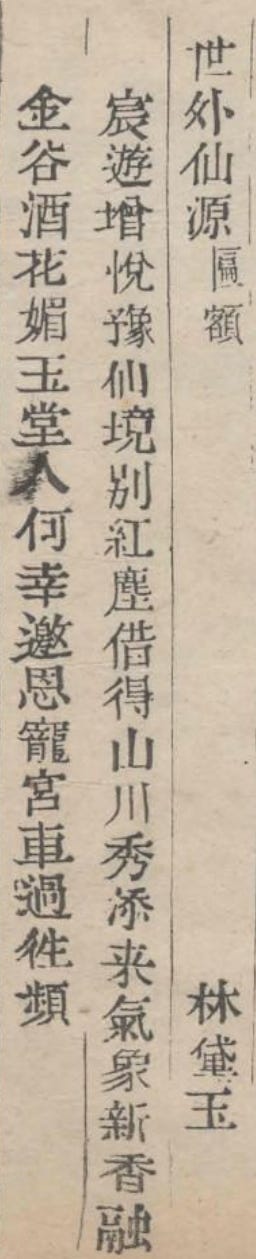
世外仙源(匾額)
林黛玉
宸遊增悅豫,仙境別紅塵。借得山川秀,添來氣象新。
香融金谷酒,花媚玉堂人。何幸邀恩寵,宮車過往頻?
Translation Notes
金谷酒 is a direct reference to Shi Chong (石崇), a wealthy person who lived in Luoyang during the Jin dynasty. Shi Chong was known for extravagant banquets and fine wine. He’s best known through the idiom 金谷酒數, which referred to a penalty of three drinks for anybody who failed to compose a poem during a literary gathering. Lin Daiyu uses this allusion here to describe the joyous atmosphere of the gathering at the Grand View garden.
花媚 is a form of personification. 媚 means “eyebrow,” and is used here as a verb that should be translated as something like “raise one’s eyebrows in a smile.”
玉堂人, or “the jade hall people,” refers specifically to Jia Yuanchun and her group from the palace.