


The Lingering Glance
We’ve got another short passage today. This one is extremely significant, however. Jia Baoyu’s overwhelming feelings for 二丫頭, or “girl number two,” says a lot about his character and a lot about the nature of this novel.
My Translation
Baoyu felt sad and bored once she left. Just then a servant sent by Wang Xifeng arrived to ask them to come into the main room.
When they went in, they saw that Xifeng had already cleaned up and had changed her clothes. She asked if Baoyu wanted to change clothes as well. Baoyu declined.
The maids brought out a tray of snacks and poured cups of fine tea. Xifeng and the others had their tea, waited while things were cleared away, and then got up and went into the carriage.
Meanwhile, Lai Wang was busy giving red envelopes willed with cash to the members of the rural family. The women quickly went over to him to express their gratitude.
Baoyu looked carefully, but did not see the girl who had demonstrated the spinning wheel. However, after they went a little bit further, he saw her.
She was holding a small child in her arms and was standing with two little girls at the edge of the village. She was staring straight at him.
Baoyu couldn’t contain his feelings. However, he was stuck inside the carriage by this point, and could only convey his overwhelming emotions by looking at her.
And then, like a gust of wind or a flash of lightning, they sped away. When he turned back, she was already gone without a trace.
Translation Critique
Hawkes
David Hawkes does a very good job here conveying Jia Baoyu’s emotions:
Bao-yu could not repress a strong emotion on seeing her, but sitting there in the carriage there was not much he could do but gaze back at her soulfully; and soon, as the carriage bowled along at a smarter pace, ertie was lost to sight for ever.
This strikes me as much better than earlier passages in The Story of the Stone, where 情 is interpreted only in a romantic sense. Baoyu’s feelings here are more than just romantic.
Yang
The Yangs translate this scene in a way that I find less satisfying:
Pao-yu longed to alight and go with her, but knowing that the others would not agree he could only follow her with his eyes as their carriage drove swiftly off. Soon she was out of sight.
This seems to emphasize Jia Baoyu’s youth more than anything else, and implies that he wanted to play with the girl and the other children. The truth is that the phrase 眼角留情 is a lot stronger than just wanting to stay behind and play. Jia Baoyu’s frustration is that the sight of this farm girl brings out an uncontrollable emotional feeling (情) within him that he simply has to express.
Chinese Text
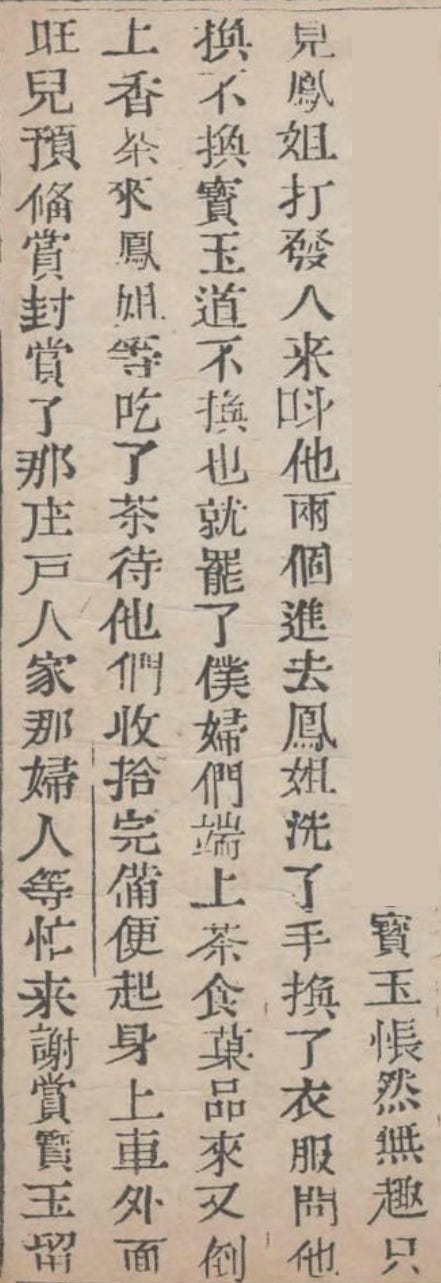
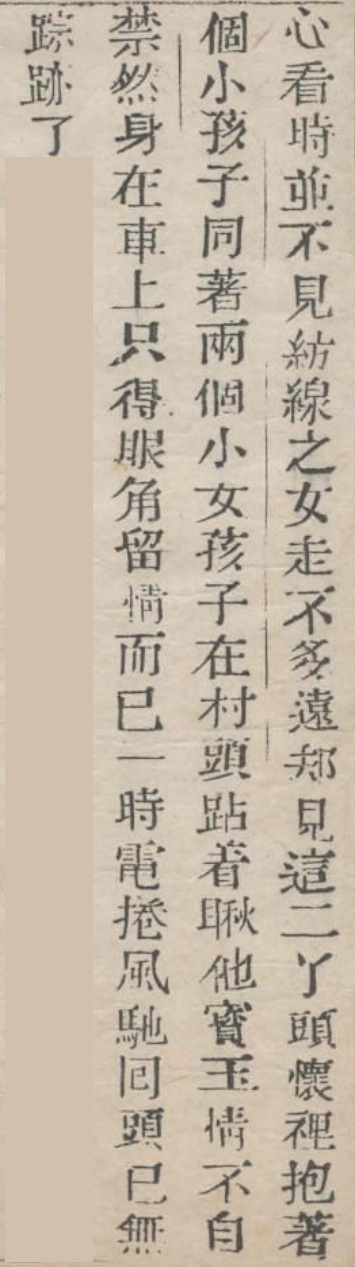
寶玉悵然無趣。只見鳳姐打發人來叫他兩個進去。鳳姐洗了手,換了衣服,問他換不換。寶玉道:「不換。」也就罷了。僕婦們端上茶食果品來,又倒上香茶來。鳳姐等吃了茶,待他們收拾完備,便起身上車。外面旺兒預備賞封,賞了那莊戶人家。那婦人等忙來謝賞。寶玉留心看時,並不見紡線之女;走不多遠,卻見這二丫頭懷裡抱著個小孩子,同著兩個小女孩子在村頭站著瞅他。寶玉情不自禁,然身在車上,只得眼角留情而已。一時電卷風馳,回頭已無蹤跡了。
Translation Notes
旺兒 seems to refer to the servant Lai Wang (來旺). We met the servant Lai Wang very briefly at the beginning of chapter 14, though the focus was honestly more on his wife than on him.
In my mind, the phrase 眼角留情 here is one of the most powerful phrases we’ve seen so far. Faced with no other choice, all Jia Baoyu can do to express the overwhelming emotion (情) that naturally wells up inside him is to try to speak with his eyes (here described as 眼角, or the corner of his eye). Remember that Jia Baoyu naturally overflows with 情, to the point where he seriously cannot control or contain himself. It’s not really that Jia Baoyu feels some sort of romantic affection for 二丫頭, though you could interpret it that way if you wanted. Rather, it seems that Jia Baoyu is romanticizing the idea of an authentic lifestyle, or even of something different than the stiflingly opulent upbringing that he has always known. More on this tomorrow.
“寶玉情不自禁,然身在車上,只得眼角留情而已。一時電卷風馳,回頭已無蹤跡了。.”
Interestingly, this line is unique among all discovered editions, including the Cheng-Jia (published one year before Cheng-Yi) edition: 「寳玉情不自禁,然身在車上,只得以目相送。一時電捲風馳,囘頭已無踪跡了。」(https://zh.wikisource.org/wiki/%E7%B4%85%E6%A8%93%E5%A4%A2%EF%BC%88%E7%A8%8B%E7%94%B2%E6%9C%AC%EF%BC%89/%E5%8D%81%E4%BA%94).
It’s 「寶玉恨不得下車跟了他去,料是眾人不依的,少不得以目相送,爭奈車輕馬快,一時展眼無蹤。」(https://zh.wikisource.org/wiki/%E7%B4%85%E6%A8%93%E5%A4%A2/%E7%AC%AC015%E5%9B%9E) in the Geng-Chen edition btw.
I don't know why would they (maybe Gao E) change this line here, but I actually prefer the later version this time. Maybe because hopping off the wagon to stay with the girl (「恨不得下車跟了他去」) sounds a bit much, even for Baoyu.
Is it "willed with cash" or "filled"?