


The Loud Plays
We’re back to more literary references. Fortunately, these are a little bit easier than the ones we previously saw.
My Translation
The visit had complete exhausted the staff of both the Ning and Rong mansions. Every single person was completely worn out, both physically and mentally. It then took another two or three days just to pack away all the display items and other things that they had set up in the garden.
Wang Xifeng was clearly the busiest out of all. She had many important duties that overwhelmed her. The others could slip away to someplace quiet for a moment or two, but Wang Xifeng simply could not get away. Besides, she was driven by her naturally competitive spirit. She couldn’t bear to give anybody a chance to criticize her, and so she forced herself to keep going, doing her best to look like nothing was wrong.
Jia Baoyu, on the other hand, was clearly the most idle and carefree out of everybody. And it just so happened that on this particular morning Hua Xiren’s mother came in person to see Grandmother Jia. Xiren’s mother told Grandmother Jia that she was taking her daughter home for New Year’s tea, and that she wouldn’t bring her back until that evening.
And so Baoyu was left to amuse himself with the maids by playing a board game. Just as he was starting to lose interest in this game, a maid came into his room to report: “Jia Zhen has sent somebody to invite you over to watch the opera and see the lanterns set out.”
Baoyu ordered the maids to help him change clothes. He was just about to leave when a gift suddenly arrived from Jia Yuanchun. This was sugar-steamed sweet milk curd. Baoyu remembered that Xiren had enjoyed this treat the last time they had it, so he ordered that it be set aside for her. Then he reported to Grandmother Jia and went to watch the opera.
Who would have thought that the plays Jia Zhen staged were Ding Lang Recognizes His Father and Huang Boyang Lays Out the Great Formation of Ghostly Souls? There was also Sun Wukong Wreaks Havoc in the Heavenly Palace and Jiang Taigong Slays the Generals and Invests the Gods. In an instant, gods and demons came swarming out; the next moment, every fiend and monster were fully revealed. And throughout all of this were processions bearing ceremonial banners and passing before the altars, as well as devotees chanting the Buddha’s name and carrying incense. The clash of gongs and drums and all the shouting was so loud that it could be heard across the lanes outside the complex. The men, all the cousins, nephews, and brothers, toasted and made pledges to each other. The women, including sisters, maids, and concubines, laughed and chatted together.
Baoyu, however, decided to wander off to amuse himself after seeing that the splendor and excitement had reached such an intolerable level. He first slipped inside to fool around for awhile with Lady You and her maids and concubines. He then exited through the inner gate.
Lady You and the others assumed that he had gone back to watch the opera, and so nobody paid much attention to him. Jia Zhen, Jia Lian, Xue Pan, and the rest were entirely absorbed in guessing riddles and drinking games, and were enjoying themselves to the fullest. Even if they noticed Baoyu hadn’t been in his seat for a while, they assumed that he had gone off somewhere inside and thought nothing of it.
As far as Baoyu’s male attendants were concerned, the older ones knew that he wouldn’t leave this sort of affair until evening, and so they took the chance to slip away. Some went off to gamble, and others went to visit relatives or friends, drinking and betting, each drifting off on his own with plans to return that night. The younger ones, meanwhile, had all squeezed into the backstage area to watch all the excitement.
Translation Critique
Hawkes
Hawkes makes a few small rhetorical changes to the beginning of this section. In Chinese it talks about how Wang Xifeng was the busiest of them all, calling her “第一個” (i.e. the busiest of all). Hawkes instead talks about how “Xi-Feng forced herself to supervise the taking down and storing away of all the decorations” and so forth, putting Wang Xifeng in as an integral part of everything happening. It’s not inaccurate, but it’s also not exactly the same as the original.
Hawkes calls the somewhat awkwardly explained board game (擲骰子趕圍棋, or “the throwing dice Go board game”) as “Racing Go,” explaining that “this was a game in which you moved your Go-piece across the board in accordance with the throw of dice, the object being to reach the opposite side before everyone else and pocket all the stakes.”
Hawkes translates the drink from Jia Yuanchun as “koumiss.” Koumiss is a kind of fermented drink made from the milk of a mare, and is common among people in the Centra Asian steppes. The name seems to come from the Russian word кумы́с, and probably originally was from an ancient Turkic language.
Yang
The Yangs translate the mysterious game as “dice or draughts.” Draughts is actually an alternative name for the game checkers, and seems to be common in the United Kingdom.
Chinese Text
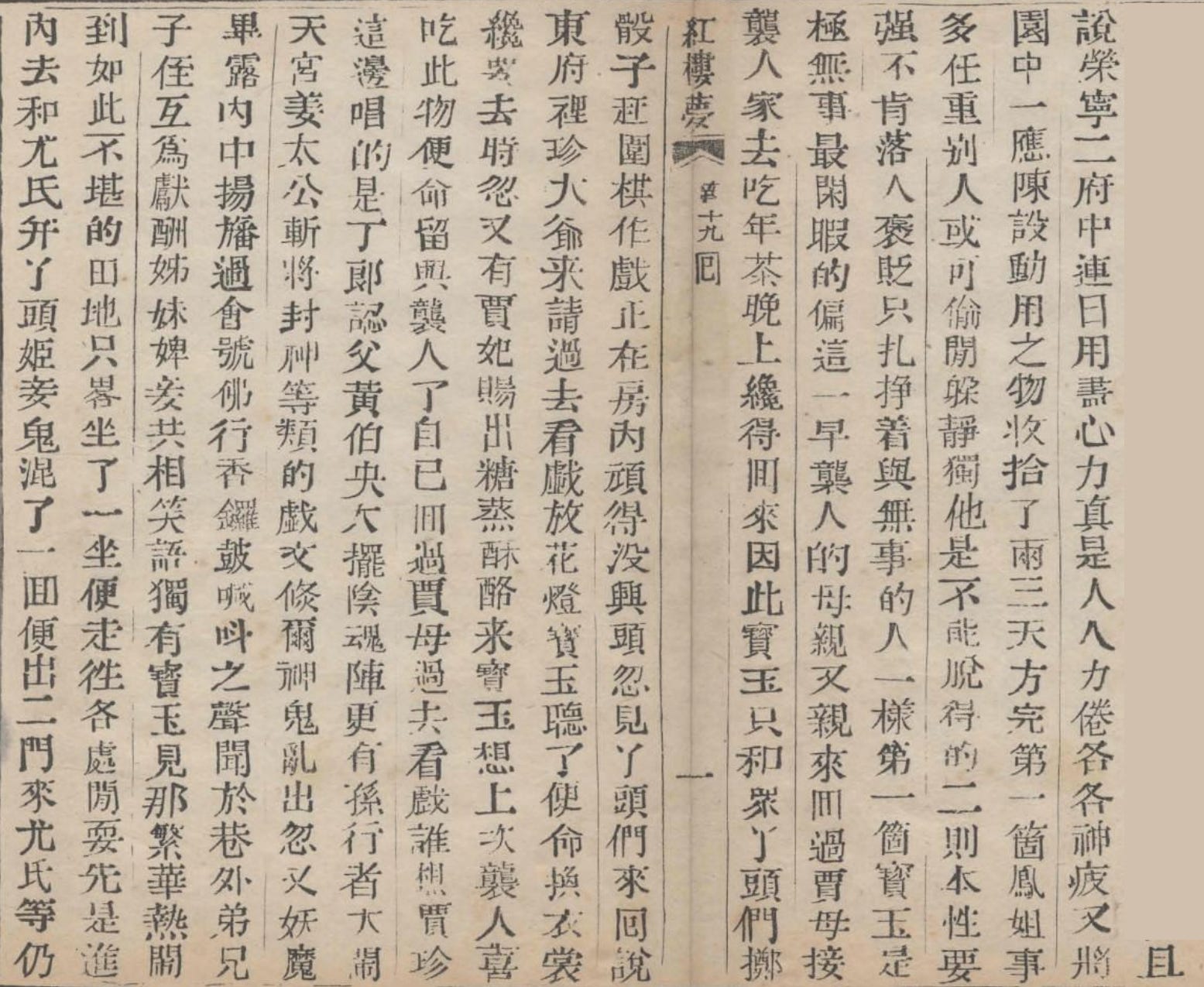
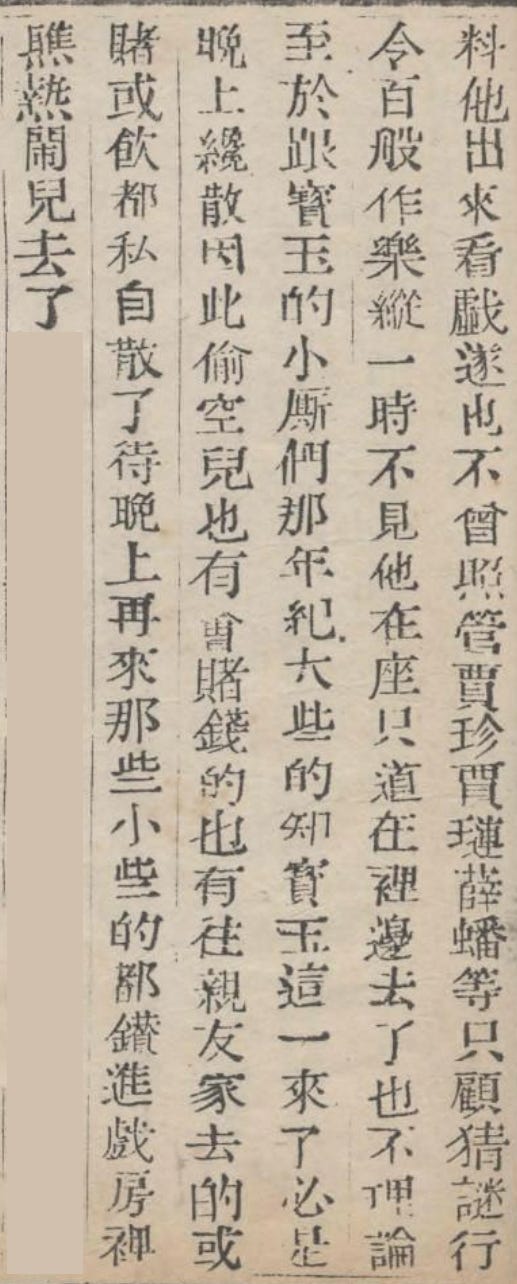
且說榮寧二府中連日用盡心力,真是人人力倦,各各神疲,又將園中一應陳設動用之物,收拾了兩三天方完。第一個鳳姐事多任重,別人或可偷閒躲靜,獨他是不能脫得的;二則本性要強,不肯落人褒貶,只扎掙著,與無事的人一樣。第一個寶玉是極無事最閒暇的。偏這一早,襲人的母親又親來回過賈母,接襲人家去吃年茶,晚上才得回來。因此,寶玉只和眾丫頭們擲骰子趕圍棋作戲。正在房內頑得沒興頭,忽見丫頭們來回說:「東府裡珍大爺來請過去看戲,放花燈。」寶玉聽了,便命換衣裳。才要去時,忽又有賈妃賜出糖蒸酥酪來。寶玉想上次襲人喜吃此物,便命人留與襲人了,自己回過賈母,過去看戲。
誰想賈珍這邊唱的是《丁郎認父》、《黃伯央大擺陰魂陣》,更有《孫行者大鬧天宮》、《姜太公斬將封神》等類的戲文,倏爾神鬼亂出,忽又妖魔畢露。內中揚旛過會、號佛行香,鑼鼓喊叫之聲,聞於巷外。弟兄子侄,互為獻酬;姊妹婢妾,共相笑語。獨有寶玉,見那繁華熱鬧到如此不堪的田地,只略坐了一坐,便走往各處閒耍。先是進內去和尤氏並丫頭姬妾鬼混了一回,便出二門來。尤氏等仍料他出來看戲,遂也不曾照管。賈珍、賈璉、薛蟠等只顧猜謎行令,百般作樂,縱一時不見他在座,只道在裡邊去了,也不理論。至於跟寶玉的小廝們:那年紀大些的,知寶玉這一來了必是晚上才散,因此偷空兒,也有會賭錢的,也有往親友家去的,或賭或飲,都私自散了,待晚上再來;那些小些的,都鑽進戲房裡瞧熱鬧兒去了。
Translation Notes
Notice in Chinese that the phrase 第一個 (the first) is repeated twice. Basically, this means that nobody among those who were busy was as busy as Wang Xifeng. Similarly, nobody among those who were lazy was as lazy as Jia Baoyu.
扎掙 means to move on with difficulty or to barely be able to physically support oneself. Wang Xifeng is described as just barely being able to handle her many duties, as if the magnitude of her tasks were taking a very literal physical toll on her.
年茶, or the “New Year tea,” was a ritual that was part of the Lantern Festival observances.
擲骰子趕圍棋 is a description of a dice based board game using Weiqi (or “Go,” 圍棋) chess pieces.
The four operas were all loud and percussion driven plays, and served a big contrast to the more refined plays that the family had performed for Jia Yuanchun during her visit.
丁郎認父, or Ding Lang Recognizes His Father, was a melodrama set in the Ming dynasty. It features a young man whose family is destroyed by a corrupt politician. He grows up and identifies his father, who had long since been exiled, by means of a broken mirror token that his mother had given him when he was young. Actually, this play includes no gods or demons at all, and seems to be the odd one out in this list.
黃伯央大擺陰魂陣, or Huang Boyang Lays Out the Great Formation of Ghostly Souls, told the story of a military master who traps a rival in a soul-snatching illusion. Cao Xueqin’s naming here has a few problems; the actual play seems to have been called 迷魂陣, or The Bewildering Soul Formation.
孫行者大鬧天宮, or Sun Wukong Wreaks Havoc in the Heavenly Palace, comes straight from chapters 3 through 7 of Journey to the West (西遊記). Sun Wukong rebels, names himself the Great Sage Equal to Heaven, and storms the celestial palace.
姜太公斬將封神, or Jiang Taigong Slays the Generals and Invests the Gods, tells the story of how the Grand Duke Jiang slayed his opposing generals in battle. Then he canonizes the dead, both allies and enemies, as Gods of the Chinese pantheon.
The point Cao Xueqin seems to be making here is that this sort of entertainment is a much better reflection of the actual interests of the Jia family. These are all loud and vulgar plays, sort of like the equivalent of watching action movies in the White House.