


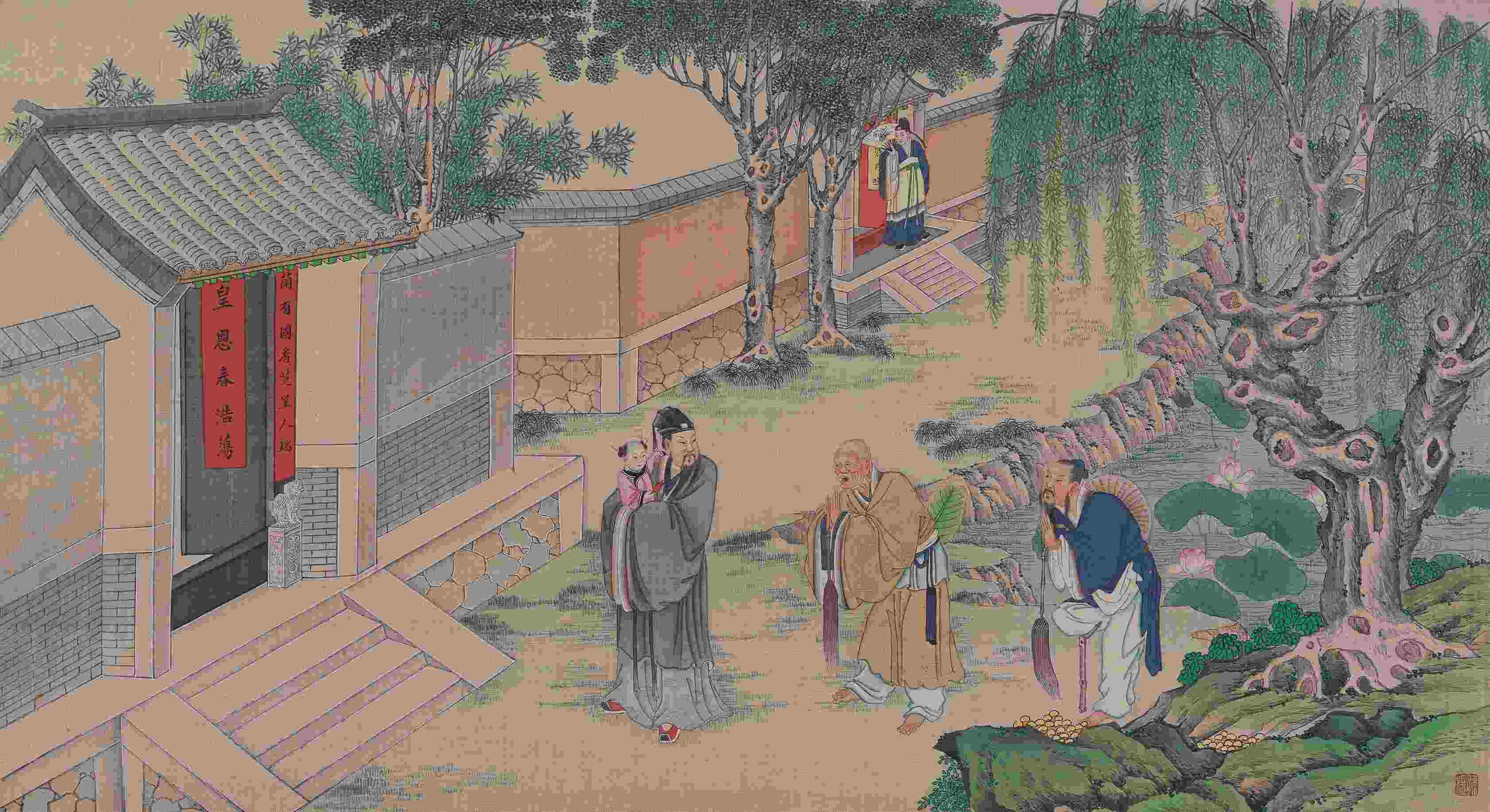
Dream of the Red Chamber opens with a Buddhist monk and a Taoist priest walking along together, laughing and talking, until they stop to chat with a stone.
In English, a monk and a priest walking along together is how a joke starts. In this novel, it’s how the whole story starts. The two of them carry the stone down into the world, and the stone becomes the hero of the book. They also keep turning up, in disguise, for the next twenty chapters, and every time they do, something important happens.
So who are they? And why would a novel pair a Buddhist with a Taoist? The answer says a lot about how Qing dynasty China saw religion. It says even more about what the book itself thinks.
Who they are
In the first chapter, the two go by grand titles: the Vast Master (茫茫大士), a Buddhist monk, and the Ethereal Sage (渺渺真人), a Taoist priest. Up in the heavens, they look like immortals. When they come down to earth, they look like beggars. The monk has a scabby head and bare feet. The priest is lame, with his hair in a tangle. The people who meet them think they’re crazy.
Here’s where they show up in the first twenty-two chapters:
Chapter 1: they tell Zhen Shiyin to give up his little daughter. He refuses. Later, after he loses her and nearly everything else, the lame priest comes by singing a song about how everything good comes to an end, the Hao-Liao Song. Shiyin takes the priest’s bag on his shoulder and walks away with him for good.
Chapter 3: Lin Daiyu remembers a scabby-headed monk who came to her house when she was three and wanted to take her away to become a nun.
Chapters 7 and 8: Xue Baochai’s strange medicine, the Cold Fragrance Pill, came from a monk. So did the words engraved on the gold locket she wears.
Chapter 12: the lame priest hands Jia Rui a magic mirror and warns him to look only at the back of it.
So two of the novel’s three heroines owe something to the monk, and one of its first characters walks off into the world with the priest. These two aren’t scenery.
Why a monk and a priest go together
To see why the book pairs them, you have to know how religion worked in a family like the Jias.
Qing China had three teachings: Confucianism, Buddhism and Taoism. Confucianism ran the family and the government. It told you how to treat your parents, how to study for the exams and how to run a household. But Confucius didn’t have much to say about what happens after you die, how to cure a strange illness or what your fate holds. For those, people went to Buddhist monks and Taoist priests, and most families saw no reason to choose between them.
The novel shows this on a grand scale in Chapter 13, at Qin Keqing’s funeral. The Jias hire 108 Buddhist monks to chant in the main hall for forty-nine days. They also hire 99 Taoist priests to hold their own rites in a separate tower. Nobody in the book finds that strange. If one set of prayers is good for the dead, two are better.
So a monk and a priest walking together would have looked perfectly normal to Cao Xueqin’s readers.
But that only explains why the pair makes sense in Qing China. It doesn’t tell us what the novel thinks of them. And on that question, the book is a lot less polite than its characters.
The rest of this post is for members. For $5 a month you get every passage of the translation, the weekly podcast and every post like this one, and you help fund a complete modern translation.
