


The Naming War
With this passage, we’re starting to get into the poetic heart of Dream of the Red Chamber. We’ve got a lot more stuff like this to come. Here Cao Xueqin shows us Jia Baoyu’s genius for poetry and contrasts it in an interesting way with the scholars that surround Jia Zheng.
My Translation
Coincidentally, Jia Baoyu was so saddened by the loss of Qin Zhong that Grandmother Jia had some of the servants take him to the new garden to amuse himself. He had only just entered when he saw Jia Zhen approaching.
“Shouldn’t you run off?” asked Jia Zhen with a grin. “Your father will be here any minute now!”
When he heard this, Baoyu ran out of the garden like a wisp of smoke, with his old nursemaid and a few servants flanking him. But, just as he turned the corner, he ran straight into Jia Zheng, who was walking together with his group of scholars. There was no way to avoid them in time, and so Baoyu had no choice but to move to the side and stand respectfully.
Now, Jia Zheng had recently heard from Dai Rui that Baoyu was particularly good at composing poetry, particularly matching couplets. Though Baoyu wasn’t all that fond of studying, he still had a certain unorthodox cleverness. And so Jia Zheng ordered Baoyu to follow him into the garden, hoping to test out the boy’s skills.
Baoyu had no idea what was going on, but had no choice but to go along anyway. Once they reached the garden gate, they saw Jia Zhen standing there with a number of servants lined up to his side.
“Close the gate,” said Jia Zheng. “Let’s look over the outside first, and then we’ll go in.” Jia Zhen ordered the gate shut.
Jia Zheng first stood upright and gazed at the fence. He saw that there were five bays on top of the main gate, and that the roof was covered with cylindrical tiles that formed a ridge shaped like the back of a mudfish. The door frames, railings, and lattice windows were all exquisitely carved in the latest fashion, and yet they had no vermilion or painted adornment. The surrounding walls were all made of polished, smoothly ground stone. The white marble steps below those walls were carved with a passionflower motif. When he looked left and right, Jia Zheng saw plastered walls as white as snow, with their lower areas being made of tiger-skin stone in a texture pattern, avoiding the ostentation of more common wealthy people. Jia Zheng was delighted by this, and ordered that the gate be opened.
He immediately saw a green mountain screen before him, blocking his view. “What a great mountain!” exclaimed the resident scholars spontaneously.
“If it weren’t for this mountain,” pontificated Jia Zheng, “every scene in the garden would be fully exposed to the eye as soon as we entered. Where would the pleasure be in that?”
“Perfectly true!” agreed the scholars. “Unless they had great hills and valleys in one’s own breast, how could anyone have even thought of this?”
They then looked straight ahead and saw jagged white rocks piled up in rugged peaks. Some looked like demons and goblins and others looked like fierce beasts. They stood in a crisscrossing formation in front of the men. Mottled moss covered the stones, draped here and there with vines and other foliage. A narrow winding path was faintly visible in the middle of the scenery.
“Let’s continue our tour on this little path,” said Jia Zheng. “When we return we can come out the other side. This way we’ll be able to see everything thoroughly.”
He then ordered Jia Zhen to lead the way, and took Baoyu by the hand himself. And so they wound their way into the mountain pass.
Looking up, they suddenly caught sight of a smooth, mirror-like white stone on the mountain. This was precisely the spot that had been left open for an inscription.
“Gentlemen,” said Jia Zheng as he turned back with a smile, “what name would be most fitting to inscribe here?”
The men accompanying him all responded. Some proposed “Layered Emerald.” Others suggested “Brocade Screen.” Still others offered names such as “Rival of the Incense Burner” or “Lesser Zhongnan.” Dozens of names and variations were put forward.
Now, the truth was that every one of those men knew that Jia Zheng had intended to test Baoyu’s literary talent. And therefore they deliberately had put forward these trite and hackneyed suggestions to go through the motions.
But Baoyu also understood this perfectly well.
When Jia Zheng heard those recommendations, he turned around and asked Baoyu to come up with a proposal.
Baoyu said, “I’ve often heard that the ancients said ‘Making something new is never as good as drawing upon the old; carving in the modern style can never surpass ancient inscriptions.’ And besides, this spot is not the main peak or the principal view of the garden. There’s nothing here that cries out for a formal title. This is really just a preliminary step that leads further into the scenery.
“I think it would be best to inscribe an old line from the ancients: ‘A winding path leads to a secluded spot.’ That would be proper and dignified.”
“Exactly right!” exclaimed everyone around him as they heard this. “Amazing! Jia Baoyu has a naturally high level of intelligence and literary gifts that far exceed our own. He’s far beyond those of us who have read the old books until they’ve gone stale!”
“Don’t give him too much praise,” laughed Jia Zheng. “He’s still young, and can use his limited knowledge to an unusual extent. It’s really only for fun. Let’s wait and make the final selection later.”
Translation Critique
Hawkes
We see a bit more of David Hawkes’ wordy nature in this passage. For example, he describes how Jia Baoyu “nevertheless possessed a certain meretricious talent for versification not undeserving of commendation.” The Chinese original simply says 卻有些歪才, or that Jia Baoyu had a certain unusual cleverness. Hawkes is correct that this description refers to how Jia Baoyu could create poetry; however, the Chinese original is not as formal or as wordy as the Hawkes translation.
When Jia Zhen remarks on the hill that blocks his view, Hawkes describes that “Jia Zheng somewhat otiosely observed” how excellent the screen was. Otiosely means perfunctorily, or doing something with no real reason or out of boredom. The idea here is apparently that Jia Zheng is only being polite when he makes this remark.
When the attendants propose names for the inscription, Hawkes provides a little bit of explanation:
Another proposed that they should call it ‘Little Censer’ after the famous Censer Peak in Kiangsi.
However, Hawkes makes no reference to the famous Li Bai poem, nor does he offer any context for the “Little Zhong-nan” suggestion that comes afterwards.
Meanwhile, Hawkes correctly and helpfully notes that Jia Baoyu’s “Pathway to Mysteries” suggestion comes from a Chang Jian poem.
In the end, Hawkes has Jia Zheng say “we shall have to think of a better name later on” rather than saying that they would select the most appropriate name later. It’s kind of a minor point, though I think it’s pretty significant.
Yang
The Yangs have the group around Jia Zheng comment that “only a bold landscape gardener could have conceived this” when they see the screen. This is a little bit misleading, since this group is actually fawning on Jia Zheng, not on the man that he hired to design the garden.
The Yangs provide footnote explanations for the two literary allusions that the men around Jia Zheng propose (“The Censer” and “A Miniature Chungnan”). However, they don’t include any footnote for the Chang Jian poem that Jia Baoyu cites.
Chinese Text
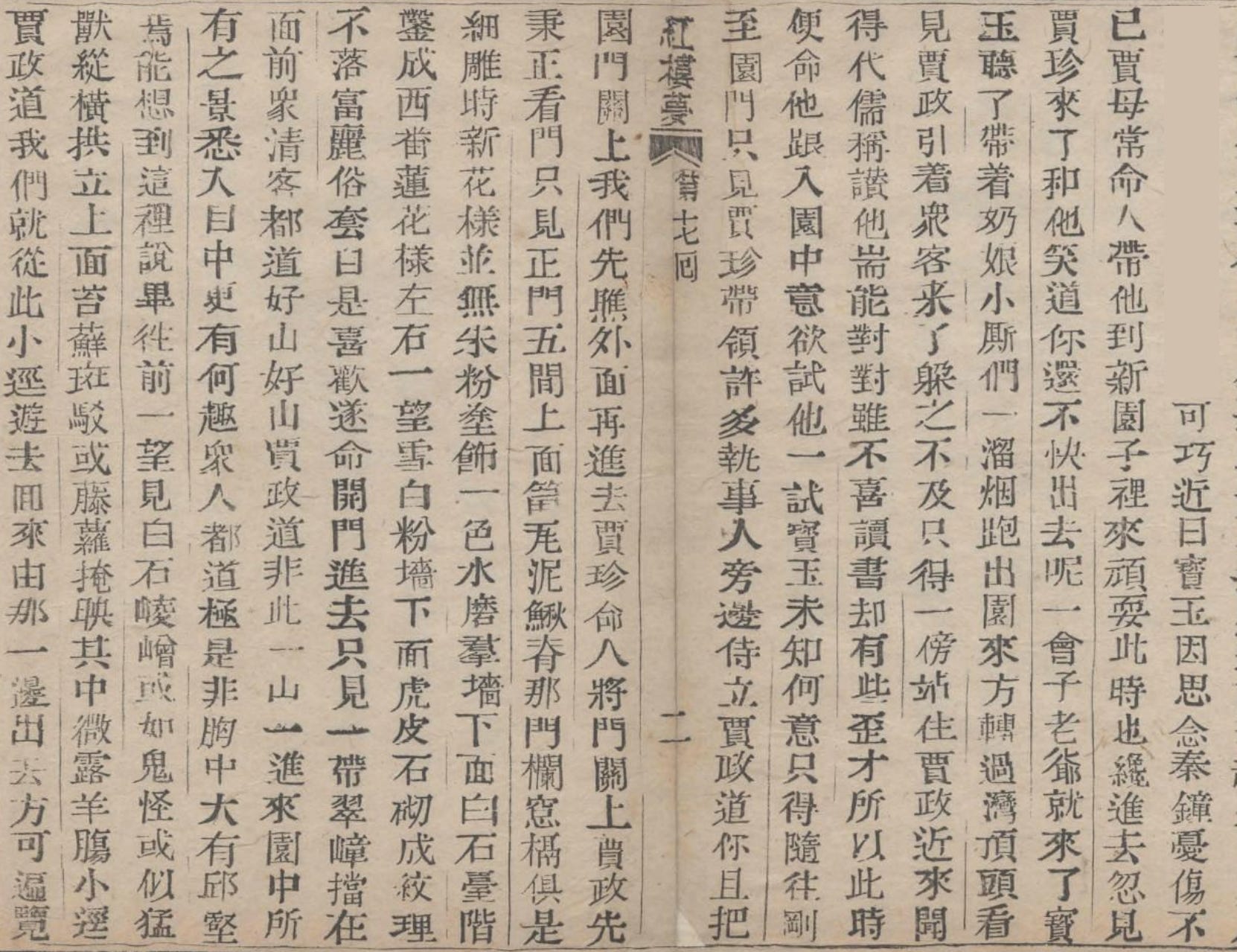
可巧近日寶玉因思念秦鍾,憂傷不已,賈母常命人帶他到新園子裡來玩耍。此時也才進去,忽見賈珍來了,和他笑道:「你還不快出去呢,一會子老爺就來了。」寶玉聽了,帶著奶孃小廝們,一溜煙跑出園來。方轉過彎,頂頭看見賈政引著眾客來了,躲之不及,只得一旁站住。
賈政近來聞得代儒稱讚他專能對對,雖不喜讀書,卻有些歪才,所以此時便命他跟入園中,意欲試他一試。寶玉未知何意,只得隨往。剛至園門,只見賈珍帶領許多執事人旁邊侍立。賈政道:「你且把園門關上,我們先瞧外面,再進去。」賈珍命人將門關上。
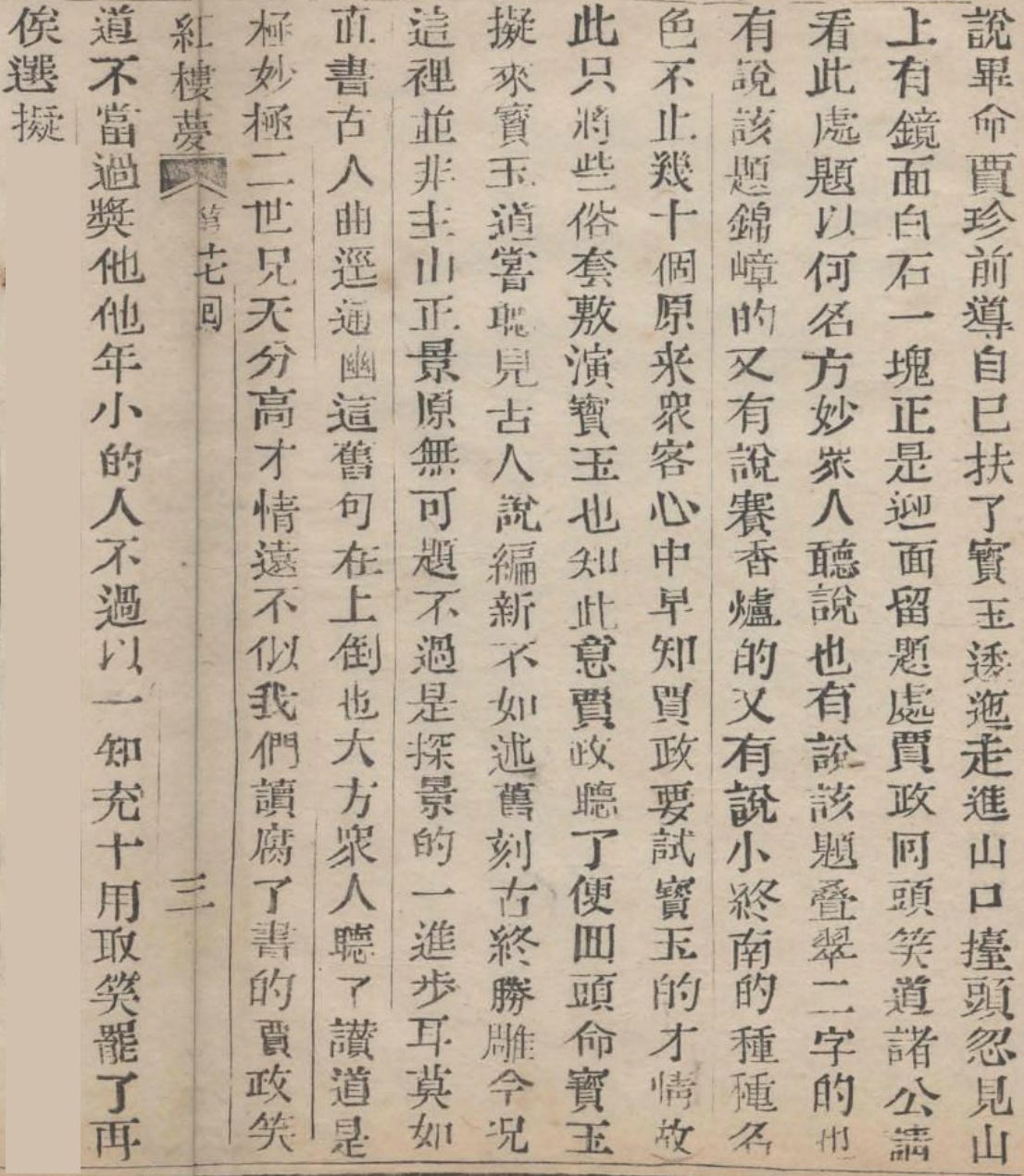
賈政先秉正看門。只見正門五間,上面筩瓦泥鰍脊;那門欄窗槅俱是細雕時新花樣,並無朱粉塗飾,一色水磨群牆;下面白石臺階,鑿成西番蓮花樣;左右一望,雪白粉牆,下面虎皮石砌成紋理,不落富麗俗套。自是喜歡,遂命開門進去。只見一帶翠嶂,擋在面前。眾清客都道:「好山,好山!」賈政道:「非此一山,一進來,園中所有之景悉入目中,更有何趣?」眾人都道:「極是。非胸中大有邱壑,焉能想到這裡!」說畢,往前一望,見白石崚嶒,或如鬼怪,或似猛獸,縱橫拱立。上面苔蘚斑駁,或藤蘿掩映,其中微露羊腸小道。賈政道:「我們就從此小徑游去,回來由那一邊出去,方可遍覽。」說畢,命賈珍前導,自己扶了寶玉,逶迤走進山口。抬頭忽見山上有鏡面白石一塊,正是迎面留題處。
賈政回頭笑道:「諸公請看,此處題以何名方妙?」眾人聽說,也有說該題「迭翠」二字的,也有說該題「錦嶂」的,又有說「賽香爐」的,又有說「小終南」的,種種名色,不止幾十個。原來眾客心中早知賈政要試寶玉的才情,故此只將些俗套來敷衍,寶玉也知此意。
賈政聽了,便回頭命寶玉擬來。寶玉道:「嘗聽見古人說:『編新不如述舊,刻古終勝雕今。』況這裡並非主山正景,原無可題,不過是探景的一進步耳,莫如直書古人『曲徑通幽』這舊句在上,倒也大方。」眾人聽了,讚道:「是極!妙極!二世兄天分高,才情遠,不似我們讀腐了書的!」賈政笑道:「不當過獎他。他年小的人,不過以一知充十用,取笑罷了,再俟選擬。」
Translation Notes
對對 might seem a little bit confusing at first. This refers to the traditional art of composing parallel poetic couplets, which is actually something that we see a lot of in this book. The idea was naturally to compose those parallel poems on the spot.
歪才 means something like “unorthodox talent.” 歪 means slanted or crooked.
秉正 means to be upright
五間 refers to five “bays” that comprise the width of a building. A “bay” (間) is basically the horizontal distance between two adjacent columns on the front facade of the building. So, if you had a building with five of these bays, you’d have six columns; the “bay” is basically the space between each column. In the Qing dynasty, officials and nobles would have five bays to their buildings; commoners would have three, princes would have seven, and the Emperor would have nine or eleven for the most grand halls.
筩瓦 refers to semicircular tiles on the top of a roof. Since these tiles are gathered together in a way that resembles the back of a mudfish (泥鰍), you can imagine that they’re fairly round and aren’t just square.
水磨 refers to a finishing technique common in Qing dynasty architecture for high quality construction. After laying down the masonry, the craftsmen would grind the surface with stones to achieve a very smooth and flat finish. They’d often use water as a sort of lubricant, which explains why this was called “water polishing,” or 水磨.
虎皮石, or “tiger-skin stone,” refers to a sort of rustic and naturally variegated stone. This stone usually was a kind of yellowish brown with darker colored streaks running through it. They called it “tiger skin stone” because the color and stripes made it look something like the coat of a tiger.
This talk about 不落富麗俗套, or avoiding the vulgar cliché of wealthy ostentation, goes back to the earlier statement about the lack of bright colors and excessive ornamentation. The idea behind using things like “tiger-skin stone” is that it looked and felt natural as opposed to being purely ostentatious. This reflects the “雖由人作,宛自天開” principle of classical Chinese garden design, which means something like “although it was made by man, it ought to seem like it was divinely created.”
翠嶂 refers to a verdant green visual screen that serves to block the scenery (障景). This is actually pretty common in older Chinese garden architecture, and you’ll see this if you have the chance to visit some of the more famous gardens that still exist in China. The idea here is that the designer would force you to follow a certain visual path once you enter the garden instead of seeing every single thing at once. The idea is that there’s a ton of depth that awaits you, but that the immense grandeur of the scene ahead will only be unfolded to you a bit at a time, instead of overwhelming you with everything at once. If you spend a lot of time with Chinese poetry, literature (including Dream of the Red Chamber), and art, you’ll notice that this concept appears over and over again. There are a lot of deep and complex ideas and concepts that are deceivingly simple at first glance.
The phrase 胸中大有邱壑 (one having great hills and valleys in one’s own breast) refers to an old Chinese idiom that reads 胸中有丘壑. This was a compliment to landscape painters, implying that they had already internalized the entire natural world, including every mountain peak, every stream, and every valley, long before their brush ever touched canvas. It basically means to have a grand vision and profound strategic thinking, and it’s a complement aimed directly at Jia Zheng.
Of course, this is a phrase that is designed to overly flatter Jia Zheng. Remember that Jia Zheng did not actually design the garden; rather, he used a professional designer to create this design. Additionally, the idea of using a scene blocking and delayed revelation technique was actually extremely common in classical Chinese works of art and literature; in fact, if you were to look at 10 random pieces of Chinese art, you’d likely discover hints of this concept in every single one of them. Praising Jia Zheng for this achievement is extremely sarcastic, though he can’t tell.
逶迤 means winding or meandering.
迭翠, or Layered Emerald, is a pretty stock phrase for any green mountain or hill. It could apply to just about any garden out there.
錦嶂, or Brocade Screen, is another relatively safe and conventional name. 錦, or “brocade,” signifies colorful and rich vegetation in this sense; you can think of all the plants forming together as if they were woven.
賽香爐, or Rival of the Incense Burner, refers to the famous Incense Burner Peak (香爐峰) in Jiangxi Province. 賽, or course, means to compete or contest, or, as an adjective, something like “competitor” or “rival.” The name 香爐峰 was made famous by this Li Bai poem:
日照香爐生紫煙,遙看瀑布掛前川。
飛流直下三千尺,疑是銀河落九天。
Sunlight shines of Incense Burner Peak, giving birth to a purple mist.
From a distance, I see the waterfall hanging before the river.
Flying waters plunge three thousand feet straight down.
One might suspect that the Milky Way has fallen from heaven.
Like many of Li Bai’s poems, this is incredibly famous, to the point of being somewhat hackneyed. This is precisely why the scholar recommended this name: it’s an attempt to set up Jia Baoyu to see what brilliance he can come up with, almost like a baseball pitcher serving up a fat and juicy pitch to see what the batter will do with it.
Similarly, the name 小終南 (Lesser Zhongnan) refers to Mount Zhongnan (終南山), a famous retreat for hermits and Daoist immortals and a place of spiritual cultivation. It would be like calling the park behind your house “Little Yellowstone.”
When Baoyu says 編新不如述舊,刻古終勝雕今 (making something new is not as good as drawing upon something old, and the modern style of carving will never be as good as the ancient), he’s not necessarily saying something extremely conservative. Instead, his argument is that an apt quotation from an old and revered poet would carry cultural weight that would always surpass any new phrase or poetic turn. In other words, the idea here is to transform the past to fit the present, not to come up with something entirely new. Of course, the irony is that none of the titles that Jia Zheng’s people proposed were anything new anyway.
曲徑通幽 (a winding path leads to a secluded spot) comes from an old poem by Chang Jian (常建) of the Tang dynasty:
曲徑通幽處,禪房花木深。
A winding path leads to a secluded spot;
The meditative hall lies deep among flowers and trees.
By using this simple line, Jia Baoyu accurately describes the physical scene (the winding path among the natural beauty), lends literary prestige to the spot (by associating it with the quiet and contemplative atmosphere of a Buddhist monastery), and shows off his learning without being boisterous by quoting and attributing the phrase to the ancients. This is an excellent example of the principle he just mentioned, which is drawing upon something old and showing how it fits with a new concept.
If you’re familiar with the Chinese language, you’ll recognize right away that the language itself reflects this general concept. Older set phrases and idioms are constantly in modern use, as if the history of the language never really died off or changed. It’s the same idea: true learning comes from taking great ideas and thoughts of the past and using them in new environments.
一知充十用 literally means “use one piece of knowledge to fill up a measure of ten.” The idea is that a little bit of knowledge is expanded and stretched to turn into something impressive.
Truly appreciate your extensive notes! This is one of the passages dense with cultural details where I get frustrated with Hawkes lack of footnotes.