


The Tragedy
This is a very meaningful and insightful passage. If you read most of the English translations of Dream of the Red Chamber, however, you won’t feel the full impact of this section. More on that tomorrow.
My Translation
By this time, Wang Xifeng had already received Yun Guang’s reply. Everything had been settled. Jingxu informed the Zhang family of the outcome. There was nothing that the Brigadier could do, and so he swallowed his pride and accepted the return of the engagement gifts.
Who would have thoughts that parents who loved power and wealth would manage to raise a daughter who knew what was right and treasured love above all? When she heard that she would not be marrying the son of the Brigadier after all, and that she was going to join the Li household, she quietly took a sash and ended her own life.
And who would have thought that the son of the Brigadier also had a pure heart? When he heard that the girl had taken her own life, he threw himself into the river and drowned.
Unfortunately, the Zhang and Li families were both humiliated. In the end, both families lost both the girl and the money.
Meanwhile, Wang Xifeng was able to enjoy her three thousand taels without any regrets. And Lady Wang didn’t know a single thing about the whole affair.
From this point on, Xifeng became even more bold. The things she went on to do, following this pattern and exceeding it, are beyond counting.
Translation Critique
Hawkes
For some reason, David Hawkes decides to remind us here that Yun Guang was replying to a “bogus letter” that he supposed came from Jia Lian. I’m not sure why Hawkes decided to include this note, since the legitimacy or lack of legitimacy of the letter Wang Lai gave to Yun Guang doesn’t really matter. The point here is not to criticize Wang Xifeng for thinking up a clever way to solve the problem and get some extra money. Rather, the point here is the callous way that the three families involve treat the feelings of their children.
Hawkes uses the word affianced to describe the girl’s earlier fiance. Affianced is a rare adjective that means “engaged” or “betrothed.”
Hawkes translates 情種 as “a young person of unexpectedly romantic notions,” which is really not a good translation. More on this in tomorrow’s commentary post.
Hawkes translates 人財兩空 as “the maid and eke the money gone.” Eke is an archaic English word that means “also” or “in addition to.” Meanwhile, 人財兩空 is a common idiom and has nothing to do with any classical poems.
I’m going to go out on a limb and say that Hawkes’ translation here is simply poor, and that he’s obfuscating the actual power of the passage in question. I think he wanted to dress this up in archaic language and with a false archaic reference for a certain effect. However, in the end it’s all extremely confusing and distracts the reader from the power of the story.
Yang
The Yangs translate 知義多情 as “principled and feeling.” “Feeling” feels kind of like an odd adjective to use in this context, though at least the meaning is clear.
Chinese Text
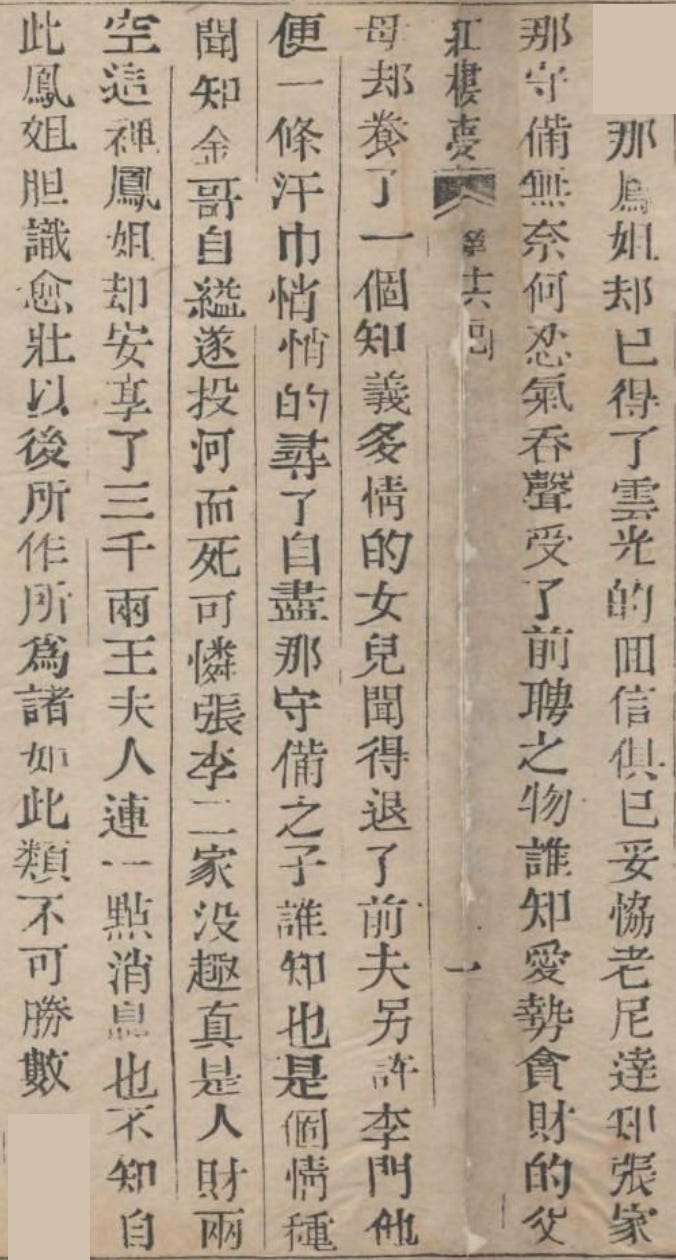
那鳳姐卻已得了雲光的回信,俱已妥協。老尼達知張家,那守備無奈何,忍氣吞聲,受了前聘之物。誰知愛勢貪財的父母,卻養了一個知義多情的女兒:聞得退了前夫,另許李門,他便一條汗巾,悄悄的尋了自盡。那守備之子誰知也是個情種,聞知金哥自縊,遂投河而死。可憐張李二家沒趣,真是「人財兩空」。這裡鳳姐卻安享了三千兩。王夫人連一點訊息也不知。自此,鳳姐膽識愈壯,以後所作所為,諸如此類,不可勝數。
Translation Notes
妥協 normally means to compromise, though here it seems to mean to come to terms or to settle the problem.
忍氣吞聲 means to suppress your anger and quietly bear a humiliation
自盡 means to take your own life.
The word 情種 is a reference to the first line of the “Prelude to Dream of the Red Chamber” in chapter 5:
紅樓夢引子
開闢鴻蒙,誰為情種?
Prelude to The Dream of the Red Chamber
At the dawn of creation, who sowed the seed of emotion?
See more here:

Of course, it doesn’t make much sense in English to say that the boy “sowed the seed of emotion,” which is why I’ve translated this text this way.
自縊 means to hang oneself.
沒趣 normally means that something is not fun or interesting. Here it seems to refer to both families being embarrassed or put in an awkward position.
人財兩空 (they lost both the person and the money) might seem odd here. The Zhang family received the engagement gifts back, but wound up paying the 3,000 taels that ended up with Wang Xifeng in the end. Meanwhile, the Li family had already given up the engagement gifts for a girl who wound up taking her own life. It’s a pretty sarcastic statement, and highlights the fact that these families really didn’t care about what their young people thought or wanted. The entire affair winds up looking completely transactional.
Meanwhile, 人財兩空 is a common idiom that means “to lose both people and money.”
膽識 means courage and insight.
"she quietly took a sash and ended her own life" I presume this means she hang herself?