


The Young Phoenix
This is a long passage, but is one of my favorites. The literary allusion here is simply great.
My Translation
Chapter 15
Wang Xifeng Abuses Her Power at the Iron Threshold Monastery;
Qin Zhong Finds Pleasure in the Steamed Bun Convent
After he approached the carriage and lifted his eyes, Baoyu saw that the Prince of Beijing, Wang Shirong, wore a white official cap with a silver pin and tassel and silver-tipped wings on his head, along with a white ceremonial dragon robe with wavy borders embroidered with the insignia of a dragon with five claws, as well as a scarlet leather belt inlaid with jade. His face was like beautiful jade, and his eyes looked like bright stars. He was an extremely handsome man.
Baoyu hurried forward to pay his respects. When Shirong reached out from his chair to help Baoyu up, he saw that Baoyu was wearing a silver headdress that gathered up his hair, a headband with a twin-dragons-rising-from-the-sea design, a white arrow-sleeved dragon robe, and a silver belt dotted with pearls. His face was like a spring flower, and his eyes were like dots of paint.
“You live up to your reputation,” said the Prince of Beijing with a smile. “Like your name, you truly are precious and a jewel! Where is that precious jewel that came in your mouth?”
Baoyu responded by quickly taking it from inside his clothes and handing it over. The Prince looked closely at it, read the characters inscribed on it aloud, and asked, “Does it really work as well as they say?”
“Though they say it works,” replied Jia Zheng, “we’ve never tried it yet.”
The Prince commented on how amazing the jade was as he smoothed out its silk cord and placed it back on Baoyu’s neck. He then held Baoyu’s hand and asked him how old he was and what books he was currently studying. Baoyu answered every question clearly.
The Prince saw that Baoyu’s speech was clear and that he was well spoken. He turned to Jia Zheng with a smile. “Your esteemed son is truly brilliant and promising! I don’t mean to be presumptuous in your venerable presence, but surely one day ‘the young phoenix will sing more clearly than the old.’ His future will surely be beyond all measure.”
“How could my dog of a son accept such an undeserved golden compliment? And yet, if things were to turn out as Your Grace has so benevolently suggested, it would indeed be a great blessing to the younger generation.”
“Only one more thing,” replied the Prince. “With such natural gifts, it’s clear that your honored son must be the apple of his revered grandmother’s eye. And yet we of the later generation are not well served by excessive indulgence, for excessive indulgence surely will lead to the neglect of our studies. I myself once fell into this very trap, and I suspect that your esteemed son will also do likewise.
If he finds it difficult to apply himself at home, he should come frequently to my humble residence. Though I am a man of little account, I am fortunate that none of the renowned scholars of the empire who pass through the capital fail to extend their favorable regard towards me. Accordingly, my humble abode is a gathering place for men of exceptional talent. If your esteemed son were to come often to converse and meet with them, his learning would certainly progress daily.”
“Of course,” replied Jia Zheng with a deep bow.
The Prince then removed a string of beads from his wrist and handed them to Baoyu. “Today is our first meeting,” he said, “and, in my hurry, I was unable to bring a congratulatory gift. This is a bracelet made with fragrant prayer beads that I graciously received from His Imperial Majesty. Let this gift represent my congratulations and respect.”
Baoyu accepted the gift, and turned and presented it to Jia Zheng. Jia Zheng and Baoyu then offered their thanks to the Prince.
At this point, Jia She and Jia Zhen came together and asked the Prince to return to his carriage.
“The departed has now ascended to the Immortal Realm, and is no longer part of our world,” said the Prince. “Though I, as a minor prince, have been privileged with the Emperor’s favor and have inherited an empty noble title, how could I dare proceed ahead of the casket of the departed?
When Jia She and the others saw that he was determined, they had no choice but to express their gratitude for his grace and leave. They ordered their attendance to silence the music, they allowed the funeral procession to pass, and the Prince only proceeded after that. No more of this story.
Translation Critique
Hawkes
David Hawkes calls 鐵檻寺 (the Iron Threshold Monastery) “Water-moon Priory,” for some reason. I’m not entirely sure why.
Hawkes doesn’t do a great job with the poem, unfortunately:
“I trust I shall not offend you by saying so to your face,” he said, “but I venture to prophesy that this fledgling of yours will one day ‘sing sweeter than the parent bird.’”
You’d have to know the Chinese original to understand the phrase “sing sweeter than the parent bird.” Hawkes was a master of classical Chinese poetry, and I can only cringe at the fact that he didn’t do anything more with this masterful literary reference. It really loses the flavor of the original, and is a tremendous shame.
Hawkes deals with the troublesome phrase 蕶苓香念珠 by calling it a “rosary made of the aromatic seeds of some Indian plant.” The uncertainty by the word “some” is actually masterful here, hiding the fact that nobody knows what in the world 蕶苓香 actually refers to.
Yang
The Yangs avoid the poem entirely: “May I venture to predict that in time to come this young phoenix may even surpass the old one?”
Again, this really is a shame, especially since the Yangs frequently use footnotes to explain the novel. This was a great chance to show the reader the literary masterpiece that is Dream of the Red Chamber, and yet they sadly let it slip away.
The Yangs deal with 蕶苓香念珠 by calling it “this string of beads made of the aromatic seeds of some plant.” Again, the unclear “some” helps cover up the fact that nobody really knows what in the world it refers to.
Chinese Text
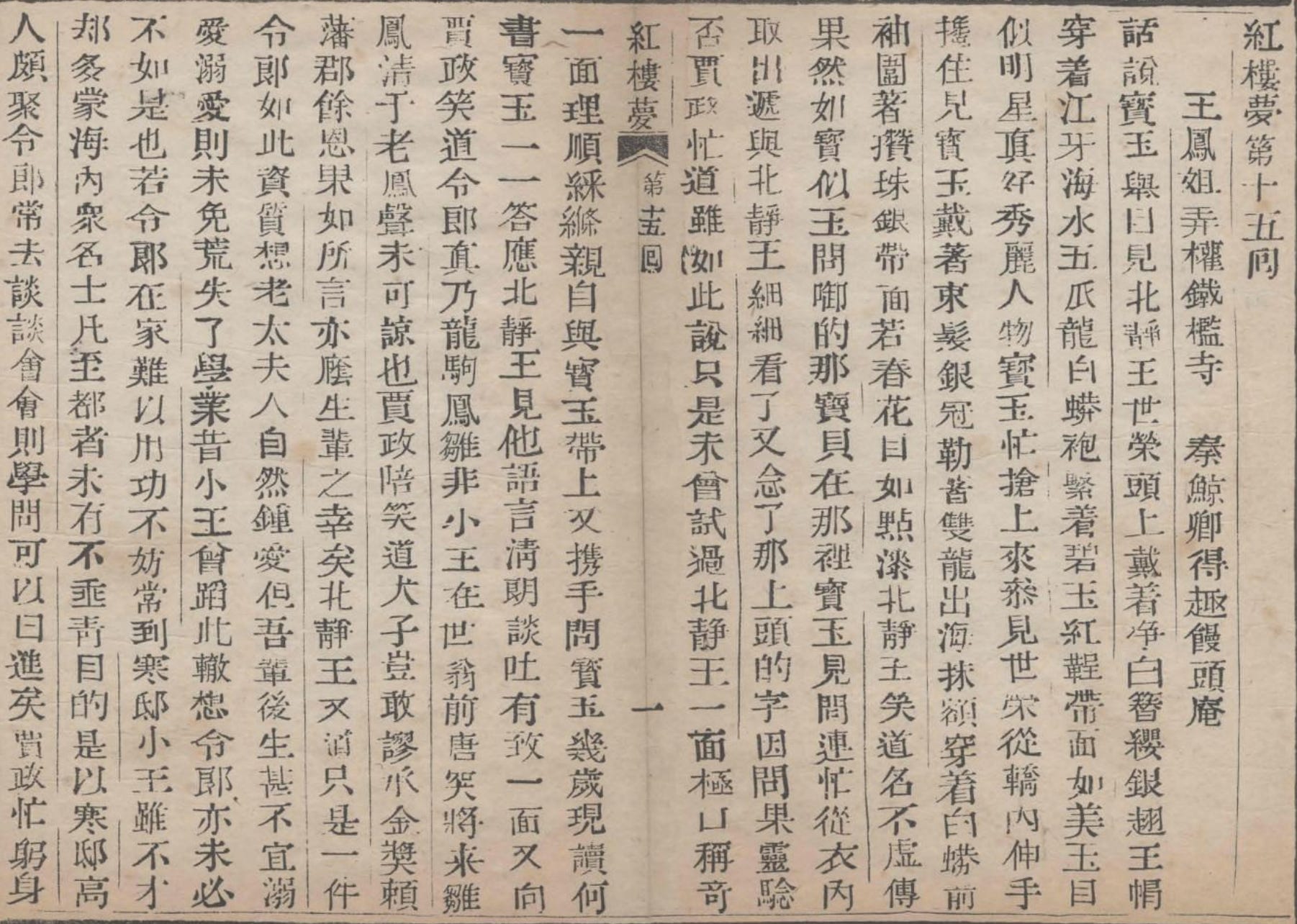
第十五回 王鳳姐弄權鐵檻寺 秦鯨卿得趣饅頭庵
話說寶玉舉目見北靜王世榮頭上戴著淨白簪纓銀翅王帽,穿著江牙海水五爪龍白蟒袍,繫著碧玉紅鞓帶,面如美玉,目似明星,真好秀麗人物。寶玉忙搶上來參見。世榮從轎內伸手攙住,見寶玉戴著束髮銀冠,勒著雙龍出海抹額,穿著白蟒箭袖,圍著攢珠銀帶,面若春花,目如點漆。北靜王笑道:「名不虛傳,果然如寶似玉!」問:「銜的那寶貝在那裡?」寶玉見問,連忙從衣內取出遞與。北靜王細細看了,又唸了那上頭的字,因問:「果靈驗否?」賈政忙道:「雖如此說,只是未曾試過。」
北靜王一面極口稱奇,一面理順彩絛,親自與寶玉帶上,又攜手問寶玉幾歲,現讀何書。寶玉一一答應。北靜王見他語言清朗,談吐有致,一面又向賈政笑道:「令郎真乃龍駒鳳雛!非小王在世翁前唐突,將來『雛鳳清於老鳳聲』,未可量也。」賈政陪笑道:「犬子豈敢謬承金獎。賴藩郡餘恩,果如所言,亦廕生輩之幸矣。」北靜王又道:「只是一件:令郎如此資質,想老太夫人自然鍾愛;但吾輩後生甚不宜溺愛,溺愛則未免荒失了學業。昔小王曾蹈此轍,想令郎亦未必不如是也。若令郎在家難以用功,不妨常到寒邸。小王雖不才,卻多蒙海內眾名士,凡至都者,未有不垂青目的,是以寒邸高人頗聚。令郎常去談談會會,則學問可以日進矣。」賈政忙躬身答道:「是。」
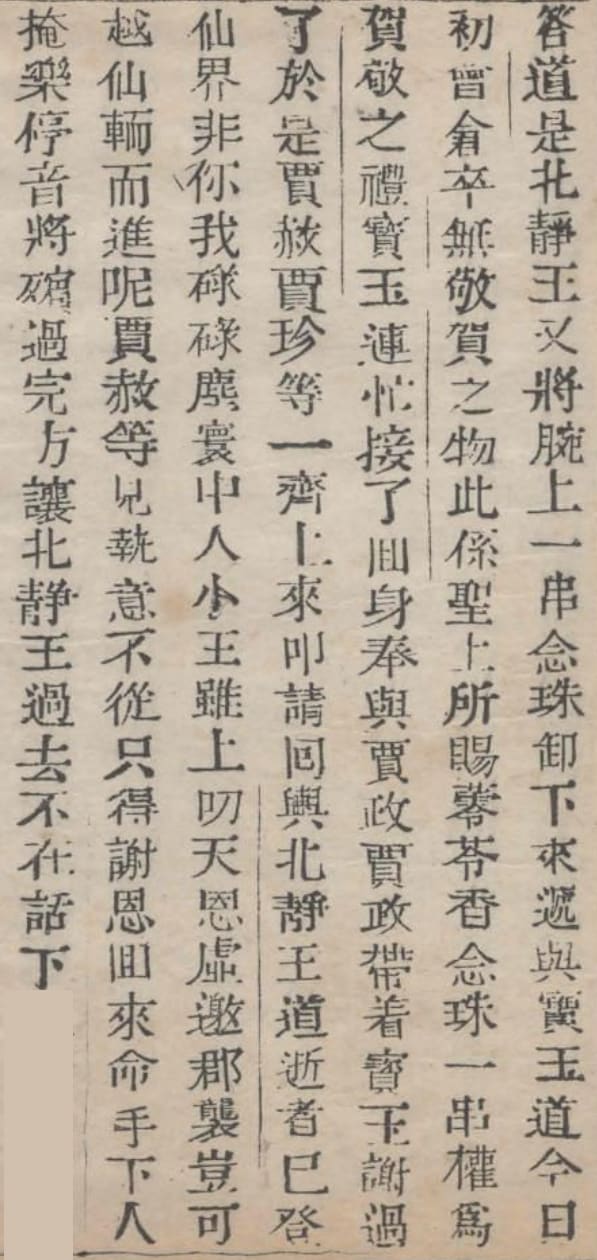
北靜王又將腕上一串念珠卸下來,遞與寶玉,道:「今日初會,倉卒無敬賀之物,此係聖上所賜蕶苓香念珠一串,權為賀敬之禮。」寶玉連忙接了,回身奉與賈政。賈政帶著寶玉謝過了。於是賈赦賈珍等一齊上來叩請回輿。北靜王道:「逝者已登仙界,非你我碌碌塵寰中人。小王雖上叨天恩,虛邀郡襲,豈可越仙輀而進呢?」賈赦等見執意不從,只得謝恩回來,命手下人掩樂停音,將殯過完,方讓北靜王過去。不在話下。
Translation Notes
弄權 means to abuse one’s power or to manipulate one’s power for personal goals
秦鯨卿 is the courtesy name (or 字) of Qin Zhong (秦鍾). I don’t believe that we’ve seen this courtesy name before.
秀麗 means beautiful or pretty, and is normally used to describe a woman.
The Prince’s first comment to Jia Baoyu, 名不虛傳,果然如寶似玉, is a play on Baoyu’s name. Baoyu’s Chinese name is 寶玉; 寶 means a treasure (or, as an adjective, precious), and 玉 means jade. You can think of this phrase as the Prince saying something like “you really are a precious piece of jade, just like your name.”
銜 means to hold in the mouth. The Prince’s question refers to the jade piece that Jia Baoyu was famously born with in his mouth. That story is implied here by that simple verb 銜.
寶貝 usually means “darling,” “honey,” or “baby” in modern Chinese. Here it means “a treasure.”
靈驗 means effective. This is a fascinating word to use here, since the name of the jade piece is 通靈寶玉; as you’ll remember, this translates to something like “The Precious Jade of Spiritual Understanding,” though the phrase 通靈 is kind of hard to translate. 靈驗 actually is a word that means “effective”; however, it’s interesting that Cao Xueqin would have the Prince say this particular word. See more here:

極口稱奇 means to express one’s wonder at something over and over again.
令郎 is an honorific noun meaning “your son.”
龍駒鳳雛 means “a dragon’s colt and a phoenix’s chick.” It’s a phrase that refers to a young person who is especially bright and who has a promising future.
世翁 is another honorific term. The Prince is noting the fact that Jia Zheng is from an elder generation.
The line 雛鳳清於老鳳聲 comes from a poem by the Tang Dynasty poet Li Shangyin (李商隱) that he composed to praise the son of a good friend. The poem is called 韓冬郎即席爲詩相送,一座盡驚。他日余方追吟「連宵侍坐裴回久」之句,有老成之風,因成二絕寄酬,兼呈畏之, which is a long name that translates to “Han Donglan composed an impromptu poem at the farewell feast, astonishing everybody. Days later, when I recited that line ‘All night we sat together, lingering long,’ I found it mature far beyond his years. Therefore I wrote this four line poem to send him in return, and have also presented them to Wei Zhi.” Wei Zhi (畏之) was the courtesy or literary name of Han Wo’s father, Han Zhan, who was Li Shangyin’s friend. This is the full poem:
十歲裁詩走馬成,冷灰殘燭動離情。
桐花萬里丹山路,雛鳳清於老鳳聲。
劍棧風檣各苦辛,別時冰雪到時春。
爲憑何遜休聯句,瘦盡東陽沈姓人。
At ten, you composed poems as fast as a horse.
With cold ashes and a dying candle, there was a feeling of parting.
On the thousand mile road to Mount Dan, amid the phoenix tree blossoms,
The young phoenix sang clearer than the old phoenix.
The sword-path bridge and the wind-tossed mast both have its toil.
It was icy when we parted; it will be spring when you arrive.
Don’t press He Xun to make a linked verse;
Mr. Shen from Dongyang has already wasted away.
The second part includes a pretty obscure reference about not composing a matching poem. He Xun was a gifted poet of the Liang Dynasty, several hundred years before this poem was created. Meanwhile, Mr. Shen was a famous poet of the Southern Qi dynasty who was known for being very thin; Li Shangyin used Mr. Shen to refer to himself, claiming that he was too thin and weary to keep up with the brilliance of his friend’s son.
Mount Dan (丹山) was the mythological home of the phoenix, and doesn’t really refer to an actual place. The idea is that the old phoenix, or Li Shangyin’s friend, is already living on the mountain. The new phoenix, his friend’s son, is going up the mountain to replace the old phoenix, and will likely surpass him.
The phrase 冷灰殘燭動離情 evokes the emotion of parting. Note the word 情 at the end, which, of course, is one of the most important words in the entire novel. This poem would fit in nicely with the poems by Lin Daiyu and Jia Baoyu that we’re going to eventually get to.
Anyway, in the novel text, the Prince of Beijing is clearly saying that Jia Baoyu will outshine his father Jia Zheng.
賴藩郡 is an old fashioned formal phrase used to address royalty such as the Prince.
寒邸 is a humble term used by nobles or officials to refer to their own residence.
蕶苓香念珠 is a fragrant group of prayer beads. It’s not entirely clear what 蕶苓 actually stands for.
I think Hawkes replaces the reference to Iron Threshold Monastery with Water Moon Priory to correct for what he believes to be an error in the original text. In Appendix IV to Volume 4, there is a discussion on the textual ambiguities surrounding whether Jia Qin's activities in Chapter 93 are occurring in Iron Threshold or Water Moon. In this same appendix, there is a remark relating to the events of Chapter 15 ("...Xi-Feng's shady connection is only with Euergesia, the Prioress at Water-moon"). This comment makes me think Hawkes believed that the conversation between Jingxu (Euergesia) and Wang Xi Feng that is alluded to in the introductory couplet is occurring at Water Moon and not Iron Threshold.
Hawkes makes this sort of textual "correction" multiple times in his translation. For example, he swaps references to the maids Cai Yun (Suncloud) and Cai Xia (Sunset) in Chapters 30, 61, and 62 to address what he sees as inconsistencies (see Appendix II in Volume 3 for Hawkes' elaboration on this particular alteration).
"the young phoenix will sing more clearly than the old."
Here「清」is better to be translated as "clearly and melodically" because it means「清越」(《漢語大辭典》:清越。「候扇舉而清叫,野聞而應媒。」(《射雉賦》)) when describing music.