


Translating Names
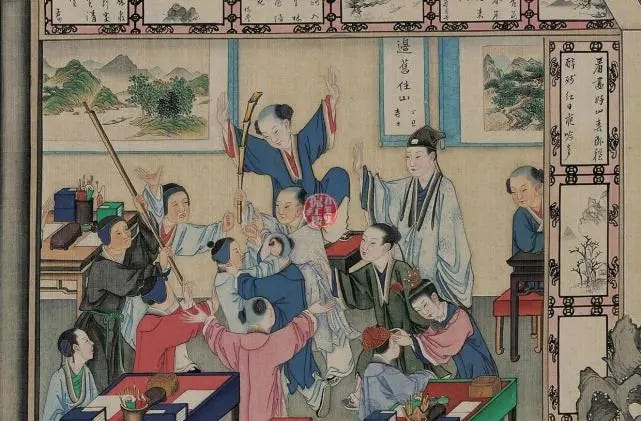
In yesterday’s translation post, we came across four new characters with interesting names:
賈藍, or Jia Lan, who is a distant relative of Jia Baoyu and who is technically in one generation underneath him. His name might refer to preventing something from happening, such as when he prevents Jia Jun from throwing the inkstone.
賈菌, or Jia Jun, who is another distant relative and is best friends with Jia Lan. His name indicates something lofty.
掃紅, or Saohong, a servant boy whose name means “sweep red.” Here we see the red motif that has dominated this novel to this point.
鋤藥, or Chuyao, another servant boy whose name means “hoe” (as in the gardening tool) and “medicine.”
墨雨, or Moyu, whose name means “ink rain.” Notice that this name is similar to Lin Daiyu’s name (林黛玉). The character 雨 is a hononym with 玉, and 墨 shares a major graphical characteristic (what we call a “radical” in Chinese) with 黛. That characteristic, 黑, is a word that means the color black.
David Hawkes translates the three servant names into English. 掃紅 becomes “Sweeper,” 鋤藥 becomes “Ploughboy,” and 墨雨 becomes “Inky.” He leaves Jia Lan and Jia Jun the way they are, which is consistent with his policy of leaving the “major character” names alone and only playing with the names of the “minor characters.”
While I think I understand the logic behind translating names as opposed to transliterating them, I disagree with the practice.
Now, on the one hand it’s actually important to make it clear to the readership what these names mean. One of the real tricky features of Dream of the Red Chamber is that so many of the names wind up being important, especially when it comes to the poetry used in the book. There are poems that simply don’t make sense unless the names mean the things that they mean.
There’s also an argument that the names ought to be Westernized to some extent so that the reader doesn’t get completely lost. In fact, if you read Red Tower Dream, the machine learning based translation by Eugene Ying and Victor Ying, you’ll notice that they insist on translating the names to something recognizable in English.
Actually, their name translations are a big selling point of their versions of the classic Chinese novels. This comes from the back of the book:
Our Revolutionary Methodology
It all began when Eugene Ying developed a new and revolutionary translation methodology that addressed the problems plaguing countles English translations of classic Chinese literature. Eugene, who had read the Chinese versions of all four of the Great Novels of China in his youth, perused every English translation of these novels at a large New york library, and realized that they all contained hundreds of similar-sounding Chinese names that would even confuse native Chinese speakers like himself, as well as numerous translation errors and other inaccuracies.
Before you get too excited, you need to know that the Ying translation is almost completely indecipherable - or, at least the version published in 2018 is (that’s the version I own).
The problem with this “revolutionary approach” is that it completely loses the feeling that the original book has. In fact, the translation here is so poor that I simply cannot take it seriously. Check this out:
Rong grabs a bamboo board, but there is not enough room to swing a cat in a small classroom with so many students.
Smokey is hit by the board, and he yells at his comrades, “Why don’t you fellows help me out?”
Jade has three more valets out there. They are Broomy 扫红, Druggy 锄药, and Stainy 墨玉. How could they not be naughty? They shout at Rong in unison, “You’re now using a weapon, you son of a turtle!”
Stainy grabs a door bar while Broomy and Druggy hold onto their horsewhips, and they rush into the classroom.
This approach is much closer to the terse translation style of the Yangs than the long winded style of David Hawkes. However, the bizarre insistence on using the historical present to write an entire novel, combined with the extremely awkward phrases, make this book impossible for me to even start with.
It’s also clear that some sort of mechanical translation method was used, and that this was likely pieced together before AI chatbots were widely used. “Not enough room to swing a cat” is actually a pretty good English idiom, but it’s use here is extremely awkward and unnatural - and doesn’t fit the Chinese text. “Son of a turtle” sounds like a machine trying to translate a curse word into English without swearing, and calling friends “valets” is just wrong.
And, for a translation that is revolutionary in its use of names, “Broomy” sure is a bizarre choice. So is “Stainy.” And “Druggy” doesn’t mean what they think it means.
Anyway, as you’ve already seen, my preferred style is to simply transliterate names and write a bunch of notes and commentary articles to explain things. I also prefer to go slow and to pay attention to little things instead of rushing through the novel as fast as possible. In this case, it helps to not have a book deal, to not be on some sort of academic publishing schedule, and to not need to rush things.
Do you like reading slowly and actually thinking about what you’re reading? If so, and if you haven’t signed up yet, consider becoming a paying subscriber. You can read the entire novel at your own pace, you can argue with me if you don’t like my translation, you can look things up, you can compare my translation with other translations, or you can use ChatGPT to redo my translation and taunt me with it.
You can’t do that with the Ying translation - and both David Hawkes and Gladys Yang passed away years ago. So hit me with your best shot.
I was looking forward to this one, and it didn't disappoint.
On this, I prefer Hawkes's method. First I want to make a point about whose names are translated. You say it's minor characters, but I don't think this is quite right. "Aroma" and "Patience" could be said to be relatively major characters, while someone like Shi Bu-ren is hardly major.
Rather, servants' names are translated while other people's aren't.
With this in mind, there are two reasons why I like this practice. The less important one is that it provides an easy and natural guide to the class status of the vast number of characters.
The more important one is a sensitive point: it hints at the servile status of the servants through referencing the practice of slave names, something that happened in both ancient Rome and the American South. And this makes an essential point about how unfree and vulnerable these people are when interacting with their masters and how little access to justice they have. This is one of the main themes of the book, and I don't think I would have absorbed it as well without Hawkes's naming practice