


New Here? This is Chapter 21 of Dream of the Red Chamber, China's greatest novel, translated into modern English one scene at a time. Start with the Start Here guide, or meet the family on the Characters page.
Now that Jia Baoyu has managed to make his maids mad at him, everything is silent. But Baoyu decides that he doesn’t care.
He’s had two cups of wine, he’s got a candle and a pot of tea, and he’s reading one of the strangest books in Chinese philosophy, the one that says the world would be better off if we smashed every ruler, scale and musical instrument in it. Then he picks up his brush and writes a continuation. Watch who ends up in it.
Previously: Xiren gave Baoyu the silent treatment, and he took it out on a new little maid by renaming her “Number Four.” (See The Silent Treatment.)
Who’s here: Jia Baoyu · Si’er (All the characters) · and, in a way, Hua Xiren, Sheyue, Xue Baochai and Lin Daiyu
The Note. Baoyu skillfully alludes to the girls who frustrated him so much in his writing. Unfortunately, it’s impossible to adequately reflect this in an English translation. See more below.
The Translation
Baoyu had had two cups of wine after dinner. That made him feel tipsy, with warm ears and eyes that felt heavy. Normally Xiren and the others would have been there with him, and everybody would have been laughing and having a great time. Tonight it was cold and quiet. He sat alone facing the lamp, and felt despondent.
He felt like sending them all away, but he was afraid they would think they had won if he dismissed them, and then they would come back to lecture him even more. On the other hand, it felt too heartless for him to act like a harsh master to scare them into line. It seemed pointless.
Baoyu hardened his heart and decided to act as if they were dead. He had to go on living his own life anyway. Once he had thought it through like this, he didn’t have a care in the world, and he actually began to feel quite content.
So he told Si’er to trim the candle wick and make some tea. He sat down and read the Classic of Nanhua for a while. When he came to the passage called “Prying Open Trunks,” in the Outer Chapters, it read:
Therefore cut off the sages and throw away wisdom, and the great robbers will stop. Fling away the jade and smash the pearls, and the petty thieves will not rise up. Burn the tallies and break the seals, and the people will be simple and plain. Split the measures and snap the scales, and the people will not quarrel. Tear down every last one of the sages’ laws under heaven, and only then can the people be reasoned with. Scramble the six pitch-pipes, melt down the reed organs and zithers, stop up the ears of Music Master Kuang, and only then will everyone in the world keep their hearing to themselves. Wipe out the patterns, scatter the five colors, glue shut the eyes of Li Zhu, and only then will everyone in the world keep their sight to themselves. Destroy the hook and the ink-line, throw away the compass and the square, break the fingers of Chui the Craftsman, and only then will everyone in the world keep their skill to themselves.
When he had read this far, he was delighted with it. Riding the mood the wine had put him in, he couldn’t help picking up his brush and continuing it:
Burn the flower and scatter the musk, and only then will everyone in the women’s quarters keep their lecturing to themselves. Destroy the fairy-like beauty of Baochai, burn the quick mind of Daiyu to ash, wipe out all tender feeling, and only then will beauty and ugliness in the women’s quarters be alike. If they keep their lecturing to themselves, there will be no fear of drifting apart like two stars that never meet. Destroy that fairy-like beauty, and there will be no more longing hearts. Burn that quick mind to ash, and there will be no more passion for talent and wit. The hairpin, the jade, the flower and the musk: every one of them spreads a net and digs a deep pit, and that is how they bewilder, entangle and trap everyone in the world.
When he had finished, he tossed the brush aside and went to bed.
He says he doesn’t care, but the night is long, and morning is coming. How long can Baoyu keep pretending the girls don’t exist? Members read every passage, plus the weekly podcast, for $5 a month.
The Chinese Text
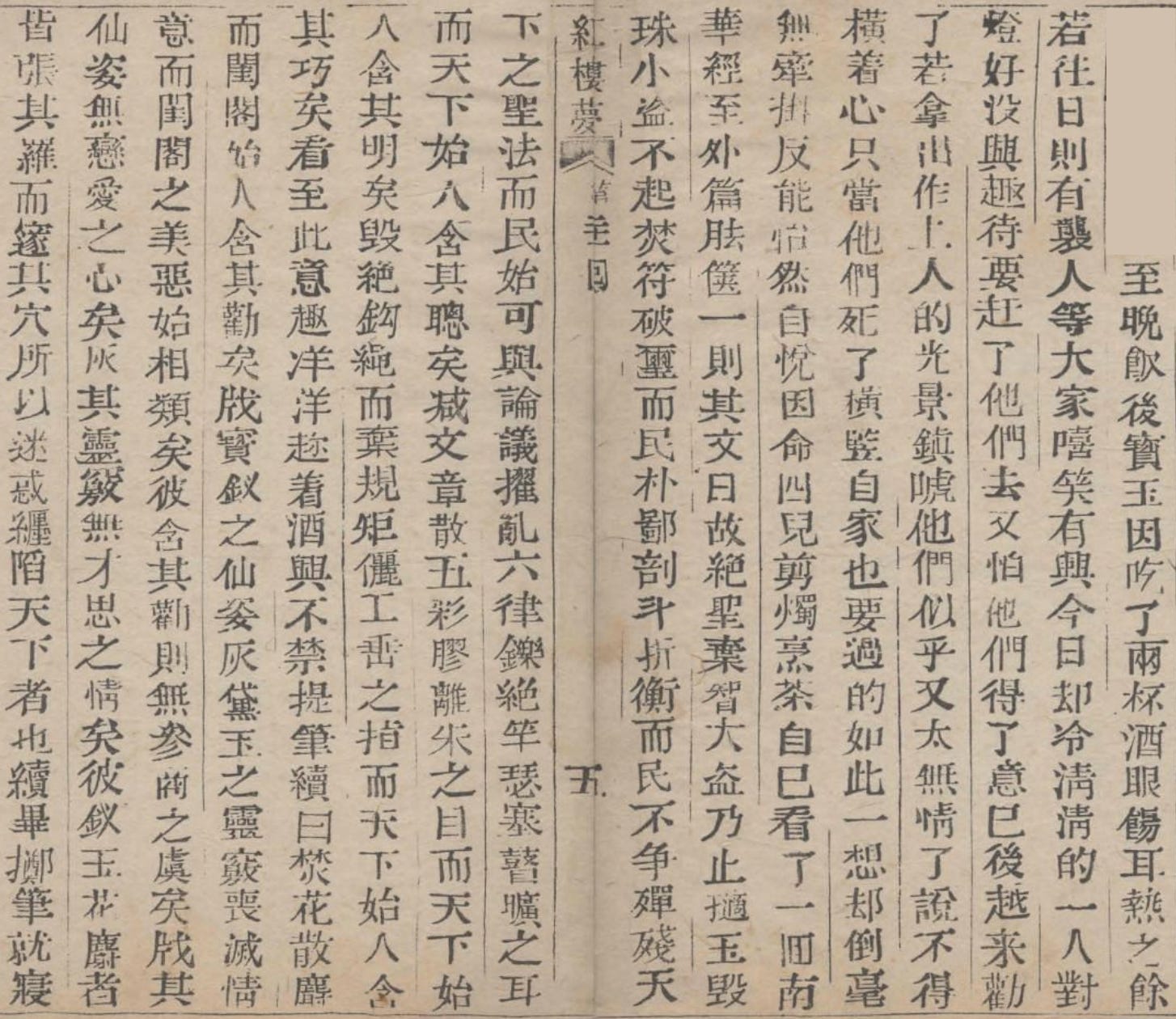
至晚飯後,寶玉因吃了兩杯酒,眼餳耳熱之餘,若往日則有襲人等大家嘻笑有興;今日卻冷清清的,一人對燈,好沒興趣。待要趕了他們去,又怕他們得了意,已後越來勸了;若拿出作上人的光景鎮唬他們,似乎又太無情了。說不得橫著心,只當他們死了,橫豎自家也要過的。如此一想,卻倒毫無牽掛,反能怡然自悅。因命四兒剪燭烹茶,自己看了一回《南華經》。至外篇《胠篋》一則,其文曰:
故絕聖棄智,大盜乃止;擿玉毀珠,小盜不起。焚符破璽,而民朴鄙;剖斗折衡,而民不爭;殫殘天下之聖法,而民始可與論議。擢亂六律,鑠絕竽瑟,塞瞽曠之耳,而天下始人含其聰矣;滅文章,散五彩,膠離朱之目,而天下始人含其明矣;毀絕鉤繩,而棄規矩,儷工垂之指,而天下始人含其巧矣。
看至此,意趣洋洋,趁著酒興,不禁提筆續曰:
焚花散麝,而閨閣始人含其勸矣;戕寶釵之仙姿,灰黛玉之靈竅,喪滅情意,而閨閣之美惡始相類矣。彼含其勸,則無參商之虞矣;戕其仙姿,無戀愛之心矣;灰其靈竅,無才思之情矣。彼釵、玉、花、麝者,皆張其羅而邃其穴,所以迷惑纏陷天下者也。
續畢,擲筆就寢。
Reading Notes
眼餳耳熱 (yǎn xíng ěr rè) means “eyes heavy, ears warm.” 餳 is malt sugar, and here it’s used as a verb. His eyes have gone soft and sticky, the way they do after a drink or two. This isn’t falling-down drunk. It’s that warm, slightly dazed stage where everything seems like a good idea. Keep that in mind for the rest of the passage.
得了意 / 越來勸了 (dé le yì / yuè lái quàn le). 得意 is to feel like you’ve won, to be smug about it. Baoyu’s worry is that if he sends the girls away, they’ll think they’ve beaten him, and then they’ll lecture him even more. 勸 (quàn) is the same word Baoyu used when he complained that Xiren didn’t even lecture him, 你勸也罷了, in the last post. (See The Silent Treatment.) I’ve translated it as “lecture” both times, and you’ll see it again in a minute.
作上人的光景 / 鎮唬 (zuò shàngrén de guāngjǐng / zhènhu). 上人 is “the person above,” the master. 光景 here is an air or a manner. 鎮唬 is to scare someone into line: 鎮 is to press down, and 唬 is to frighten. So his second option is to play the stern master and frighten them. He rejects that too. It would be 太無情, “too heartless.” Whatever else you say about Baoyu, he can’t bring himself to bully the maids.
Of course, you’ll notice that our famous word 情 has turned up here yet again. Baoyu simply cannot act in a way that does not encompass 情, and so he decides not to vent his anger on the girls.
說不得橫著心,只當他們死了 (shuōbude héngzhe xīn, zhǐ dàng tāmen sǐ le). 說不得 is “there’s nothing more to say,” or “it can’t be helped.” 橫著心 is to harden your heart. 只當他們死了 is “just act as if they were dead.” Don’t take that one too literally. It’s the kind of thing a sulking teenager says. He doesn’t wish them dead. He’s decided to pretend they don’t exist.
毫無牽掛 / 怡然自悅 (háo wú qiānguà / yírán zì yuè). 牽掛 is literally “being tugged at” or “hung up on” someone, worrying about them. 毫無 is “not the slightest.” 怡然自悅 is to be content and pleased with yourself. And notice the little word 反 (fǎn), “on the contrary.” The moment he decides not to care, he feels great. Or at least he tells himself he does.
四兒 / 剪燭烹茶 (Sì’ér / jiǎn zhú pēng chá). This is Si’er, “Number Four,” the little maid Baoyu renamed in the last post. She’s the only one waiting on him tonight. 剪燭 is to trim the candle’s wick, and 烹茶 is to brew tea. A trimmed candle, a pot of tea and a book make for a cozy scholar’s evening. He’s setting the scene for himself.
《南華經》 (Nánhuá jīng), the Classic of Nanhua. This is the book we usually call the Zhuangzi, after the philosopher Zhuang Zhou. In the Tang dynasty, the emperor gave Zhuangzi the honorary title “the True Man of Nanhua,” and the book became the True Classic of Nanhua. The novel uses the fancy title. It’s a little like calling the Bible “the Holy Scriptures.” Same book, higher register.
外篇 / 胠篋 (wàipiān / qūqiè). The Zhuangzi is divided into the Inner Chapters, the Outer Chapters and the Miscellaneous Chapters. Most scholars think the Inner Chapters are the oldest and the closest to Zhuangzi himself. This passage is from the Outer Chapters. 胠 is to open something from the side, and 篋 is a trunk or chest, so the chapter title is “Prying Open Trunks.” The chapter starts with a simple picture. People tie up their trunks and lock them to keep petty thieves out. Then a big thief comes along, picks up the whole trunk and carries it off, and he’s only worried that the ropes and locks aren’t strong enough. In other words, the things we invent to protect ourselves end up helping the biggest thieves.
絕聖棄智,大盜乃止 (jué shèng qì zhì, dàdào nǎi zhǐ), “cut off the sages and throw away wisdom, and the great robbers will stop.” This is where Baoyu starts reading. It sounds crazy, but it follows from the trunk. If the sages’ laws and clever inventions are the ropes and locks, then the great robbers can steal those too, and use them to run a whole country. Get rid of them, and there’s nothing left to steal.
擿玉毀珠 (zhì yù huǐ zhū), “fling away the jade and smash the pearls.” 擿 here is read zhì, and it means to throw away. Jade is 玉 (yù), the same 玉 as in Baoyu’s own name, 寶玉, “precious jade.” This is also the same character that we see in Lin Daiyu’s name (林黛玉). Perhaps Zhuangzi served as an inspiration for what Baoyu winds up writing next?
符 / 璽 / 斗 / 衡 (fú / xǐ / dǒu / héng). These are the tools of trust and fair dealing. A 符 is a tally, a token split in two so that the two halves can be matched to prove who you are. A 璽 is a seal. A 斗 is a measure for grain, and a 衡 is a scale, the kind with a weight that slides along a beam. Zhuangzi’s point is that you only need these things because people cheat. Break them, and people will stop fighting over them.
朴 (pǔ). 朴 (also written 樸) is uncarved wood, the raw block before anybody has shaped it. It’s one of the big images of Daoism, a picture of people before civilization got to them. I translated 朴鄙 as “simple and plain.” 鄙 usually means “vulgar” or “crude,” but here it isn’t an insult.
六律 / 竽瑟 / 瞽曠 (liù lǜ / yú sè / Gǔ Kuàng). Now Zhuangzi goes after the senses. The 六律 are six pitch-pipes that set the notes of ancient Chinese music. The 竽 is a reed mouth organ, and the 瑟 is a large zither. 瞽曠 is Music Master Kuang (師曠), a famous court musician of the state of Jin who was said to have the best ear in history. 瞽 means blind. Court musicians in ancient China were traditionally blind, and Kuang was too.
文章 / 五彩 / 離朱 (wénzhāng / wǔcǎi / Lí Zhū). Today 文章 means an essay or an article, but here it has its old meaning, colored patterns, like the designs on embroidered silk. That’s why I translated it as “patterns.” 五彩 is the five colors. Li Zhu (also called Li Lou) was a legendary man with perfect eyesight. Mencius mentions him too.
鉤繩 / 規矩 / 工倕 (gōushéng / guījǔ / Gōng Chuí). A carpenter’s tools: the hook for drawing curves, the ink-line for snapping straight lines, the compass for circles and the square for right angles. Chui was a legendary master craftsman. Here’s a fun one for Chinese learners. 規矩 still means “rules” or “good manners” in modern Chinese. If someone says you have no 規矩, they mean you don’t know how to behave. It comes straight from the compass and the square.
始人含其聰 / 明 / 巧 (shǐ rén hán qí cōng / míng / qiǎo). This is the frame that Baoyu is about to borrow. 含 is literally to hold something in your mouth, and here it means to keep something inside yourself. 聰 is sharpness of hearing, 明 is sharpness of sight, and 巧 is skill. Zhuangzi’s idea is that once the great musician, the great seer and the great craftsman are gone, everybody gets to keep their own hearing, sight and skill, instead of measuring themselves against the expert. 始 is “only then.” I translated all of these as “keep their hearing to themselves,” and so on. That bends Zhuangzi’s meaning a little toward “keep it private,” but it lets you see the joke Baoyu makes out of it.
續 (xù), “to continue.” The novel says Baoyu 續, “continued,” the passage. It doesn’t call it a parody or a joke. But Jia Baoyu keeps Zhuangzi’s grammar, his rhythm and his favorite verbs, and he swaps in the names of the girls that are frustrating him so much. This is actually one of those things that is hard to see in an English translation, though David Hawkes certainly made a valiant effort to connect the two passages. Anyway, to me this reads like a parody. Whether he means any of it is another question, and I’ll have a few things to say about that tomorrow.
焚花散麝 (fén huā sàn shè), “burn the flower and scatter the musk.” Here’s the one to remember from this passage. 花 (huā) is a flower. It’s also Xiren’s surname, Hua. 麝 (shè) is musk. It’s also the first character of Sheyue’s name, 麝月, “Musk Moon.” So “burn the flower and scatter the musk” sounds like getting rid of the perfume in the women’s quarters, but it’s really Xiren and Sheyue, the two maids who wouldn’t speak to him. And notice the verb. 焚 (fén), “burn,” comes straight from Zhuangzi’s 焚符破璽, “burn the tallies and break the seals.” English can’t hide two names inside two ordinary words, so I kept the flower and the musk in the translation and I’m explaining the names here.
閨閣 (guīgé), “the women’s quarters.” The inner rooms where the women and girls of the household live. Where Zhuangzi says “everyone in the world,” Baoyu says “everyone in the women’s quarters.” His whole world has shrunk to a few rooms full of girls, which, for Baoyu, is about right.
含其勸 (hán qí quàn), “keep their lecturing to themselves.” And here’s the punch line. Zhuangzi says that only then will everyone keep their hearing, their sight and their skill. Baoyu says that only then will everyone keep their 勸, their lecturing. It’s the same word from the last post. After a day of being lectured and then ignored, this is the line he’s been waiting to write.
戕寶釵之仙姿,灰黛玉之靈竅 (qiāng Bǎochāi zhī xiānzī, huī Dàiyù zhī língqiào). Now he names names. 戕 is to destroy or injure. 仙姿 is a fairy-like, almost otherworldly beauty, and that’s Baochai. 灰 is ash, used here as a verb, “burn to ash.” 靈竅 is the quick, sharp mind, literally the “spiritual openings” of the heart. Do you remember how Daiyu was introduced in Chapter 3? Her heart had “one more opening than Bi Gan’s,” Bi Gan being the ancient minister famous for his wisdom. This is the same idea. So Baoyu matches each girl with what makes her dangerous to him: Baochai’s beauty and Daiyu’s brilliance. They’re his Music Master Kuang and his Li Zhu.
美惡始相類 (měi è shǐ xiāng lèi), “only then will beauty and ugliness be alike.” In Zhuangzi, break the scales and the people stop quarreling. In Baoyu’s version, destroy the most beautiful and the cleverest girls, and nobody will stand out anymore.
參商 (Shēn Shāng), “two stars that never meet.” 參 is a constellation that we know as part of Orion, and 商 is Antares, in Scorpius. They sit on opposite sides of the sky, so one sets as the other rises, and you never see them together. An old legend says they were two brothers who fought so much that they were put at opposite ends of the sky. The poet Du Fu used them for friends who can never meet: 人生不相見,動如參與商. Baoyu’s point is that if the girls stopped lecturing, there’d be no more fights, and no more danger of being driven apart.
戀愛之心 / 才思之情 (liàn’ài zhī xīn / cáisī zhī qíng). Careful with 戀愛. Today it means romantic love, dating, being in a relationship. Here it’s older and broader, referring simply to longing or attachment. So “no more longing hearts.” 才思 is literary talent and quickness of mind. 才思之情 is the feeling that talent stirs up, the attraction to someone who’s brilliant. Think about who’s brilliant in this house.
釵、玉、花、麝 (chāi, yù, huā, shè), “the hairpin, the jade, the flower and the musk.” Four ordinary things you’d find in a girl’s room. And four girls. 釵 is the hairpin in Baochai’s name, 玉 is the jade in Daiyu’s name, 花 is Xiren and 麝 is Sheyue. Hawkes and the Yangs both handle this line differently, which you’ll see below.
張其羅而邃其穴 (zhāng qí luó ér suì qí xué), “spreads a net and digs a deep pit.” 羅 is a bird net, and 穴 is a pit or a hole. 邃 normally means “deep,” and here it’s a verb, to make deep. These are a hunter’s traps. Zhuangzi’s thieves have turned into girls, and the girls have turned into hunters. And who’s the prey? Everyone in the world, which means Baoyu.
擲筆就寢 (zhì bǐ jiù qǐn), “tossed the brush aside and went to bed.” 擲 is to throw, the same as the 擿 in “fling away the jade.” He’s just written a manifesto about destroying the four girls he cares about most, and then he throws down his brush and goes to sleep. So much for the revolution.
The Other Translations
Hawkes
The biggest question in these other major English translations has to do with how the translators handle the references to the various girls. David Hawkes simply translates the various nouns as the names of characters:
These Bao-chais, Dai-yus, Aromas and Musks spread their nets and dig their pits, and all the world are bewitched and ensnared by them.
Hawkes mentions that Jia Baoyu is reading Zhuangzi, but doesn’t offer any additional commentary on the passage.
Yang
Oddly, the Yangs take away the references to ancient sages (Music Master Kuang, Li Zhu, and Chui the Craftsman) in their translation of the Zhuangzi passage.
The Yangs note within their translation of Baoyu’s text who he is referring to:
Burn the flower (Hsi-jen), get rid of the musk (Sheh-yueh), and those in the inner apartments will keep their advice to themselves.
However, there are no footnotes that explain why this passage of Zhuangzi is important for this part of the story, nor is there any attempt to discern whether this is a funny moment or something that reveals Jia Baoyu’s actual feelings.
Is Baoyu joking, or does part of him mean it? Tell me in the comments.
Next in the story: We’ll see what happens to Baoyu when he wakes up in the next post.
Go deeper: Tomorrow I take a closer look at what Baoyu did to Zhuangzi, line by line.
Meet them: Jia Baoyu / Lin Daiyu / Xue Baochai / Hua Xiren / All the characters
Get the next passage free in your inbox!
I’m digging the new format of these posts: the scene setting, recap of the prior episode, and the scene’s principal players. The pinyin in the Reading Notes are great too.