


Wang Xifeng Begins Managing The Ningguo Mansion
In today’s translation snippet, Wang Xifeng is given the reigns to manage the internal affairs of the Ningguo Mansion, the house across the street from her Rongguo Mansion (which she is also managing). I’ve split this up into two parts; we’ll get to the end of the chapter in tomorrow’s part.
My Translation
And so Jia Zhen’s wishes were being fulfilled. However, inside the household Lady You’s old sickness had flared up again, leaving her unable to manage the household affairs. Jia Zhen was afraid that he’s become a laughingstock if there were any lapse in protocol when official ladies came to visit. And so he was deeply concerned.
Baoyu happened to be at his side as Jia Zhen was worried about this. “Everything seems to be working perfectly,” said Baoyu. “What is there to worry about?”
Jia Zhen explained to him that there was nobody at home to handle the visitors. “What’s so hard about that?” laughed Baoyu. “Let me recommend somebody to you that can take care of those visitors for a month. I guarantee that it will be well managed!”
Jia Zhen asked eagerly who it was. Since there were a lot of relatives and guests present, Baoyu thought it would be best for him to not speak openly. And so he went close to Jia Zhen’s ear and whispered a few words.
Jia Zhen was ecstatic when he heard this. “This is a perfect solution! I’ll go at once.” And he took Baoyu by the hand, left the visitors, and headed back to his living quarters.
Fortunately, since this day was not one of the main ceremonial days, only a few relatives and friends were in the inner quarters. There were only a few close female relatives there, and Lady Xing, Lady Wang, and Wang Xifeng were accompanying them.
A servant announced “The Master is coming in.” The women let out a collective gasp and hurried to hide themselves at the back. Only Wang Xifeng rose slowly to her feet.
Now, by this time Jia Zhen was also sick, and was overwhelmed with grief. And so he used a cane to walk, and hobbled inside the room.
“You’re not well,” said Lady Xing and the others to him. “You should rest, especially since you’ve got so many things to attend to. Why did you come here?”
Leaning on his cane, Jia Zhen tried to lower himself into a kneeling position to pay his respects and express his gratitude for their trouble.
Lady Xing and the others told Baoyu to hold him up, and quickly ordered someone to bring a chair for him to sit on. However, Jia Zhen refused to sit. Forcing a smile, he said, “Your nephew has come to ask a favor of my two aunts and my young cousin.”
“What is it?” asked Lady Xing and the others.
“You certainly know the situation,” continued Jia Zhen. “Now that my daughter-in-law has passed away and my own wife is ill, I see that the inner household is in a state of chaos. Therefore, I must beg Wang Xifeng to take care of my household for one month. That would help me feel at ease.”
“So that’s what this is all about,” replied Lady Xing with a smile. “Wang Xifeng is part of Lady Wang’s household. You should ask her about this.”
“She’s only a child,” said Lady Wang quickly. “What does she know about managing a household? If she doesn’t manage this properly, others will laugh at us. It would be better to ask someone else.”
“I understand your concerns,” smiled Jia Zhen. “You’re afraid that it would be too difficult for her. As for her ability to manage things, she’s shown decisive judgment since she was a child. Now that she is married and handles affairs across the street, she has clearly grown more capable and mature.
“As I’ve been thinking about this for the past few days, I’ve realized that Wang Xifeng is really the only one I can ask. If you won’t agree to this for the sake of your nephew and his wife, then at least do it for the sake of the deceased!” And he started crying.
Lady Wang was concerned because Wang Xifeng had never managed funeral affairs before. She was worried that Wang Xifeng would make mistakes and would invite ridicule. However, now that she saw how earnestly Jia Zhen was pleading, her heart softened somewhat. She sat staring at Wang Xifeng, lost in thought.
Wang Xifeng had always loved to take on responsibilities, and loved showing off her capabilities. When she saw Jia Zhen pleading so earnestly, she had already agreed in her heart. When she saw that Lady Wang seemed like she wanted to agree, she said to her, “Jia Zhen’s plea is so heartfelt. Please agree to it.”
“Are you up to it?” asked Lady Wang, quietly.
“Why wouldn’t I be?” replied Wang Xifeng. “The major external matters have already been sorted out by Jia Zhen. All that remains is to take care of the internal affairs. Besides, if there’s anything I don’t understand, I can always ask you.”
This made sense to Lady Wang, and so she didn’t say anything more.
When Jia Zhen saw that Wang Xifeng had agreed, he said with a forced smile, “I can’t concern myself with too much at the moment. In any case, I’ll have to ask you to take the trouble. Allow me first to offer you my respects. Once this is concluded, I’ll go over to your mansion to formally express my gratitude.”
He made a deep bow after saying that. Xifeng quickly returned the bow without delay.
Translation Critique
Hawkes
This is another good example of how wordy The Story of the Stone is. It’s obvious from the context that Jia Zhen is concerned about his wife being ill and being unable to attend to the various official women who have come to visit. In Chinese, when Jia Baoyu asks him what the matter is, his replay is that “裡面無人,” or that there’s nobody to help manage the internal affairs. David Hawkes translates this passage this way:
Cousin Zhen explained that it was the present lack of a responsible female head of household which was the cause of his concern.
This is wordy and unnecessary, since it’s obvious from the context. It’s much easier to simply say “Jia Zhen said he was worried that nobody would be home to handle the visitors” or something similar.
Hawkes has Jia Zhen refer to Wang Xifeng as “Cousin Feng” in this portion. He seems to have used this title because Jia Zhen refers to her as 大妹妹 in the original, which really translates to something like “honored younger sister.” I’ve chosen to have him refer to her as Wang Xifeng instead to make it easier to read and understand. Note that Jia Zhen never refers to her as “Xifeng” or “Feng” in this entire passage; instead, he refers to her formally, as if she were superior to him.
Hawkes has Jia Zhen asking Wang Xifeng to “let me make you a reverence now, to show my gratitude.” “Make a reverence” is an odd phrase that I’m not familiar with, and is how Hawkes translates 行禮 (to offer one’s respects). Meanwhile, he has Wang Xifeng curtsy back to his formal bow.
Yang
As usual, the Yangs undertranslate this section. Jia Zhen’s concern is that his wife, Lady You, is unable to see to her internal responsibilities, in particular seeing to the female guests that come (惟恐各誥命來往,虧了禮數). The Yangs simply translate this as her being “unable to see to things.” It’s not just that she was sick in bed and unable to get up. The real problem is that the formality of the funeral demanded that she formally and politely receive the numerous official female visitors.
Oddly, the Yangs translate 可巧這日非正經日期 as “as this was not one of the major days on which masses were said.” The reference to the Mass is extremely bizarre, and I’m really not sure what they were going for with this translation.
The Yangs have Jia Zhen refer to Wang Xifeng as “Cousin Hsi-feng,” which is similar to Hawkes’ “Cousin Feng.” Again, this is not consistent with the original, where he refers to her formally as 大妹妹. The problem here is that 妹妹 literally means “younger sister,” which reflects the theoretical closeness of the two families and the generational lines. “Honored younger sister” doesn’t work as an English translation, and so most translators call 妹妹 “cousin” instead. Of course, the issue is that Wang Xifeng is not Jia Zhen’s cousin. She’s the wife of Jia Lian, who happens to be on the same generational line as Jia Zhen and Jia Baoyu. However, Jia Lian isn’t technically cousins with Jia Zhen due to the separation between the two family lines that occurred generations ago. At any rate, having Jia Zhen call her “Cousin Feng” or “Cousin Hsi-feng” ignores the unusual and comical formality with which he refers to her – especially since she is clearly several decades younger than he is.
Chinese Text
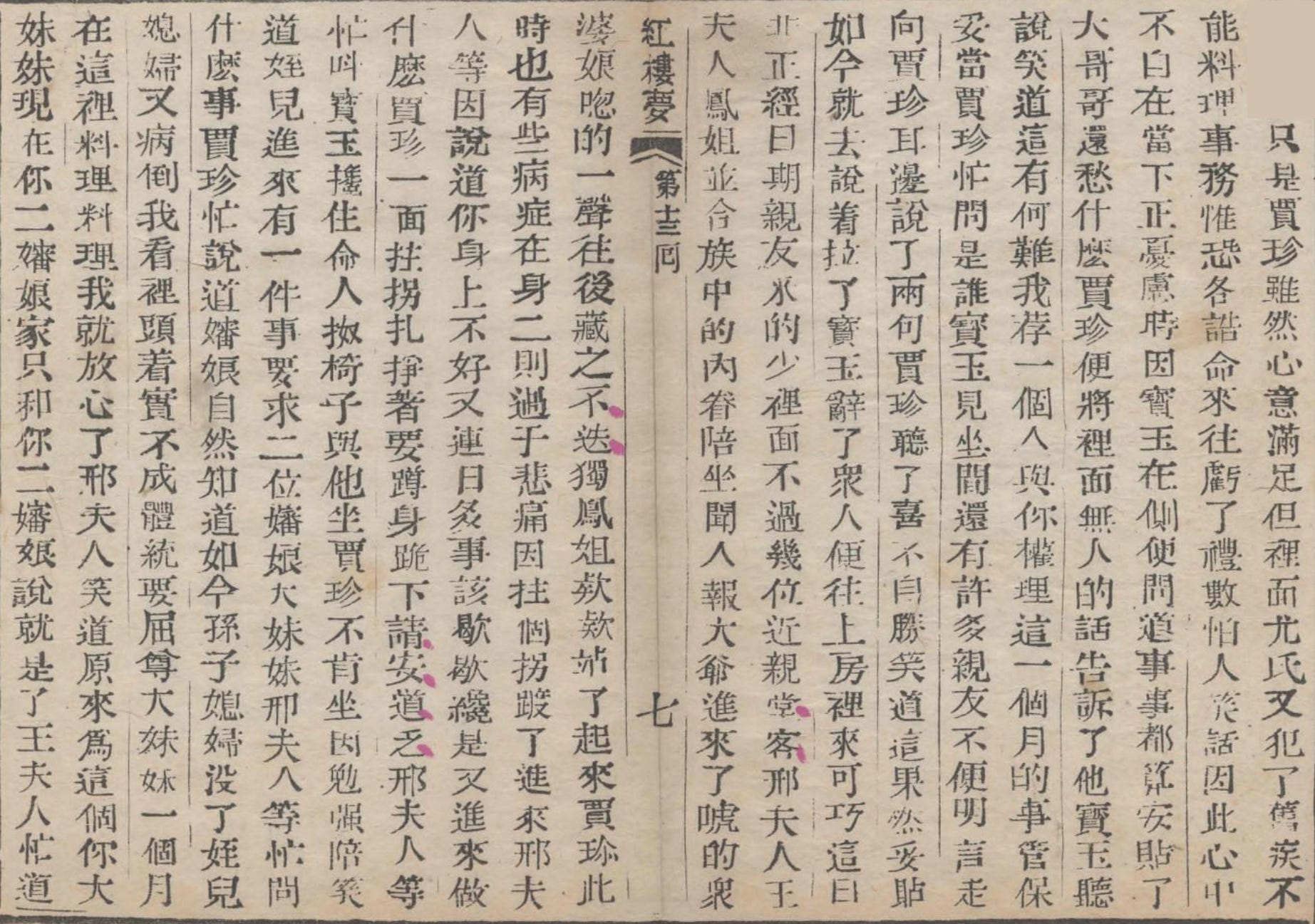
只是賈珍雖然心意滿足,但裡面尤氏又犯了舊疾,不能料理事務,惟恐各誥命來往,虧了禮數,怕人笑話,因此,心中不自在。當下正憂慮時,因寶玉在側,便問道:「事事都算妥貼了,大哥哥還愁什麼?」賈珍便將裡面無人的話告訴了他。寶玉聽說,笑道:「這有何難?我薦一個人與你,權理這一個月的事,管保妥當!」賈珍忙問是誰。寶玉見座間還有許多親友,不便明言,走向賈珍耳邊說了兩句。賈珍聽了,喜不自勝,笑道:「這果然妥貼。如今就去。」說著,拉了寶玉,辭了眾人,便往上房裡來。
可巧這日非正經日期,親友來的少,裡面不過幾位近親堂客。邢夫人、王夫人、鳳姐併合族中的內眷陪坐。聞人報:「大爺進來了。」唬的眾婆娘唿的一聲,往後藏之不迭,獨鳳姐款款站了起來。
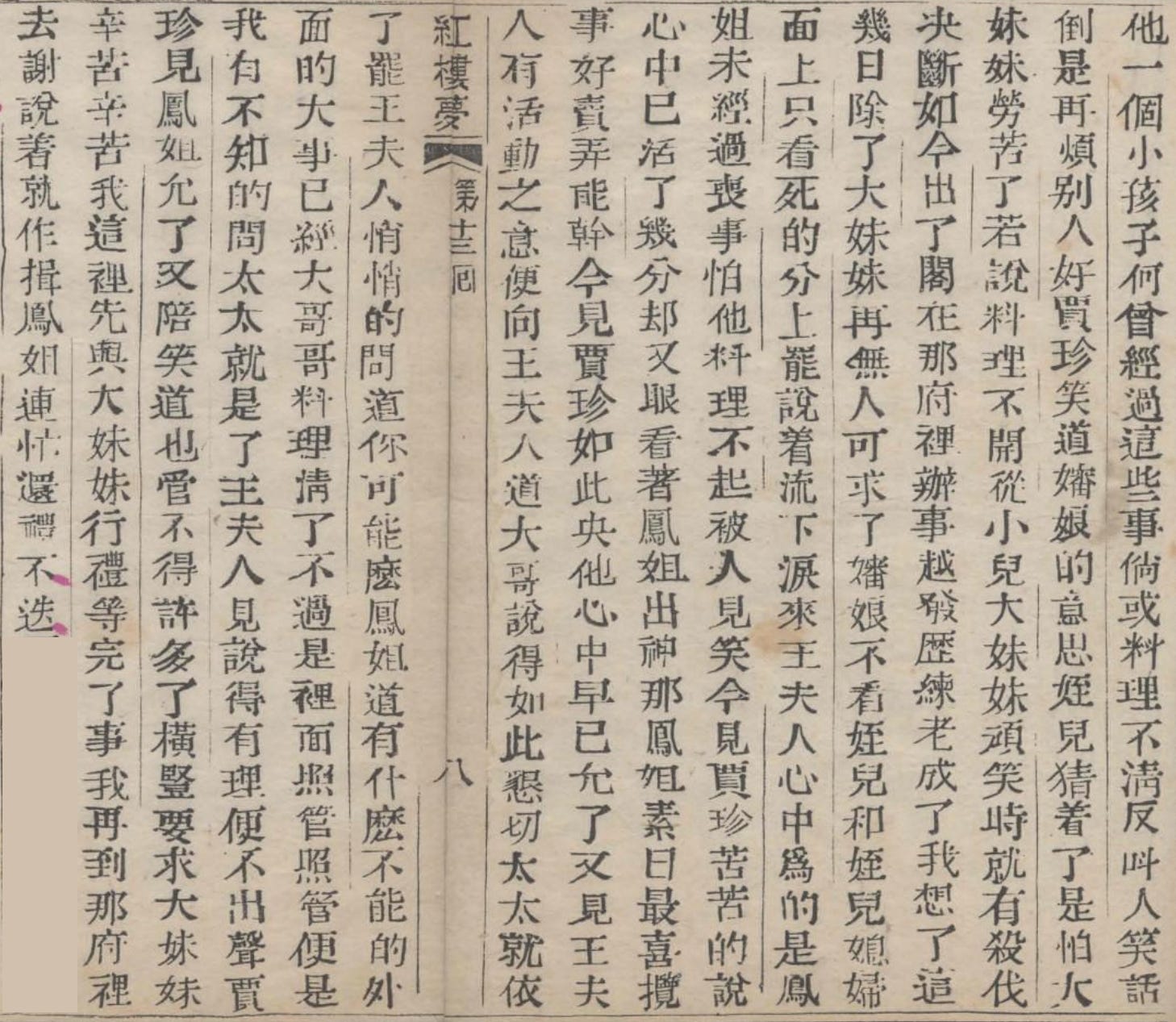
賈珍此時也有些病症在身,二則過於悲痛,因拄個拐,踱了進來。邢夫人等因說道:「你身上不好,又連日多事,該歇歇才是。又進來做什麼?」賈珍一面拄拐,扎掙著,要蹲身跪下請安道乏。邢夫人等忙叫寶玉攙住,命人拿椅子與他坐。賈珍不肯坐,因勉強陪笑道:「侄兒進來,有一件事要求二位嬸孃、大妹妹。」邢夫人等忙問:「什麼事?」賈珍忙說道:「嬸孃自然知道。如今孫子媳婦沒了,侄兒媳婦又病倒,我看裡頭著實不成體統;要屈尊大妹妹一個月,在這裡料理料理,我就放心了。」邢夫人笑道:「原來為這個。你大妹妹現在你二嬸孃家,只和你二嬸孃說就是了。」王夫人忙道:「他一個小孩子,何曾經過這些事?倘或料理不清,反叫人笑話,倒是再煩別人好。」賈珍笑道:「嬸孃的意思,侄兒猜著了:是怕大妹妹勞苦了。若說料理不開,從小兒,大妹妹玩笑時就有殺伐決斷;如今出了閣,在那府裡辦事,越發歷練老成了。我想了這幾日,除了大妹妹,再無人可求了。嬸孃不看侄兒和侄兒媳婦面上,只看死的分上罷!」說著,流下淚來。
王夫人心中為的是鳳姐未經過喪事,怕他料理不起,被人見笑。今見賈珍苦苦的說,心中已活了幾分,卻又眼看著鳳姐出神。那鳳姐素日最喜攬事,好賣弄能幹,今見賈珍如此央他,心中早已允了,又見王夫人有活動之意,便向王夫人道:「大哥說得如此懇切,太太就依了罷。」王夫人悄悄的問道:「你可能麼?」鳳姐道:「有什麼不能的!外面的大事已經大哥哥料理清了,不過是裡面照管照管。便是我有不知的,問太太就是了。」王夫人見說得有理,便不出聲。賈珍見鳳姐允了,又陪笑道:「也管不得許多了,橫豎要求大妹妹辛苦辛苦。我這裡先與大妹妹行禮,等完了事,我再到那府裡去謝。」說著,就作揖。鳳姐連忙還禮不迭。
Translation Notes
On first glance, you’d think that 誥命 would mean an official decree. While the word does have that meaning, here it refers specifically to women who have official titles through their husbands.
Jia Baoyu refers to Jia Zhen as 大哥哥 (older brother) despite the large age difference between them. This is because they are part of the same family generation. Remember that Qin Keqing was referred to as Jia Baoyu’s nephew’s wife back in chapter 5, even though she was older than him.
喜不自勝 means so happy that you can’t control yourself.
正經日期 refers to the bigger and more important days of Qin Keqing’s extended funeral ceremonies. This basically means that there were fewer people around on this particular day.
堂客 means female guest.
The reason these women “hid themselves at the back” (往後藏之不迭) is because Jia Zhen suddenly went from the more official outer quarters of the house, where he would handle official business, back to the inner quarters, where women and children tended to stay. There was also likely concern about him walking in on an informal discussion among women he was not related to.
In the phrase 藏之不迭, the pronoun 之 refers to themselves; they hid (藏) themselves. 不迭 means that they hid themselves in a disorderly fashion.
款款 doesn’t just mean “slowly.” It means something like “with a dignified manner.” This shows Wang Xifeng’s power.
二位嬸孃、大妹妹 refers specifically to the female family members who were sitting together. 嬸孃 means “aunt,” and there are two of them (二位). These are Lady Xing and Lady Wang, both of whom are one generation above Jia Zhen in the generational hierarchy (though he seem to be older than they are). Meanwhile, 大妹妹 (honored younger sister) refers to Wang Xifeng, who is of the same generation as Jia Baoyu and Jia Zhen in the generational hierarchy.
裡頭 here refers specifically to Jia Zhen’s inner household, or the domestic part of the Jia family.
體統 means decorum, decency, or dignity. When Jia Zhen says 不成體統, he means that he’s worried that the inner sphere of the household is not proper or decent enough because of his wife’s illness. “A state of chaos” really isn’t the best translation of this passage, but it gets the point across.
屈尊 means to condescend, and is an honorific term used when speaking to somebody of higher status. In other words, Jia Zhen isn’t simply asking the much younger Wang Xifeng to help take care of his household. He’s treating her as a dignitary who is much more venerated than himself.
殺伐決斷 means to be decisive.
出閣 means for a woman to get married.
When Jia Zhen says 侄兒 (nephew), he’s referring to himself. Again, this is because Lady Wang and Lady Xing are technically his aunts (嬸孃) in the generational line. Remember, though, that they’re not really his aunts, since the division between the two branches of the family happened several generations ago.
攬事 means to manage affairs, and particularly refers to taking care of the nitty gritty details.
允 is an older Chinese word that means to allow or consent. It’s kind of rare to see this verb used alone in this context, and gives kind of an old Chinese feel.
懇切 means sincere or earnest
還禮 here means to return a formal gesture. It’s pretty clear that Jia Zhen bows towards her (作揖). Wang Xifeng’s gesture in return was likely a formal female gesture of respect, which would have been comparable to a curtsy in the European tradition.
"...the issue is that Wang Xifeng is not Jia Zhen’s cousin. She’s the wife of Jia Lian, who happens to be on the same generational line as Jia Zhen and Jia Baoyu. However, Jia Lian isn’t technically cousins with Jia Zhen due to the separation between the two family lines that occurred generations ago. "
From Chapter 2&3, we know that Jia Daihua and Jia Daishan were first cousins, meaning Jia Jing and Jia She were second cousins, and Jia Zhen and Jia Lian were third cousins ( 「宁國公与榮國公是 一母同胞弟兄兩個...宁公死后,賈代化襲了官...次子賈敬襲了官...幸而早年留下一子,名喚賈珍...自榮公死后,長子賈代善...長子賈赦,次子賈政...賈赦之子賈璉」. Zhen & Lian were technically cousins (遠房堂兄弟) because they shared the same great-great-grandfather (father of NGG & RGG), keeping the bloodlines within 「五服」(https://zh.wikipedia.org/zh-hant/%E4%BA%94%E6%9C%8D). Considering the two houses had a really close relationship, it's certinly fine for Zhen to call Xifeng "sister" (though technically his 3rd-cousin-in-law), so I'd say their translation was not bad, but perhaps better to include a footnote.