


Wang Xifeng The Administrator
Today we have a long lecture by Wang Xifeng, as she instructs the staff at the Ningguo mansion on what to do. Wang Xifeng is pretty clearly a good administrator.
My Translation
Though it was early, the older maids and married female staff of the Ningguo Mansion had already gathered together. They saw Wang Xifeng and Lai Sheng’s wife assigning tasks to the staff. Not daring to intrude, they lingered outside the window to eavesdrop.
They heard Xifeng say to Lai Sheng’s wife, “Since I’ve been put in charge, I’m afraid that all of you are going to be upset with me. I’m afraid that I’m not like Lady You, who is easy going and lets you do as you please. Don’t keep talking about how things are noramlly done here in your household. From now on, you’ll do what I say. If any of you make a mistake, no matter how prominent you might be, you’ll be dealt with fairly and strictly.”
After saying this, she ordered Caiming to read out the personnel roster, callling up each person by name to appear before her for inspection. Once that was done, Wang Xifeng issued her instructions.
“These twenty will be divided up into two groups of ten,” she said. “Each day, their sole duty will be handling visiting relatives and friends, serving tea. They are not to concern themselves with anything else.
“These twenty will also be split into two shifts. Each day, their sole duty is to manage the meals and tea for the household relatives. They are not to concern themselves with anything else.
“These forty will also be split into two shifts. Their duties will be in the mourning hall, including tending the incense, adding oil to the lamps, hanging the draperies, guarding the coffin, presenting offerings of food and tea, and leading the ceremonial wailing at the appropriate times. They are not to concern themselves with anything else.
“These four will be in charge of the pantry, managing the cups, dishes, and tea utensils. If a single piece goes missing, the four of them will share the cost of its replacement.
“These eight will be solely responsible for receiving and storing ceremonial gifts.
“These eight will be solely responsible for the lamp oil, candles, and paper offerings in all areas. I will draw these supplies in bulk and hand them to you eight. You will then distribute them to the various locations according to the quantities I specify.
“These twenty will take turns keeping the night watch in all areas. They will secure the gates and doors, watch for fire hazards, and keep things clean.
“The rest will be assigned by courtyard. Every person will be responsible for a specific area. From the furniture and antiques down to the spitoons and dusters, including every last blade of grass and every object, if anything is lost or damaged, the person assigned to guard it will be held accountable to replace it.
“Lai Sheng’s wife will conduct daily inspections. If anybody is found shirking their duties, gambling, drinking, fighting, or quarreling, you will seize them and report them to me immediately. If you show any favoritism, and I find out about it, I’ll disregard even several generations of family reputation and will hold you accountable.
“Now that everything is clearly deligated, if any group’s work falls into disorder, I will hold that group accountable.
“Those who usually work for me carry timepieces with them. All tasks, large or small, have a designated time. In any case, the main room of your house also has a clock. I will come to take the morning roll call at a quarter past five. We will eat at ten o’clock. Any requests for tokens or business reports are to be handled only at a quarter past eleven. At half past seven in the evening, after the evening paper offerings have been burned, I will personally make an inspection tour. When I return from that tour, the night watch will turn the keys over to me. The next day, we will begin again at a quarter past five.
“I’m afraid we will all have to endure several days of hard work. Once this is over, your master will certainly reward you.”
When she finished saying all this, Xifeng ordered the distribution of tea leaves, oil, feather dusters, brooms,and other supplies by specified quantities. At the same time, a group began moving in furnishings, including table covers, chair drapes, seat cushions, felt rugs, spittoons, footstools, and so on. As each item was handed out, they were clearly recorded, including who was in charge of which area and who had received which items. The list was extremely detailed.
The servants accepted their assignments, and now everybody has a clear duty. This was unlike before, when they would only pick out the easy tasks, leaving the difficult ones to be avoided entirely. Now there was no risk of items going missing amid the chaos. And, with visitors coming and going, all was orderly, a far cry from the previous disorder and lack of direction. All the old practices of shirking work, pilfering, and other such abuses were entirely eliminated.
With her authority firmly established, and now that her commands were being executed, Wang Xifeng felt very happy. She noticed that Lady You was sick and that Jia Zhen, who was overwhelmed by grief, was eating very little. And so she personally saw to it that they were given a variety of fine meals and side dishes, which were prepared at the Rong Guo Mansion and were brought order. In response, Jia Zhen also ordered that excellent dishes be sent every day to Wang Xifeng’s quarters for her alone.
Wang Xifeng was not tired or overwhelmed in the slightest, and arrived punctually every day at the appointed time to take roll call and to attend to business. She acted entirely within the side quarters, never mingling with her sisters-in-law. Even when female visitors came and went, she did not receive them or see them off.
Translation Critique
Hawkes
Hawkes makes Wang Xifeng out to be a little bit more strict and arrogant than she is in the Chinese original. This is how Hawkes translates the last part of her instructions to Lai Sheng’s wife:
From now on, whatever it is, you do it the way I tell you to, and anyone who departs by as much as a hair’s breadth from what I say is for it good and proper, no matter how senior or how important she thinks she is!
In Chinese, she says 錯我一點兒,管不得誰是有臉的,誰是沒臉的,一例清白處治, which means something like “If you make a little mistake, regardless of whether you have face or don’t have face, you’ll be dealt with cleanly and transparently.” In other words, she’s emphasizing the fact that she’ll deal with everybody the same way regardless of their status, in a way that is wrapped up in a somewhat egalitarian notion of treating people fairly.
By the way, I don’t know what Hawkes means by “is for it good and proper.” I’m assuming there’s some British connotation here that I’m missing.
Hawkes calls 鐘錶 a “watch,” and is apparently undisturbed by the idea of servants in an 18th century Chinese household having “watches” with them. My guess is that he thinks of it as a kind of pocket watch, though the truth is that even in Europe pocket watches were luxury items until the second half of the 18th century.
Yang
The Yangs do a better job than David Hawkes at translating Wang Xifeng’s threat to those who don’t obey:
The least disobedience will be dealt with publicly, no matter how much face the offender might have.
“Dealt with publicly” seems like a good way to deal with the tricky 清白處治.
Chinese Text
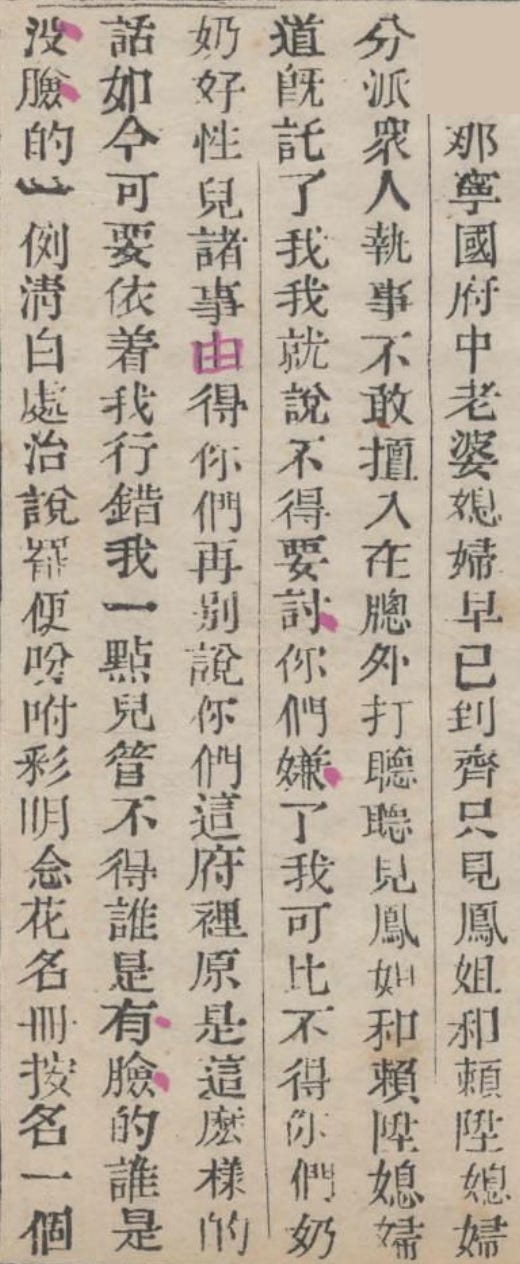
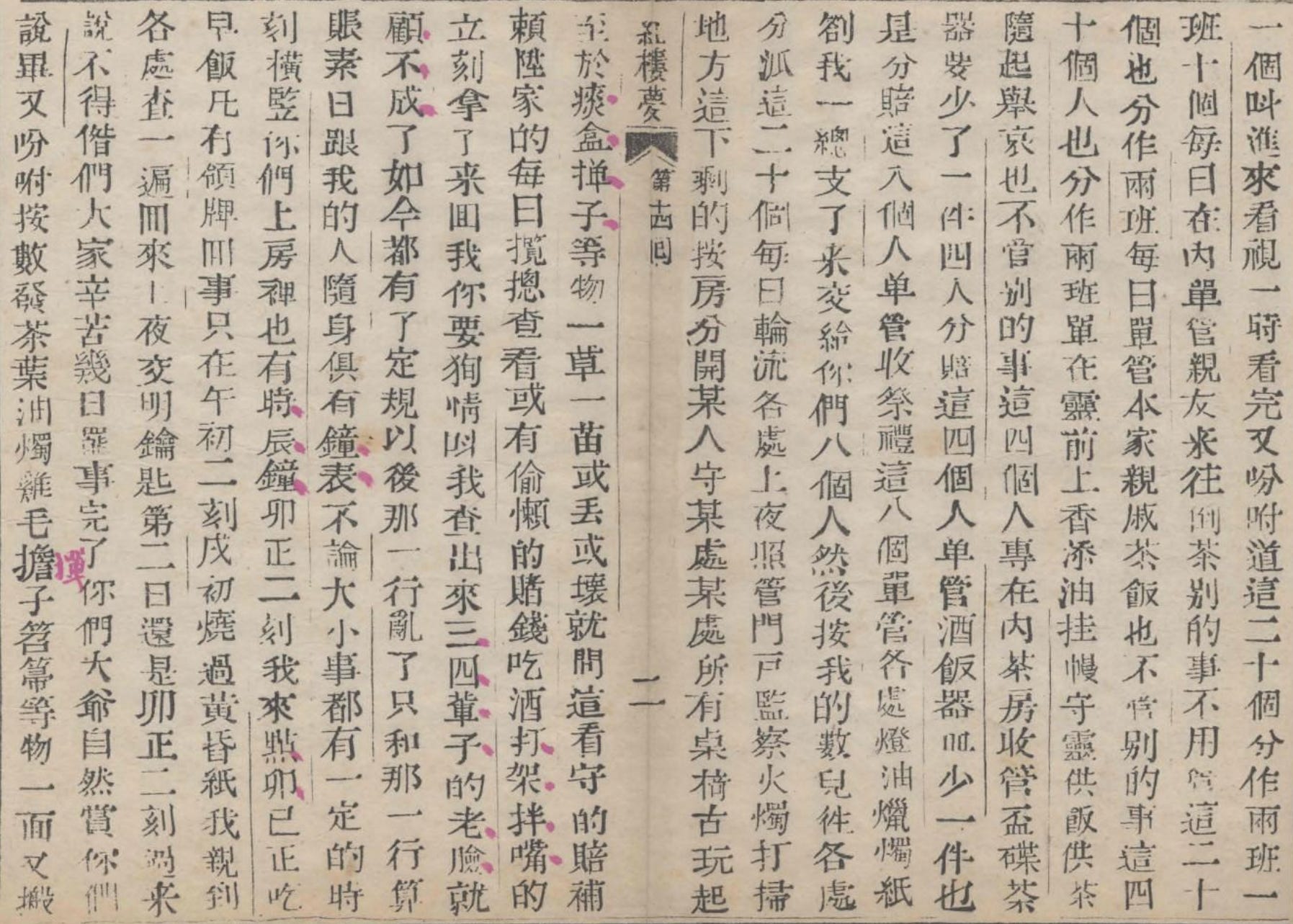
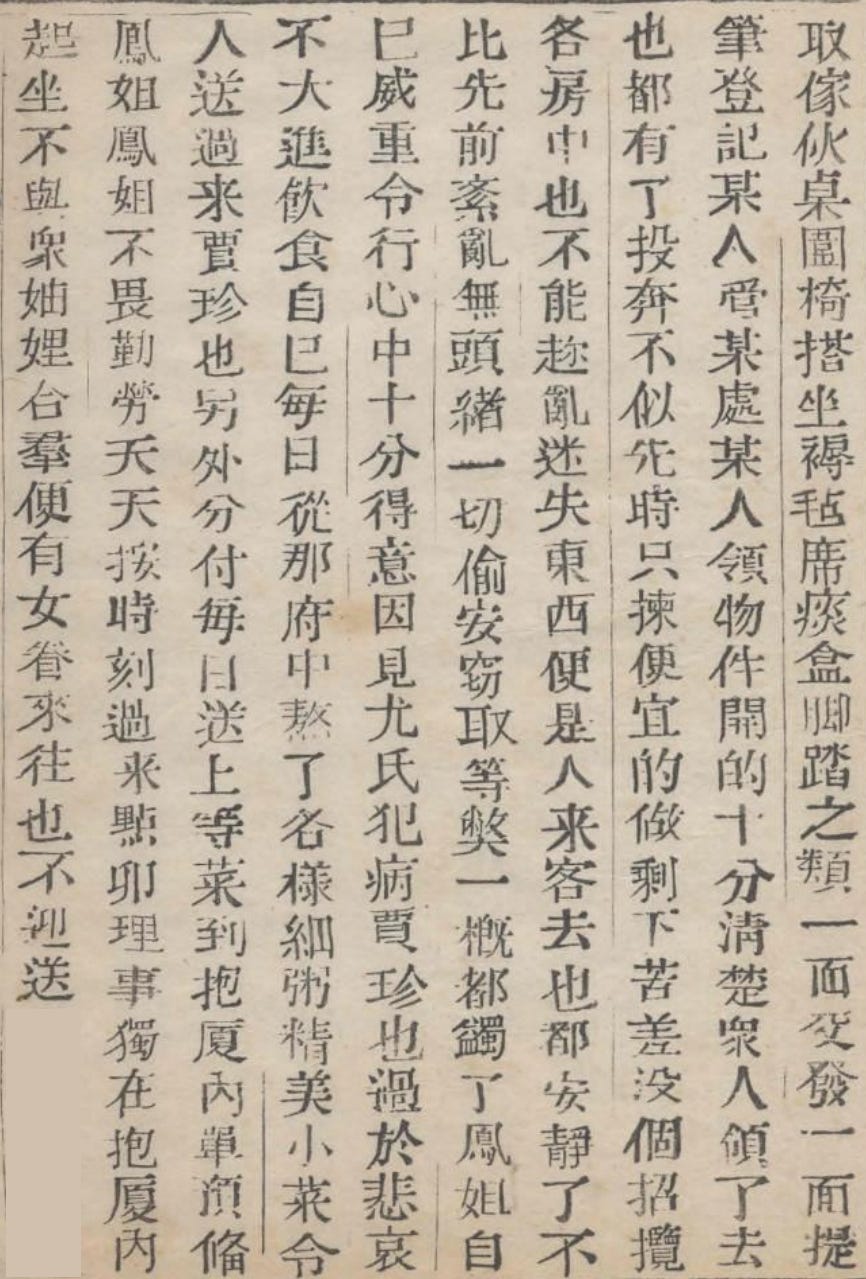
那寧國府中老婆、媳婦早已到齊,只見鳳姐和賴升媳婦分派眾人執事,不敢擅入,在窗外打聽。聽見鳳姐和賴升媳婦道:「既託了我,我就說不得要討你們嫌了。我可比不得你們奶奶好性兒,諸事由得你們。再別說你們這府裡原是這麼樣的話,如今可要依著我行。錯我一點兒,管不得誰是有臉的,誰是沒臉的,一例清白處治。」說罷,便吩咐彩明念「花名冊」,按名一個一個叫進來看視。一時看完,又吩咐道:「這二十個分作兩班,一班十個,每日在內單管親友來往,倒茶,別的事不用管。這二十個也分作兩班,每日單管本家親戚茶飯,也不管別的事。這四十個人也分作兩班,單在靈前上香、添油、掛幔、守靈、供飯、供茶、隨起舉哀,也不管別的事。這四個人專在內茶房收管杯碟茶器,要少了一件,四人分賠。這四個人單管酒飯器皿,少一件也是分賠。這八個人單管收祭禮。這八個人單管各處燈油、蠟燭、紙札,我一總支了來交給你們八個人,然後按我的數兒往各處分派。這二十個每日輪流各處上夜,照管門戶,監察火燭,打掃地方。這下剩的按房分開,某人守某處,某處所有桌椅古玩起,至於痰盒、撣子等物,一草一苗,或丟或壞,就問這看守的賠補。賴升家的每日攬總檢視,或有偷懶的、賭錢、吃酒、打架、拌嘴的,立刻拿了來回我;你要徇情,叫我查出來,三四輩子的老臉就顧不成了。如今都有了定規,以後那一行亂了,只和那一行算賬。素日跟我的人,隨身俱有鐘錶,不論大小事,皆有一定的時刻。橫豎你們上房裡也有時辰鍾。卯正二刻,我來點卯。巳正吃早飯。凡有領牌回事,只在午初二刻。戌初燒過黃昏紙,我親到各處查一遍回來,上夜交明鑰匙。第二日還是卯正二刻過來。說不得咱們大家辛苦幾日罷。事完了,你們大爺自然賞你們。」說畢,又吩咐按數發茶葉、油燭、雞毛撣子、笤帚等物;一面又搬取傢伙:桌圍、椅搭、坐褥、氈席、痰盒、腳踏之類。一面交發,一面提筆登記,某人管某處,某人領物件,開的十分清楚。眾人領了去,也都有了投奔,不似先時只揀便宜的做,剩下苦差,沒個招攬。各房中也不能趁亂迷失東西。便是人來客去,也都安靜了,不比先前紊亂無頭緒。一切偷安竊取等弊,一概都蠲了。
鳳姐自己威重令行,心中十分得意。因見尤氏犯病,賈珍也過於悲哀不大進飲食,自己每日從那府中熬了各樣細粥,精美小菜,令人送過來。賈珍也另外吩咐每日送上等菜到抱廈內,單與鳳姐。鳳姐不畏勤勞,天天按時刻過來點卯理事。獨在抱廈內起坐,不與眾妯娌合群,便有女眷來往,也不迎送。
Translation Notes
討嫌 means to dislike or loath.
花名冊 means a register of names.
拌嘴 means to bicker or argue.
徇情 means to show favoritism and not be fair.
鐘錶 must have been some sort of portable timepiece. Since we’re talking about China in the mid-18th century, this would have been something fabulously rare and probably very valuable. For Wang Xifeng’s servants to ordinarily carry around portable timepieces to know when to do their duties would have been extremely unusual, and is an obvious sign of wealth.
點卯 means an early morning roll call.
妯娌 is another word for sisters-in-law.
"for it": https://www.collinsdictionary.com/us/dictionary/english/be-for-it-be-in-for-it
"good and proper": https://www.collinsdictionary.com/us/dictionary/english/good-and-proper
You're correct, of course. "For it" is an old-fashioned British expression meaning "in big trouble", as you could probably guess. I don't think it would be a natural thing for an upper-class person like Wang Xifeng to say, so I think Hawkes intended her to be talking down to the servants in their own "language".