


Why Chinese Characters Aren’t Going Away
A little over a hundred years ago, there was a movement to try to push the Chinese language away from the Chinese characters.
Honestly, when you think about it, you can understand the sentiment. The Chinese written language can be daunting to learn even if you are a native speaker. If you want to achieve full fluency and a complete mastery of every possible character, you’ll be studying for a very long time.
But the problem that the anti-character movement has always had is that Chinese characters are actually a good way to transmit subtle information. And besides, Chinese characters have also historically been the linguistic glue that kept the vast country together.
You can see the influence of those characters to this day, actually - especially if you study dialects. For example, take the Taiwanese Hokkien word siáng, which means “who.” Despite the fact that the word is clearly only a single syllable, the most common way to write it per Taiwan’s Ministry of Education is two characters: 啥人, which literally means “what person.”
You’ll see the same thing if you try to say “yesterday” in Taiwanese Hokkien. The word is pronounced tsa̋ng and is clearly one word; yet the characters are written with two syllables, 昨昏, or literally “yesterday evening.”
You also see the same thing in the 訓讀字 (kunyomi) phenomenon in Japanese. This is where Japanese uses Chinese characters to write native Japanese words. It’s a pretty obvious example of places where the characters themselves contain meaning independent of their sound.
So, for example, 心 (heart) is pronounced こころ (kokoro) in Japanese, which is a native Japanese pronunication. And yet a compound word such as 心配 (anxiety) is pronounced しんぱい (shinpai), which is clearly a reading that comes from Chinese.
Of course, this becomes even more fun when you have the phrase 心を配る, which means to pay attention to something. Here 心 is prounounced こころ, and 配 is pronounced くば - both native Japanese pronounciations despite the fact that both characters use the Chinese pronunication when paired together.
Anyway, this phenomenon only happens because the Chinese characters themselves do indeed convey meaning. In fact, if you think about it for a little while, you’ll realize that the ability of Chinese characters to convey meaning on their own independent of pronunication makes them quite a bit more interesting than the relatively flat Latin alphabet.
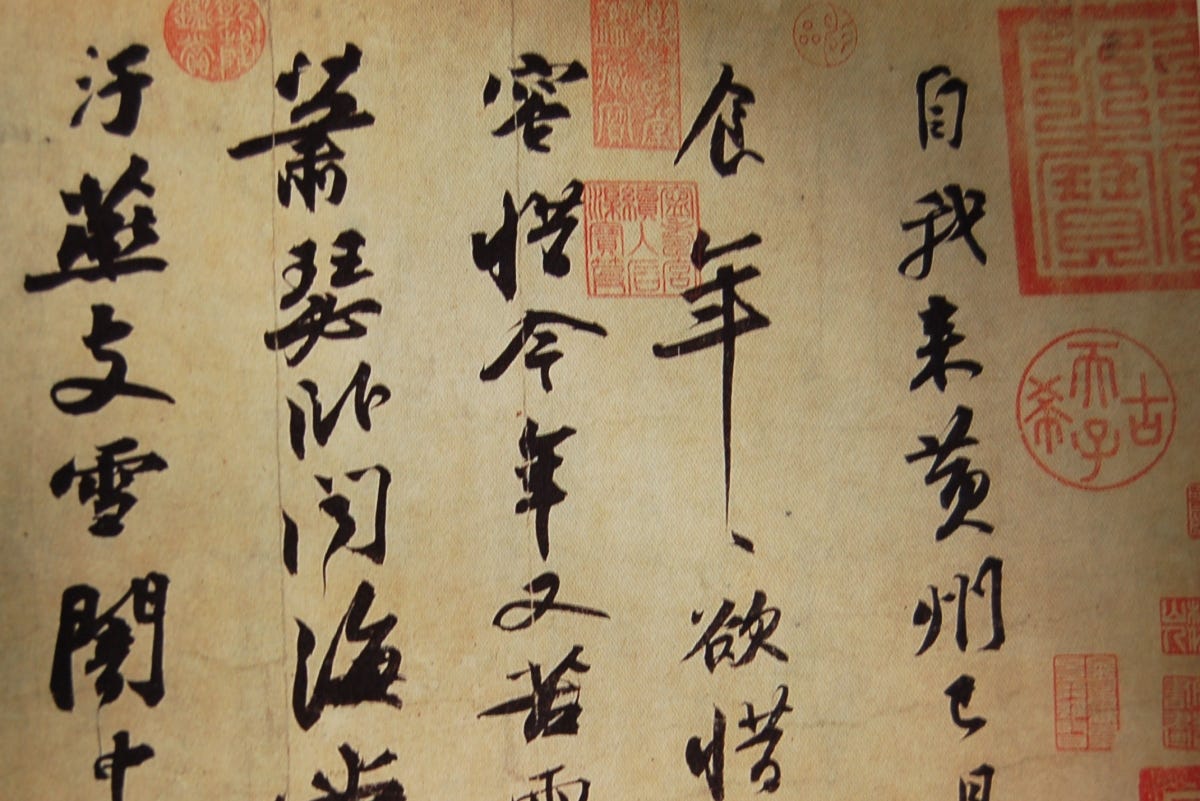
And, of course, this also helps explain why characters themselves can be a form of art independent of their meaning - something we see frequently in Chinese calligraphy:
Anyway, the long story short here is that you really should take the time to study Chinese characters if you’re going to learn the language anyway. It’s very rewarding, and is a lot more insightful and interesting than it seems at first.