


It’s common for those of us who are in English speaking countries to sing “What Child Is This?” at Christmas time. The words are a Christmas carol from 1865. The tune is “Greensleeves,” an English song about a lady in green sleeves that’s close to three hundred years older. Nobody hears the carol and wonders where the sleeves went. We all understand that the words and the tune came from different places.
That’s the key to the aria Baochai is about to recite.
In Tuesday’s post, Baochai told Baoyu that her favorite play has an aria to the tune “Mistletoe” (寄生草). The play is about a drunk monk who smashes up a monastery. There’s no mistletoe anywhere in it. David Hawkes calls the tune “Clinging Vine,” and that’s all you get. He gives you the name and moves on, and so do the Yangs. If you’ve ever read this scene in English and wondered what a vine has to do with a monk, here’s the answer.
The Title Is the Tune
寄生草 literally means “parasite plant,” the old word for plants like mistletoe that grow on other trees. It’s the name of a melody. Somebody wrote a song to it a long time ago, and the name stuck to the tune. After that, anyone could write new words for it, about anything at all, and the song would still be called “Mistletoe.”
Chinese has a word for a named tune like this: 曲牌 (qǔpái), or a “song label.” By Cao Xueqin’s time, playwrights had hundreds of them to choose from. When a playwright needed a song, he didn’t compose new music. He took a tune off the shelf and wrote words to fit it.
Cao Xueqin’s English Neighbor
The closest thing in English comes from almost exactly the same time. In 1728, when Cao Xueqin was a boy, John Gay put on The Beggar’s Opera in London. It was a huge hit, and nearly every song in it is a new set of words to an old tune the audience already knew. The printed script labels each song with its tune. Here, the “AIR LIV” tells you what tune it was:
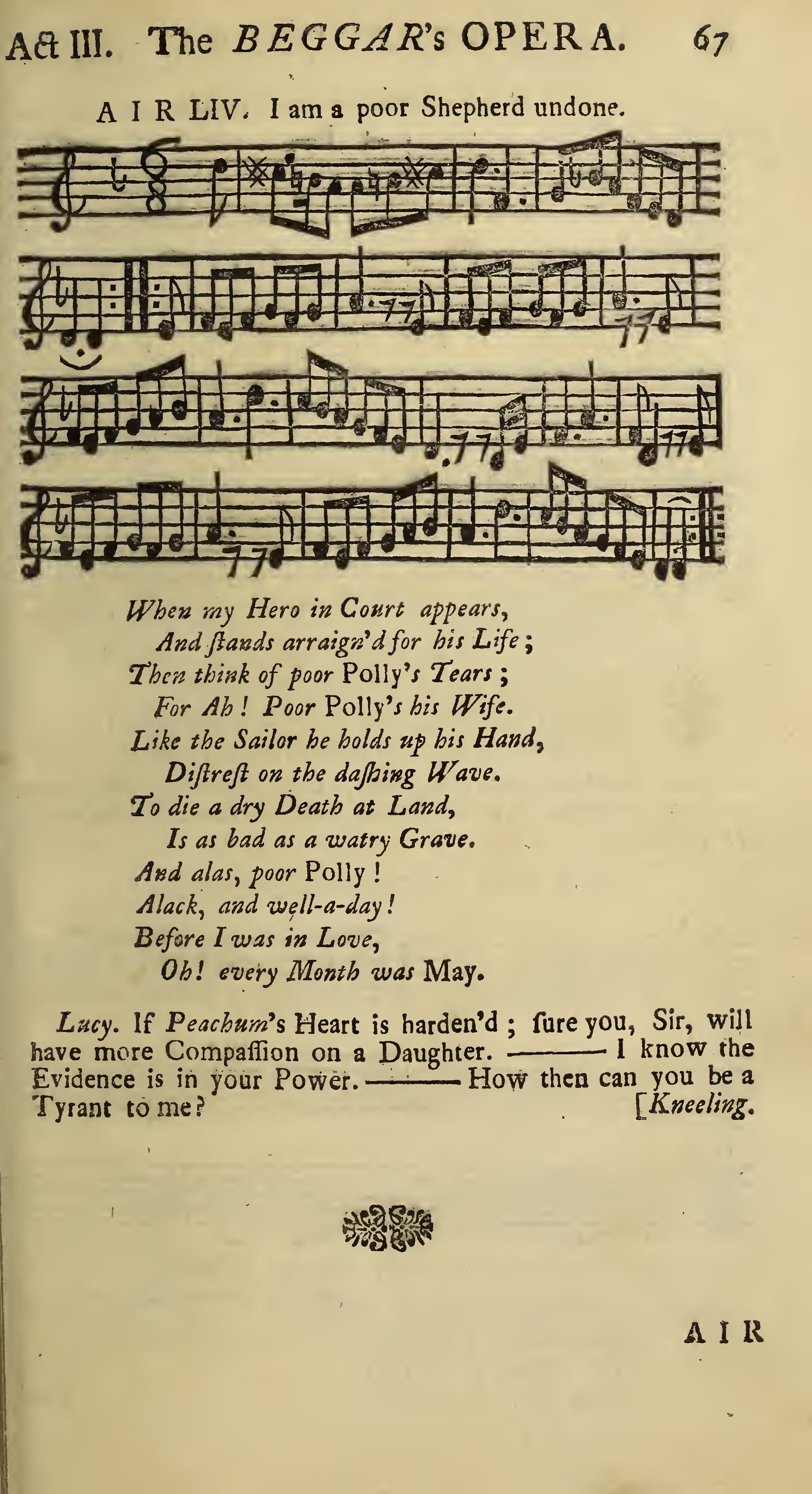
Picture a London audience hearing a favorite street ballad come back with new, wicked words about thieves and lawyers. That’s how a Chinese audience heard an aria. They already knew the tune. What they wanted to hear was what the writer did with it.
So if the title of a song doesn’t tell you what it’s about, what does it tell you?
The rest of this post is for members. For $5 a month you get every passage of the translation, the weekly podcast and every post like this one, and you help fund a complete modern translation.
