


New here? This is a companion to Chapter 22 of Dream of the Red Chamber, China's greatest novel, which I'm translating into modern English one scene at a time. Start with the Start Here guide, or meet the family on the Characters page.
Baoyu wrote two poems on the night he decided he didn’t need anyone.
The first was a Buddhist verse, a gatha, the kind a monk writes when he thinks he’s broken through. The second was a song. And the narrator tells us exactly why he wrote the second one: 又恐人看了不解. He was afraid people wouldn’t understand the first.
Hang on to that line.
What happened
If you’ve missed this week’s posts, here’s the short version. At a birthday party, someone said one of the child actors looked just like Daiyu. Baoyu shot Xiangyun a warning look to keep her from saying it, and she said it anyway. By the end of the night, both cousins were angry with him: Xiangyun for the look, Daiyu for the look and for being compared to an actor. He had tried to keep the peace and got scolded from both sides. (See Caught in the Middle.)
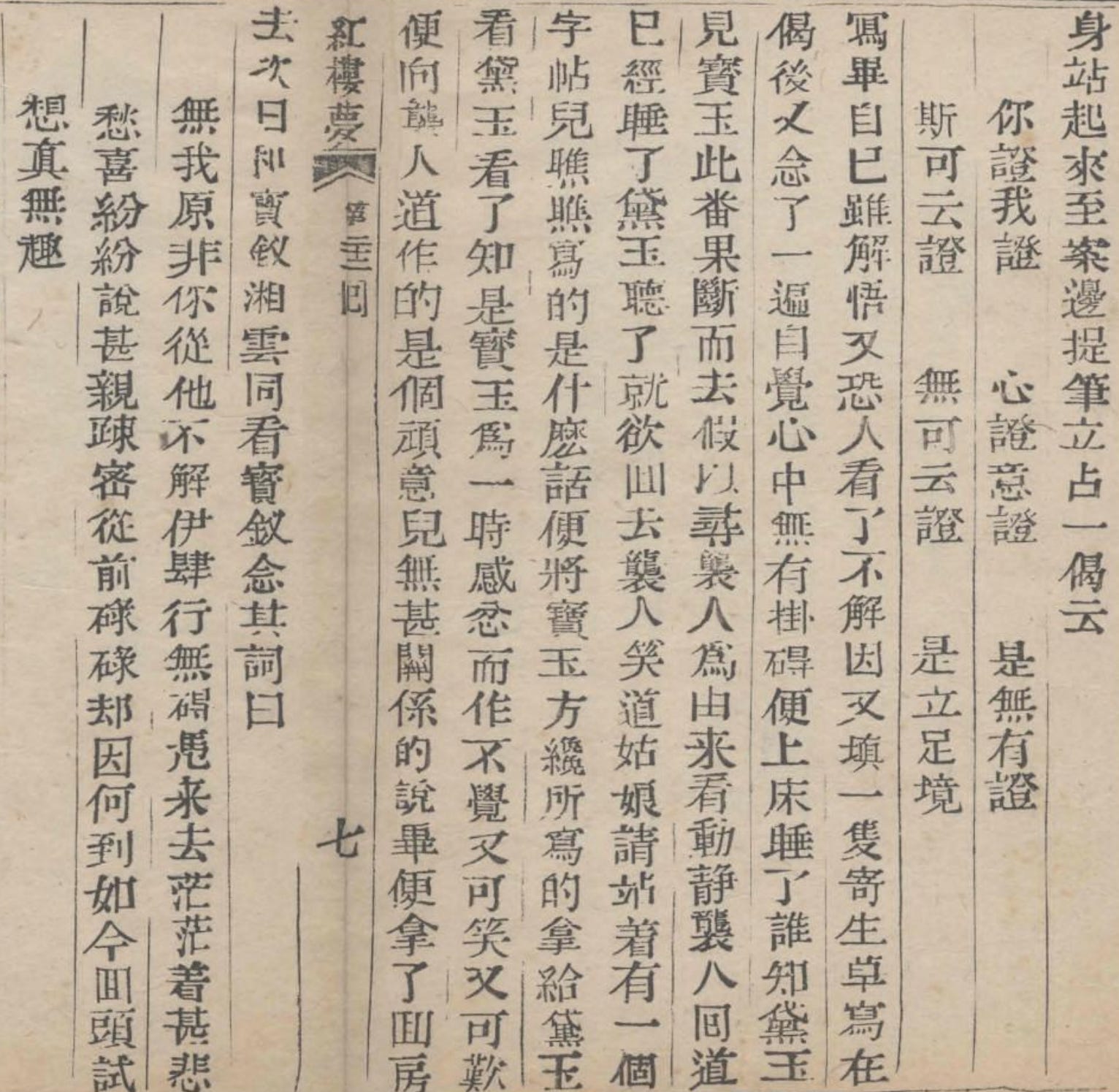
Alone in his room, he remembered a line from an aria his cousin Baochai had recited at the party: “Stark naked came I, stark naked I go, with nothing to tie me down.” He burst into tears. Then he got up, went to his desk and wrote this: (See Proof.)
你證我證,心證意證。是無有證,斯可云證。無可云證,是立足境。
You seek proof, and I seek proof,
Proof from the heart, proof from the mind.
Only when there’s no proof at all
Can we say that the proof is found.
When nothing’s left to call a proof,
There is a place to stand.
Then, to make sure people got it, he wrote a song to the same tune Baochai had recited, “Mistletoe” (寄生草):
無我原非你,從他不解伊,肆行無礙憑來去。茫茫著甚悲愁喜?紛紛說甚親疎密?從前碌碌卻因何?到如今,回頭試想真無趣!
If there is no “I,” there was never any “you.”
Let them fail to understand him.
I’ll go where I please with nothing in my way, and come and go as I like.
In this vast blur, what is there to grieve, to worry or to be glad about?
In all this tangle, why talk about who is close and who is distant?
All that toiling before: what was it for?
Now, when I look back and think it over,
It’s truly pointless!
The question
So here’s the question. Did Baoyu find what he thinks he found?
He says he did. He went to bed feeling that nothing weighed on his heart. That’s not a small claim. It’s the language of the Heart Sutra, one of the most famous Buddhist texts in China, describing a mind that has let go.
There are two ways to read these poems. One: a sensitive boy, pushed to the edge, suddenly sees through the whole game of who loves whom, and lets it go. Two: a hurt teenager dresses up a sulk in borrowed Buddhist clothes.
To decide, you have to see how the poems work, because the evidence is in the details, and some of it is better than you might expect.
Baoyu thinks he’s found a place to stand. Tomorrow, Daiyu has a question for him, and that post is free for everyone. Subscribe and it comes straight to your inbox.
