


Late Spring?
A friend of mine had a question after reading yesterday’s poem.
The question revolves around these two lines:
軟襯三春草,柔拖一縷香。
They softly contrast with the late spring grass,
Gently leaving a single sweet scent.
In particular - should we call 三春 “late spring,” or something else?
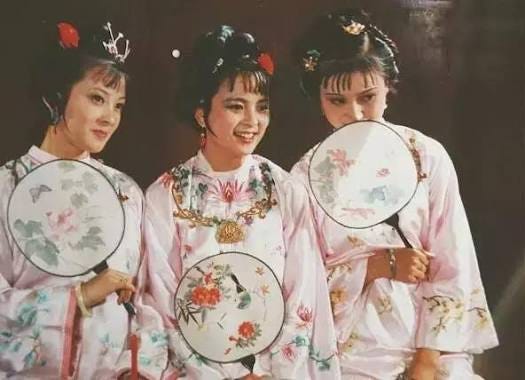
First of all, you need to realize that the phrase 三春 always has a deeper meaning in Dream of the Red Chamber. The character 春 here refers to the names of the four Jia family “sisters:” Jia Yuanchun, Jia Yingchun, Jia Tanchun, and Jia Xichun.
We were actually introduced to this way back in chapter 2, though it’s easy to forget:
The Spring Cycle

After a reader suggestion, I’ve decided to change the order of each section. This means that most future paid posts will be almost entirely behind the paywall. My hope is that this will make it easier for readers who do not read Chinese to follow.
雨村道:「更妙在甄家風俗:女兒之名亦皆從男子之名,不似別人家另外用這些『春』『紅』『香』『玉』等豔字。何得賈府亦落此俗套?」子興道:「不然。只因現今大小姐是正月初一所生,故名元春,餘者都從了『春』字。上一輩的卻也是從弟兄而來的。現有對證:目今你貴東家林公的夫人即榮府中赦政二公的胞妹,在家時名喚賈敏。不信時,你回去細訪可知。」
“What’s even more remarkable,” remarked Yucun, “is the naming custom in the Zhen family. Their daughter’s names follow the same pattern as their son’s names. They’re not like the other households, which insist on gaudy names like ‘spring,’ ‘red,’ ‘fragrant,’ or ‘jade.’ How could the Jia family stoop to such vulgar customs?”
“It’s not like that,” replied Zixing. “It’s only because their oldest daughter was born on the first day of the New Year. That’s why they called her ‘Primordial Spring,’ or ‘Yuanchun.’ The others just followed with the same ‘Spring’ character [Chun]. The daughters of the previous Jia generation, however, did follow the naming pattern of their brothers. Here’s the proof: the wife of your employer, Master Lin, is the full younger sister of the Rong mansion’s Jia She and Jia Zheng. She was named Jia Min. If you don’t believe me, ask them yourself when you go back.”
In general, the phrase 三春 refers to the three remaining Jia family sisters, now that Jia Yuanchun is part of the Imperial harem.
Now, there are actually two different ways to think about 三春. One is “the three springs,” or the three girls with “Chun” in their name, as I described above. And the other way is to think about the three different time periods within spring.
These time periods are pretty easy to understand. You’ve got 初春, or the first part of spring; 仲春, or the middle part of spring, and 暮春, or the late part of spring.
Now, you can assign numbers to each of those. If you were to use numbers to differentiate the different time periods within spring, then 三春 would naturally be the same as 暮春, or “late spring.” That’s how I translated 三春 in yesterday’s poem.
I’ve used the same translation approach when we came across 三春 in the past, too. See this post, for instance:

三春爭及初春景?虎兔相逢大夢歸。
Can the late spring rival the first dawn of spring?
When the tiger meets the rabbit, the great dream is done.
In this poem, the assocation between 三春 (the third spring, late spring, or whatever) and 暮春 (late spring) is obvious. It’s written in direct contrast to 初春. And there’s a really good chance that this poem refers to one of the three Jia sisters.
However, there are also times where 三春 really can’t be translated as “late spring.” Take this, for example:

將那三春看破,桃紅柳綠待如何?
As she sees through the splendor of the three springs,
She wonders what use the reds and greens of spring are.
In this case, 三春 absolutely needs to refer to all three of the periods of spring, rather than only the last one. Note as well the reference to the colors green and red, which is something that we’ve seen come up pretty frequently in chapters 17 and 18.
There’s also a poem where 三春 is almost impossible to translate to English:

勘破三春景不長,緇衣頓改昔年妝。
可憐繡戶侯門女,獨臥青燈古佛旁!
Clearly seeing that the spring won’t last forever,
She suddenly changed into dark robes.
What a shame that this daughter of wealth
Now sleeps alone by the dim lamp of an ancient Buddha!
I’m really not sure what to do with 三春 here, unless we translate it as “late spring” again. This one is a head scratcher.
Anyway, in the poem we saw yesterday, 三春 is mentioned in connection with an actual place. While it very likely refers to the three Jia sisters, the context of the visual image makes the most sense if we simply call it “late spring,” and not something like “the three springs:”
蘅蕪滿靜苑,蘿薜助芬芳。
軟襯三春草,柔拖一縷香。
Wild ginger fills the quiet courtyard,
The climbing vines add their fragrance.
They softly contrast with the late spring grass,
Gently leaving a single sweet scent.
Of course, if you think about what this poem represents, it’s pretty clear that it refers to a girl whose appearance and beauty sets herself apart from the three Chun sisters.
I’ll also note in my own defense that both David Hawkes and the Yangs struggle with this passage. Hawkes translates it as “summer” for some bizarre reason:
Fragrance of flower-drifts in these quiet confines
Mingles with headier scents of eglantines,
And summer’s herbs in a soft, spicy bed
Their aromatic perfumes subtly spread.
The Yangs at least call it “spring,” but they seem to get the picture completely wrong:
Alpinia fills the courtyard free from dust,
By climbing fig its fragrance reinforced;
Softly they heighten the fresh green of spring,
Gently they trail their perfume, ring on ring.
Anyway, I’d love to know what you think about all of this!
I do actually recall the three springs bits here and there but only because you brought it up again. Otherwise I never would have remembered hahaha. So massive props for managing these allusions and bringing this up even though it's been over a year since those previous appearances of this phrase.