


When you were a kid, did you ever tease somebody else for their pronunciation? Or, even worse, have you ever been teased yourself for saying something incorrectly?
Previously: Baoyu and Daiyu had their first real fight, which ended with both of them saying the same thing: “It’s my own heart I care about.” (See The Big Fight.)
Then a third girl walks in, calls Baoyu by the wrong name, and turns the scene completely around. In about five lines the lovers’ quarrel turns into a three-way roast. Watch who gets burned worst, and notice who isn’t even in the room.
Who’s here
Lin Daiyu · Jia Baoyu · Shi Xiangyun · and, without setting foot in the room, Xue Baochai
Two Translators Disagree
Hawkes has Xiangyun say “Couthin,” and the Yangs have her say “Ai brother,” with a footnote. Neither one lets an English reader hear the joke. Mine, and why, is below.
The Translation
When she heard Jia Baoyu’s expression of love, Lin Daiyu lowered her head silently. After a long while, she finally spoke.
“All you ever do is complain that people are always getting angry at you,” she said. “You have no idea how miserable you make people! Just look at the weather today. It’s obviously colder. So why on earth did you take off your fur cape?”
“Who says I wasn’t wearing it?” laughed Baoyu. “When I saw you get upset, I was so frustrated that I became hot, and so I took it off.”
Daiyu sighed. “And then you’ll catch a cold. They’ll make you go without food, and you’ll be whining for something to eat again.”
The two of them were still talking when Xiangyun came in laughing. “Love Brother! Sister Lin!” she said. “You two get to play together every single day. I finally manage to come over, and you won’t pay any attention to me at all!”
“Of all people, it’s the one with the lisp who loves to talk the most,” laughed Daiyu. “She can’t even say ‘Second Brother.’ It’s just ‘Love Brother’ this and ‘Love Brother’ that. When we play our dice game later on, you’ll be yelling ‘One, love, three’ when you roll the dice!”
“You know, if you keep imitating her lisp,” laughed Baoyu, “you’ll be speaking with a lisp, too.”
“She never gives anybody an inch,” complained Xiangyun. “All she knows how to do is pick on people.” She turned to Daiyu. “Even if you really are better than everybody else in the world, there’s no reason to make fun of every single person you meet. I’ll name one person. If you dare to pick on her, I’ll give you credit.”
Daiyu asked who it was.
“If you dare to find fault with Sister Bao,” said Xiangyun, “then I’ll admit you’re really something.”
Daiyu gave a cold laugh when she heard this. “I wondered who you meant. So it’s her! And how could I ever dare to find fault with her?”
Baoyu jumped in before she could finish and quickly changed the subject.
“Of course I’ll never be your match as long as I live,” laughed Xiangyun. “All I can do is pray that someday you marry a man with a lisp, Sister Lin. Then you’ll get to listen to him go ‘love-ah-eh’ every minute of every day! Dear Buddha! I hope I live to see it!”
This made Baoyu laugh, and Xiangyun quickly turned around and ran off.
If you want to know the whole story, read the next chapter.
We offer two free passages every two weeks. This was one of them. In the next one, Daiyu runs after Shi Xiangyun, but Baoyu plants himself right in the doorway. The next thing you know, he’s back in the girls’ room even before they’re out of bed. The best way to enjoy this blog is to become a paying subscriber. That gets you every single passage, as well as the weekly podcast, and all of this for only $5 a month!
The Chinese Text
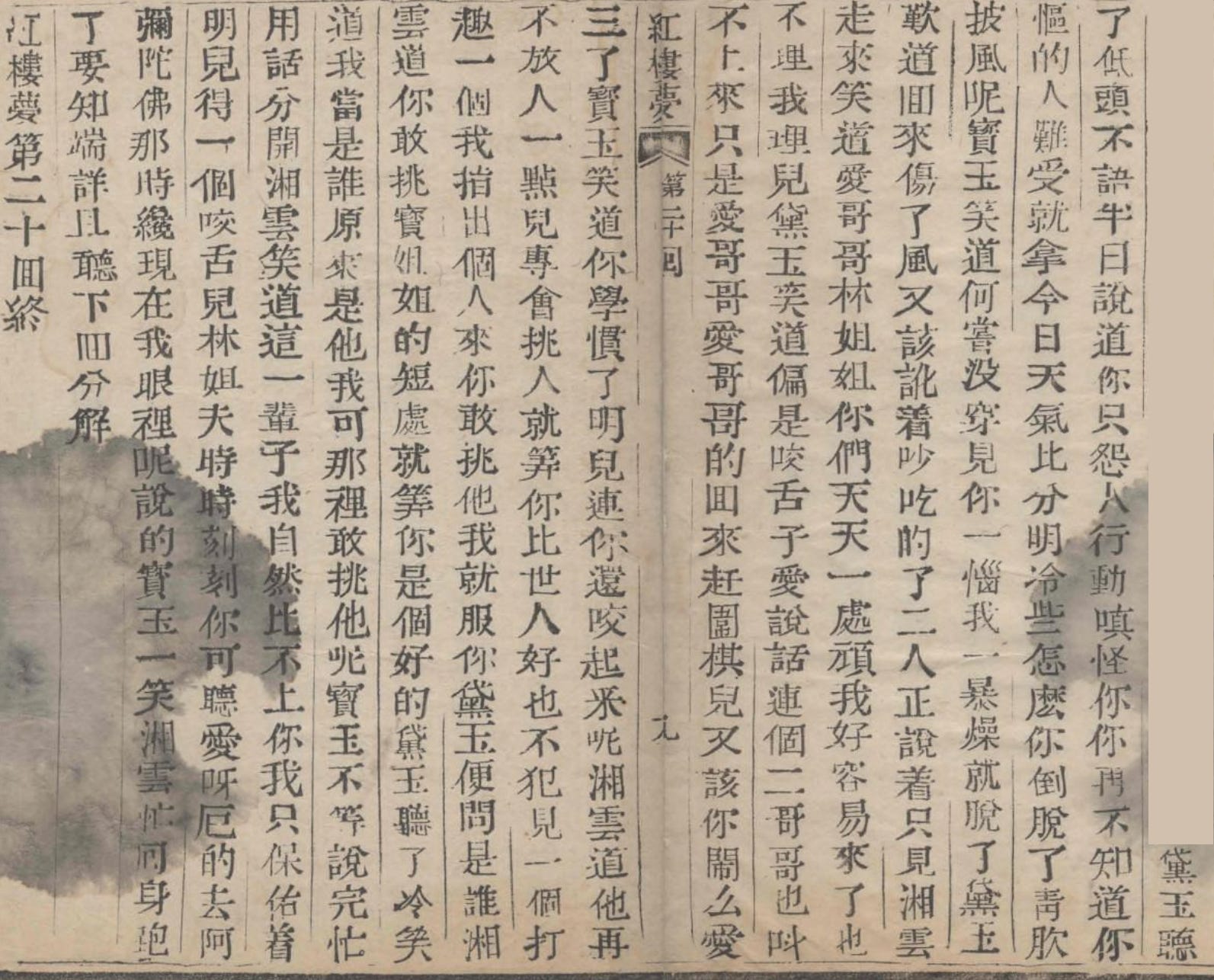
黛玉聽了,低頭不語,半日,說道:「你只怨人行動嗔怪你,你再不知道你嘔的人難受!就拿了今日天氣比,分明冷些,怎麼你倒脫了青肷披風呢?」寶玉笑道:「何嘗沒穿?見你一惱,我一暴躁,就脫了。」黛玉嘆道:「回來傷了風,又該餓著吵吃的了。」
二人正說著,只見湘雲走來笑道:「愛哥哥,林姐姐,你們天天一處頑,我好容易來了也不理我一理兒!」黛玉笑道:「偏是咬舌子愛說話,連個『二哥哥』也叫不上來,只是『愛哥哥』『愛哥哥』的。回來趕圍棋兒,又該你鬧『幺愛三』了。」寶玉笑道:「你學慣了,明兒連你還咬起來呢。」湘雲道:「他再不放人一點兒,專會挑人。就算你比世人好,也不犯見一個打趣一個。我指出個人來,你敢挑他,我就服你。」黛玉便問是誰。湘雲道:「你敢挑寶姐姐的短處,就算你是個好的。」黛玉聽了,冷笑道:「我當是誰,原來是他!我可那裡敢挑他呢?」
寶玉不等說完,忙用話分開。湘雲笑道:「這一輩子,我自然比不上你。我只保佑著明兒得一個咬舌兒林姐夫,時時刻刻,你可聽『愛呀厄』的去!阿彌陀佛!那時才現在我眼裡呢。」說的寶玉一笑,湘雲忙回身跑了。
要知端詳,且聽下回分解。
Reading Notes
Get ready, guys, because we’ve got a lot to go through today.
行動 (xíngdòng). Normally this means “action.” However, here it has its older meaning of “often” or “frequently.” It’s similar to the modern Chinese word 動不動, which means “often” or “frequently.”
嗔怪 (chēnguài) means to blame or rebuke. In other words, when Lin Daiyu says 你只怨人行動嗔怪你, she means “All you do is complain that people are always getting angry at you.” Daiyu is throwing Baoyu’s own complaint from the quarrel back at him.
嘔 (ǒu) means “to vomit” in modern Chinese. However, it means something different here. It means “to provoke” or “to make someone furious,” and exists in modern Chinese as the verb 嘔氣. And so 你嘔的人難受 is “you make people so upset they can’t stand it.”
青肷披風 is a cape (披風) lined with 青肷 (qīngqiǎn). 肷 is the soft fur you find on the belly of an animal, and 青 means a dark, blue-black or gray color. Chinese dictionaries disagree about which animal: some say the fur came from a fox, others say it was from a gray squirrel. That doesn’t really matter; all we care about is that it was a warm and expensive lining made of some kind of fur. By the way, this is another of the novel’s clothing details. Remember that Xiren noticed Baoyu’s new clothes when he showed up at her house in Chapter 19. (See Xiren’s House.)
Don’t be surprised if you notice that the way the characters talk to each other seems a lot different from the narration of the book itself. Cao Xueqin was an expert at writing authentic dialogue. If you’re familiar with colloquial Chinese, you’ll feel like you can hear the words of these two being spoken right from the page.
暴躁 (bàozào) usually means irritable or worked up, but Baoyu is playing a rhetorical game here. He’s saying that he got so heated over Daiyu’s mood that he just had to take his cape off. It’s half an excuse and half a confession. Notice that Daiyu doesn’t argue about this point. All she does is worry about him.
回來 (huílai) here is actually from the Beijing dialect. It doesn’t mean “come back;” rather, it means “in a little while” or “later on.” Like I said, the colloquial nature of the spoken Chinese here is quite remarkable.
餓著吵吃的 is a pretty difficult phrase to understand. It literally means “go hungry, and then complain that you want to eat.” Back in those days it was common for people to recommend curing a cold by starving until it went away. We have the reverse traditional concept in English: think of the old phrase “feed a cold, starve a fever.” As she teases Baoyu, Daiyu is predicting exactly what will happen: he’ll catch cold, they’ll stop feeding him, and then he’ll make a fuss for something to eat.
When Shi Xiangyun enters, things get hard to translate. Buckle your seat belt, because this is going to be a bumpy ride.
Shi Xiangyun refers to Jia Baoyu as 愛哥哥, not 二哥哥. This joke is basically the point of this entire scene. As you recall, Baoyu is the second son of Jia Zheng and Lady Wang (his older brother, Jia Zhu, died young; we read about this way back in Chapter 2, so it’s okay if you’ve forgotten). The girls call him 二哥哥 (èr gēge), or “Second Older Brother,” because he is the second son in the family. Now, Shi Xiangyun has a lisp. When she speaks, 二 (èr) sounds like 愛 (ài), which means “love.” So Baoyu becomes 愛哥哥, “Love Brother.”
But why would 二 turn into 愛? In the Beijing dialect, 二 is said with the tongue curled back, something closer to “arrr.” If you’ve ever been to northern China, you know that Chinese people there sound kind of like pirates to the untrained ear. Now, if you take away that curled tongue, you’re left with something very close to ài. (In Bopomofo, ㄦˋ becomes ㄞˋ; we’ll learn more about this in Monday’s video.)
Of course, the word that comes out is the worst one possible, especially given the scene. Xiangyun walks into the room right after Baoyu and Daiyu’s fight, the one where they’re talking about what they really feel in their hearts. And the first thing that Xiangyun does is call Jia Baoyu “Love Brother!”
I’ve translated 愛哥哥 as “Love Brother,” which keeps the meaning but loses the sound. There’s no English mispronunciation of “Second” that turns into “Love.” We’ll talk more about this choice, as well as how other translators have tried to save this joke, in our podcast tomorrow.
林姐姐, “Sister Lin.” Xiangyun calls Daiyu 姐姐, “older sister,” which indicates that she is younger than Daiyu. They’re cousins, not sisters; see the note on 姐姐 and 妹妹 in Chapter 18. (See Green Jade and Green Wax.)
偏是咬舌子愛說話. 咬舌子 (yǎoshézi), literally “tongue-biter,” is the everyday word for someone with a lisp. Notice that Daiyu’s insult has its own 愛 in it: the lisper “loves” (愛) to talk. Knowing Daiyu, she probably chose that word on purpose as a joke.
By the way, this also explains the second half of the chapter title, 林黛玉俏語謔嬌音, which means “Lin Daiyu Speaks with Wit and Teases a Feminine Voice.” The “feminine voice” refers to Xiangyun’s lisp, and this scene is that title.
趕圍棋兒 is the dice-and-Go-pieces board game the maids were playing back in Chapter 19. (See The Loud Plays.)
幺愛三. We just saw 幺 (yāo) a few posts ago, when Ying’er clapped her hands and cried “One! One!” at Jia Huan’s roll. (See Jia Huan Cheats at Dice.) In dice and card games, 幺 means “one,” or the part of the die with only a single dot. Actually, this number is still used today. When Chinese speakers read out a phone number or a room number, they usually say yāo instead of yī for “1.” Players call out their numbers as the dice land, so Xiangyun’s “one, two, three” (幺二三) would come out “one, love, three” (幺愛三). 鬧 means to make a racket, so Daiyu is picturing her shouting it across the table.
Baoyu then starts teasing Lin Daiyu. 你學慣了 means “once you’ve gotten used to imitating her,” and 咬起來 means “to start speaking with a lisp.” Baoyu tells Daiyu that she’ll find herself speaking with the same lisp if she keeps it up, and, of course, Baoyu is saying this in part to protect Xiangyun.
Xiangyun then turns to Baoyu to complain about Daiyu. 他再不放人一點兒,專會挑人 is Xiangyun’s complaint about Daiyu, said right in front of Daiyu. Remember that 他 meant either “he” or “she;” the 她 you’re familiar with didn’t come around until the early 20th century. Since this is really hard to follow, I added “She turned to Daiyu” to make the switch clear in English. The Chinese original is an excellent example of how Chinese really is a contextual language. Anyway, 挑 (tiāo) is to pick at someone’s faults, and 不犯 means “there’s no need to” or “it isn’t worth it.” 打趣 is to make fun of or tease.
我就服你: “then I’ll give in to you” or “then I’ll admit you’re the best.”
In 寶姐姐的短處, 寶姐姐 is “Sister Bao.” This refers to Xue Baochai, who is older than Xiangyun. 短處 is a shortcoming. Xiangyun talks about the one person Daiyu can’t attack without looking jealous. That’s exactly what the big fight was about, and exactly what Daiyu’s “cold fragrance” jab in Chapter 19 was about too. (See Jia Baoyu Visits Lin Daiyu.)
When Daiyu says 我當是誰,原來是他 (”I wondered who you meant, so it’s her“), she’s being purely sarcastic. Daiyu doesn’t actually say anything bad about Baochai. She just makes it obvious that she’d love to.
寶玉不等說完,忙用話分開: Baoyu doesn’t let her finish, and quickly “uses words to separate them,” that is, changes the subject before it turns into a real fight. Getting stuck between two girls who are both his cousins is a role he’ll find himself in again and again.
保佑 (bǎoyòu) is to bless or protect, and usually refers to the blessings or protection of a deity. 我只保佑著 is “all I can do is pray that…”
林姐夫. 姐夫 (jiěfu) is an older sister’s husband, a brother-in-law. Since Xiangyun calls Daiyu “older sister,” Daiyu’s future husband would be her 姐夫, so 林姐夫 is “Brother-in-law Lin,” that is, the man Sister Lin marries. A 咬舌兒林姐夫 is a brother-in-law who speaks with a lisp. Again, the thing that matters the most here is context. English isn’t quite as contextually heavy as Chinese, which is why I’ve translated this as “marry a man with a lisp, Sister Lin.”
Have you noticed how the teenage girls in this household tease each other about marriage all the time? Remember, though, that Baoyu and Daiyu just had a deep fight about Baoyu spending time with other women. Remember, too, that Baoyu is still standing there listening to all of this. His laughter might not be because he finds it funny, but because he’s trying to defuse a situation that is awkward and uncomfortable for him.
愛呀厄 (ài ya è) is the sound Daiyu would hear all day from her lisping husband. We learned about 愛 above. 厄 (è) seems to be the other way a lisper’s 二 comes out: drop the curled tongue from “er” and you get è. (In Bopomofo, ㄦˋ loses its curl and becomes ㄜˋ.) So “love-ah-eh” is Xiangyun doing an impression of a person speaking with a lisp; at least that’s my opinion. The text doesn’t make it clear what this future husband would be saying, and there really isn’t much need to speculate.
那時才現在我眼裡呢. 現 means 顯現, “to appear” or “to show.” Literally, “only then will it appear before my eyes,” that is, “then I’ll finally see you get what’s coming to you.”
The Other Translations
Hawkes
Poor David Hawkes.
He tries in this section, but he can’t really get it to work. He has Xiangyun say “Couthin Bao, Couthin Lin,” and then has Lin Daiyu make fun of that lisp.
The problem is that the “love” connection is gone. It completely defeats the purpose of the original joke. He tries to make up for it by saying that she’ll be cheering for “thicktheth” and “theventh” when they play their dice game. He also has Xiangyun say things like “yourthelf” and “elthe” (instead of “yourself” and “else”). But, again, none of this has anything to do with the actual meaning of the passage.
Hawkes translates the nonsensical 愛呀厄 as “ithee-withee, ithee-withee.”
Yang
The Yangs try to explain the joke. They have Xiangyun say “Why, Ai brother and Sister Lin!” and offer a footnote:
Erh means “two” or “second” and ai “love.”
It’s okay, but it still means nothing if you don’t already speak Chinese. What’s going on here is an interesting linguistic comment. They really should have made a longer footnote with more explanation.
They translate 愛呀厄 as “love”: “I just pray that you’ll marry a husband who talks like me, so that you hear nothing but ‘love’ the whole day long.”
End screen
We’ll explain how 二 turns into 愛 on Monday, and we’re going to use Bopomofo to do it.
Next in the story: Daiyu chases Xiangyun to the door, and Baoyu gets in the way (Sunday)
Go deeper: Why Every Great Love Story Needs A Good Fight
Meet them: Shi Xiangyun / All the characters
Get the next passage free in your inbox!