


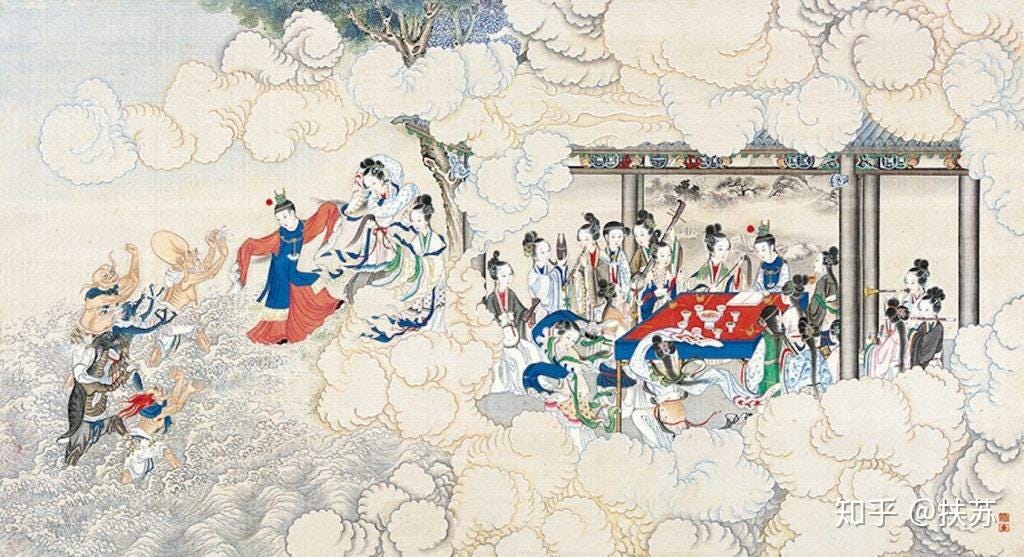
赤條條,來去無牽掛. “Stark naked I came, stark naked I go, with nothing to tie me down.”
People in China still say this. You’ll hear it about someone who quits a job and walks out with one box, or a bachelor with no family to answer to. It comes from a song sung by a drunk, violent, hugely popular monk, as he’s being thrown out of the only home he has.
Yesterday Xue Baochai recited that song for Jia Baoyu, and he loved it. (See Stark Naked Came I) Today: who the monk is, what he’s saying, and why a song this rough lands so hard on a boy like Baoyu.
Who Is Lu Zhishen?
On Tuesday I told you the short version: Lu Zhishen (魯智深) is a hero from Water Margin (《水滸傳》), the great Ming novel about outlaws. Here’s the longer one, because the song only makes sense if you know it.
He starts out as Lu Da (魯達), a military officer with a bad temper and a good heart. He meets a young singer and her father who are being cheated by a local butcher, a bully who calls himself “the Lord of the West” (鎮關西). Lu Da goes to the butcher’s shop to pick a fight, and he kills the man with three punches. He didn’t mean to kill him, but it doesn’t matter. He has to run.
The singer’s father has found shelter with a rich man, Squire Zhao (趙員外), and the squire hides Lu Da on his estate. When the authorities get close, Zhao comes up with a plan: he has promised to sponsor a monk at the great monastery on Mount Wutai (五台山), so Lu Da can be that monk. The abbot, Zhizhen (智真長老), shaves his head and gives him a monk’s name, Zhishen.
It doesn’t take. Lu Zhishen can’t keep the rules, and he can’t stay away from wine. He gets drunk twice, and the second time he comes back up the mountain, smashes the monastery gate and knocks over the statues of the guardian gods that stand inside it. The other monks want him gone, and the abbot has no choice. And so he sends Lu Zhishen away to another monastery, in the capital.
That’s the play Baochai picked. The scene is called At the Monastery Gate (《山門》, often 《醉打山門》), and it comes from a Qing play by Qiu Yuan (邱園). The aria is the moment Lu Zhishen says goodbye to the abbot.
A Goodbye From a Man Like That
Which is why it’s such a strange song. You’d expect a drunk who just smashed up a monastery to rage, or to joke his way out the door. Instead he thanks the man who’s throwing him out. He wipes his eyes. And then he walks off with nothing, and says he likes it that way.
So what does Baoyu, a rich boy who has never wanted for anything, hear in it? And why is Baochai, of all people, the one who hands it to him?
If Lu Zhishen's story hooked you, Sunday's podcast is about Chinese lantern riddles, with a real Qing riddle for you to guess before I give the answer. Free subscribers hear that part. Subscribe and it comes to your inbox.
