


Thoughts On Qin Zhong’s Journey To Hell
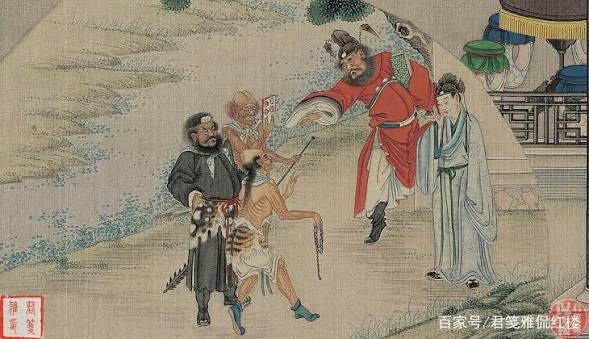
If you haven’t read it yet, you really need to read my translation post yesterday, where we saw Qin Zhong battle against the bureaucracy of the underworld:

Now, if you’re familiar with the great Chinese classic novels, you know that it wasn’t unusual for the afterlife to be described as a complex government system that mirrored the system of the Chinese empire. In fact, Journey to the West (西遊記) probably exemplifies this fact better than any other Chinese novel.
But this passage in Dream of the Red Chamber is simply impossible to put down. In fact, I was almost late to my day job the other day because I was so wrapped up in translating that passage.
Anyway, here are a few scattered thoughts that have come to my mind as I’ve been reflecting on this:
Everybody wants to put the blame on emotions. Remember that Jia Baoyu is told by the servant Li Gui to stop crying, and is warned that his friend Qin Zhong would somehow become weaker if Jia Baoyu expressed his emotions.
This is bizarre logic, of course, and was likely as strange to readers back in the late 18th century as it is today. Jia Baoyu’s emotional expression has absolutely nothing to do with Qin Zhong’s physical state. And yet Jia Baoyu forces himself to suppress his sobs and keep a straight face as he constantly tells his dying friend that he is here.
Of course, if we were forced at gunpoint (or by an overzealous literature teacher) to find some cause for Qin Zhong’s terminal illness, we’d probably blame Qin Zhong himself. After all, he’s the one who was shamelessly running around with the young nun Zhineng. But, on the other hand, it’s likely that his sickness is just one of those things that happens.
But putting the blame on Jia Baoyu for expressing any emotion just feels harsh and cruel.
The underworld judge is scared of Jia Baoyu. There really isn’t much of a logical reason given for the judge’s sudden reaction upon hearing the name Jia Baoyu:
那判官聽了,先就唬的慌張起來,忙喝罵那些小鬼道:「我說你們放了他回去走走罷,你們不依我的話;如今鬧的請出個運旺時盛的人來了,怎麼好?」眾鬼見都判如此,也都忙了手腳,一面又抱怨道:「你老人家先是那麼雷霆火炮,原來見不得『寶玉』二字!依我們想來:他是陽間,我們是陰間,怕他亦無益。」那都判越發著急,吆喝起來。
When the presiding judge heard this, he was struck with a sense of panic. He began to berate the lesser ghosts, saying, “I told you to let him go back for a while, but you wouldn’t listen to me! Now you’ve stirred things up until you’ve summoned a person in the midst of prosperity and fortune. What are we going to do?”
When the ghosts saw the judge in this state, they were also confused. At the same time, however, they complained among themselves. “Sir, you were all thunder and lightning just now,” they said, “and it turns out that you can’t even bear the thought of the name ‘Baoyu!’ As we see it, he belongs to the world of the living, and we belong to the world of the dead. What do we have to fear from him?”
This only made the chief judge more frantic, and he began to shout even louder.
As I noted yesterday, David Hawkes seems to think that this is because of Jia Baoyu’s jade, or because of some talisman that he had or something like this.
However, I side with the person who left a comment on yesterday’s post speculating that the demonic judge was scared of the power of Jia Baoyu’s emotion. In other words, it’s possible that the pure emotional sentiment that Jia Baoyu felt is strong enough to cause the demons of the underworld to shake and tremble.
This feels almost Biblical in a way.
This passage is simply awesome. My final thought for now is to simply geek out over how fantastically written the underworld scene really is.
Cao Xueqin’s writing is incredible deliberate and careful. Jia Baoyu is “暢快” (happy) that his father is too preoccupied to worry about whether he’s studying or not. However, the fact that his best friend is seriously ill means that he can’t actually be “快樂” (happy).
This sort of distinction between two very similar adjectives will drive you nuts if you’re trying to translate this book into another language. However, if you have an appreciation for the beauty of the Chinese language, you’ll slowly realize that the writing is just pure genius.
And the fact that the mere mention of Jia Baoyu is enough to cause even the leaders of hell to turn around and denounce everything they were just saying is even better. I guess it goes to show that anything really is possible in China.
I always get a kick out of these bureaucratic portrayals of the afterlife. One of my favorite stories from Pu Songling's "Strange Tales" features a man negotiating an employment deferral from his position in the underworld so he can take care of his sick mom. After some deliberation, the committee of deities reassigns the job temporarily to some other guy who died around the same time as our protagonist.