


Wang Xifeng Keeps Busy
We’ve got another segment today that describes just how busy Wang Xifeng was in the middle of the funeral preparations. This is an excellent description of her character, and includes a pretty fascinating poetry fragment.
My Translation
It just so happens that right at this time the wife of the Duke of Shanguo passed away. Lady Xing and Lady Wang went to offer their condolences and attend the funeral procession.
Meanwhile, the wife of the Prince of Xi’an Commandery was celebrating her birthday, which also meant that gifts had to be sent out.
Wang Xifeng’s older brother, Wang Ren, was returning south with his entire household. This meant writing letters to family as well as preparing items to send along with him.
Additionally, Yingchun was sick, which meant that she needed to meet with doctors every day and take medicine. Wang Xifeng had to review the written medical reports, discuss the origins of the sickness with the doctors, and deliberate over every prescription.
With so many things that needed to be done, all jumbled together, it’s hard to even describe them all. As a result, Wang Xifeng was so busy that she didn’t feel like tea or meals, and felt restless whenever she was sitting or lying down.
When she went to the Ningguo Mansion, people from the Rongguo Mansion would follow her there. When she returned to the Rongguo Mansion, people from the Ningguo Mansion would be right behind her.
However, even though she was this busy, Xifeng was fiercely competitive by nature. She was really only scared of being criticized. And so she used up every ounce of strength to plan and arrange things with meticulous precision. The entire family could do nothing but sigh in admiration at her efforts.
This particular night was the night before the funeral. Relatives and friends filled the seats of the hall, but Lady You secluded herself alone in the inner chamber. Every single detail of the entertainment and hospitality was managed by Xifeng. She did it all by herself comprehensively and without a single mistake.
Now, there were other sisters-in-law in the family. However, some were poor at speaking, some did not have proper manners, some were so shy that they weren’t able to meet with guests, and some were scared to death of officials.
This only made Wang Xifeng look better in comparison. She was poised and capable, elegantly correct and properly refined. She was truly “a single speck of red in the midst of ten thousand green leaves.”
And so how could Wang Xifeng have cared about any of those other women? She simply waved her hand and issued her commands, and let every action speak for itself.
Translation Critique
Hawkes
David Hawkes seems to make a mistake when it comes to Wang Ren:
She had to write to her parents and get things ready to send to them when her elder brother Wang Ren returned with his wife and children to the South.
The confusing part here is that it’s not clear in the Chinese original whether he was going down to the south where Wang Xifeng was (i.e. the family lives in Nanjing), or whether he was departing the Rongguo Mansion and moving further south instead (in which case the family might be living in Beijing instead of Nanjing). This is another example of details in Dream of the Red Chamber being kept deliberately obscure for literary effect.
Oddly and bizarrely, Hawkes completely skips the 萬綠叢中一點紅 line. I really don’t understand this, because it’s an excellent and interesting literary touch, and it seems to clearly belong in the text.
Yang
The Yangs add in a segment that is not in the 1792 version of the novel:
Then a first son was born to the Duke of Chenkuo and congratulatory gifts had to be sent.
It’s possible that this was in an earlier manuscript and the Yangs felt it was better to add it back in.
The Yangs also completely ignore the 萬綠叢中一點紅 line, and I’m not sure why.
Chinese Text
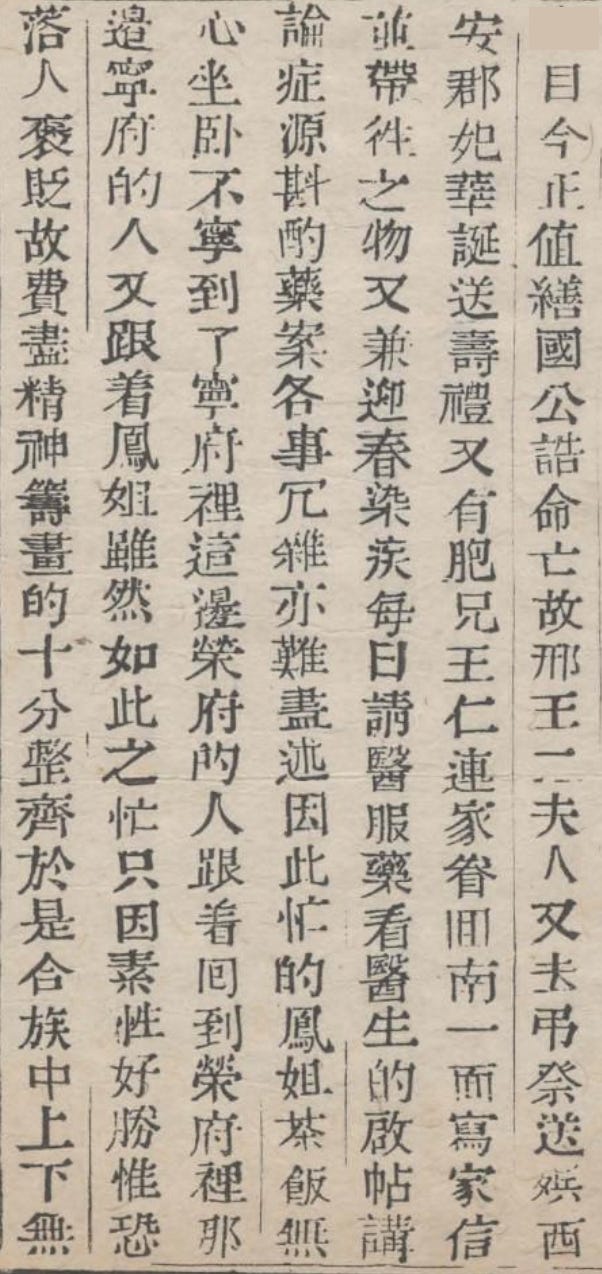
目今正值繕國公誥命亡故,邢王二夫人又去弔祭,送殯;西安郡王妃華誕,送壽禮;又有胞兄王仁連家眷回南,一面寫家信並帶往之物;又兼迎春染疾,每日請醫服藥,看醫生的啟帖,講論症源,斟酌藥案,各事冗雜,亦難盡述。因此,忙的鳳姐茶飯無心,坐臥不寧。到了寧府裡,這邊榮府的人跟著;回到榮府裡,那邊寧府的人又跟著。鳳姐雖然如此之忙,只因素性好勝,惟恐落人褒貶,故費盡精神,籌劃的十分整齊,於是,合族中上下無不稱歎。
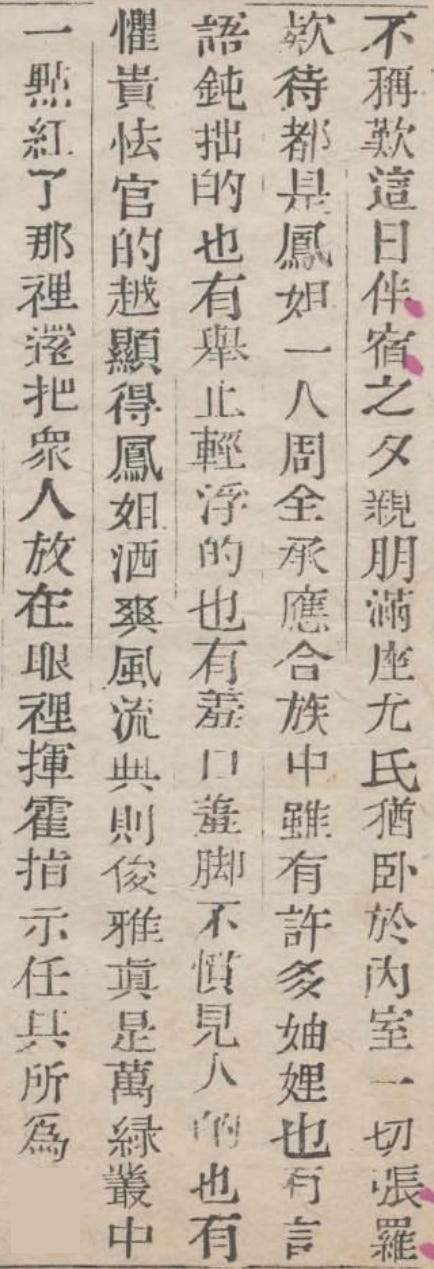
這日伴宿之夕,親朋滿座,尤氏獨臥於內室,一切張羅款待都是鳳姐一人周全承應。合族中雖有許多妯娌,也有言語鈍拙的,也有舉止輕浮的,也有羞口羞腳不慣見人的,也有懼貴怯官的,越顯得鳳姐灑爽風流,典則俊雅,真是「萬綠叢中一點紅」了。那裡還把眾人放在眼裡?揮霍指示,任其所為。
Translation Notes
繕國公 means something like “the Duke of Shanguo.” This is one of the “dukes” (公) established in the fictional hierarchy of the novel. 繕 means to repair or mend.
誥命 here means a “titled lady,” and probably refers to the wife of the Duke of Shanguo.
華誕 is an honorific word for birthday.
壽禮 means a birthday present for an elderly person
胞兄 means an elder brother who was born of the same parents.
Based on the context, it seems that 王仁 (Wang Ren) is Wang Xifeng’s older brother. The word 胞兄 specifically means an older brother of the same parents to distinguish the relative from family members born to plural wives.
染疾 means to become sick.
好勝 here means competitive or aggressive. The character 好 is read hào, as in “to like” or “to enjoy.”
褒貶 means to criticize or speak ill of
伴宿 means to keep vigil the night before the funeral of a deceased person. Here you can think of this as describing the night before the funeral.
張羅 and 款待 both mean the exact same thing in this context. Both of them mean to receive and entertain guests.
妯娌 means sisters-in-law
羞口羞腳 means so shy that you don’t dare speak or move.
灑爽 means dashing and spirited.
風流 is a word we’ve seen several times so far in this book. Here it likely means “charismatic” and not “romantic” or “dissolute.”
典則俊雅 is an idiom that means elegantly correct and properly refined.
萬綠叢中一點紅 is allegedly a quotation from a forgotten Tang dynasty poem. It’s not clear who originally wrote it. As quoted, the two lines of the poem go like this:
濃綠萬枝紅一點,動人春色不須多。
One dot of red amid thousands of green branches,
You don’t need much springtime for inspiration.
The phrase basically means something outstanding or exceptional that immediately captures your attention, with an emphasis on its contrast against everything in the background.
"The confusing part here is that it’s not clear in the Chinese original whether he was going down to the south where Wang Xifeng was (i.e. the family lives in Nanjing), or whether he was departing the Rongguo Mansion and moving further south instead (in which case the family might be living in Beijing instead of Nanjing)."
Yes, most likely the story primarily took place in Beijing, as explained here (https://www.redchamber.blog/p/the-many-names-of-the-book/comment/246273591). It makes sense if we see the work loosely based on author's life.
------
"張羅 and 款待 both mean the exact same thing in this context. Both of them mean to receive and entertain guests."
「張羅」could mean "to plan and prepare" here (https://dict.concised.moe.edu.tw/dictView.jsp?ID=30137&la=0&powerMode=0)
------
"萬綠叢中一點紅" may also emphasize that she's the only woman among the many men.
The Joly translation, like the Yang’s, includes the bit about the Duke of Chenkuo. And like Hawkes/Yang, Joly omits the 萬綠叢中一點紅 line. This makes me think that these additions/omissions come from an older manuscript.