New Here?
Today’s post is all about one of the oddest and most difficult to translate jokes in the classical Chinese novel Dream of the Red Chamber. If you’re interested in starting from the beginning or figuring out what the heck is going on, I recommend starting here. You can also check out this page for more on the many characters in the book.
In today’s video, I argue that Bopomofo is better than pinyin. Bopomofo is an alphabet of 37 letters, and it can do something pinyin can’t: let you hear one particular joke. The video makes the case. This post gives you the text, the sounds, and the receipts, so you can check it yourself.
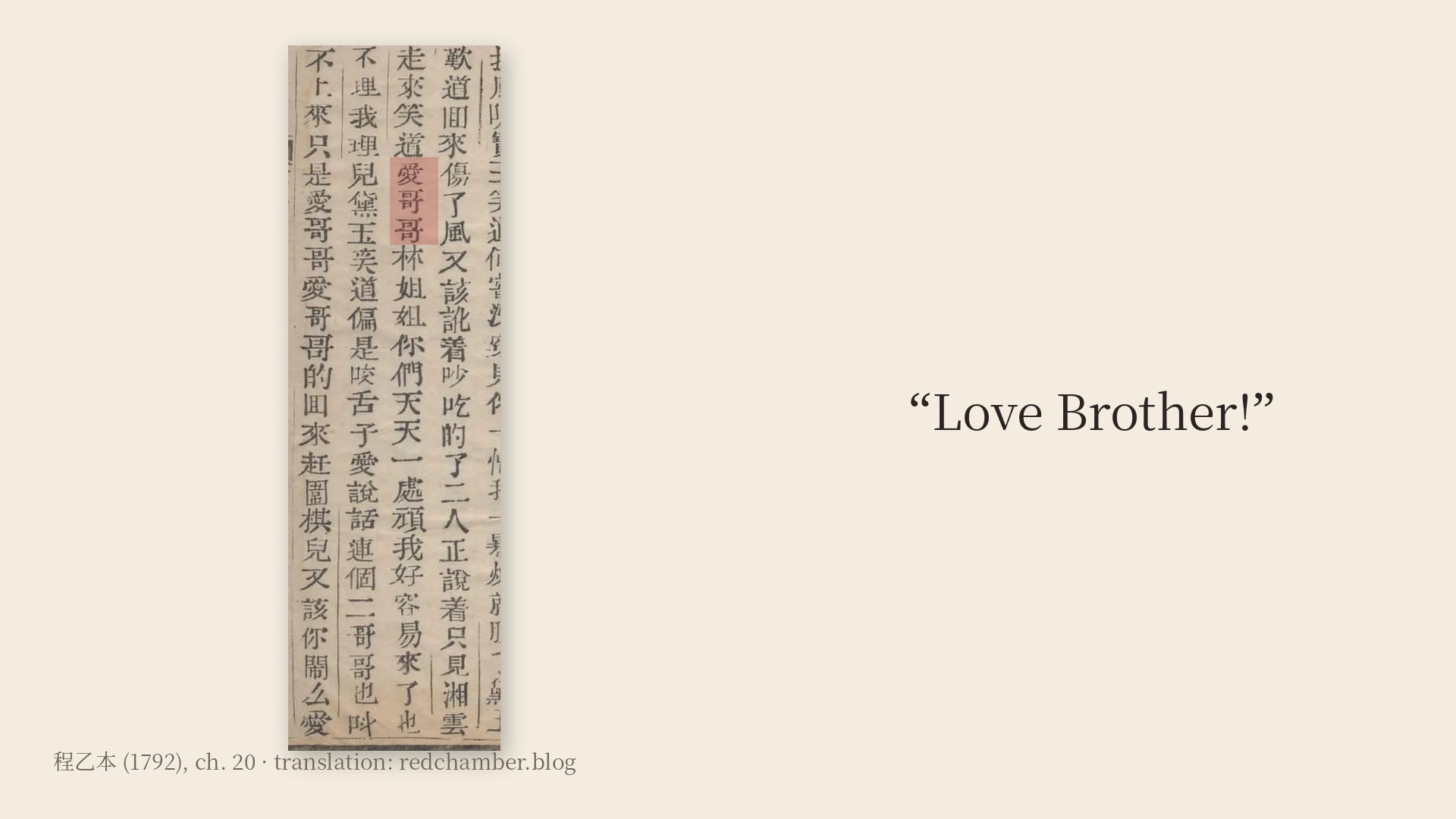
The joke comes from Chapter 20 of Dream of the Red Chamber. The whole scene is translated, free, here: Love Brother.
The Setup
Here’s the setup. Baoyu and Daiyu have just had their first real fight, about whose heart belongs to whom. Then their younger cousin Shi Xiangyun bursts in, and she has a lisp.
Keep one sound in your ear. A few posts earlier, the maid Ying’er claps her hands and cries “One! One!” at Jia Huan’s dice roll. (See Jia Huan Cheats at Dice.) That’s the sound of this house at play.
The Lines
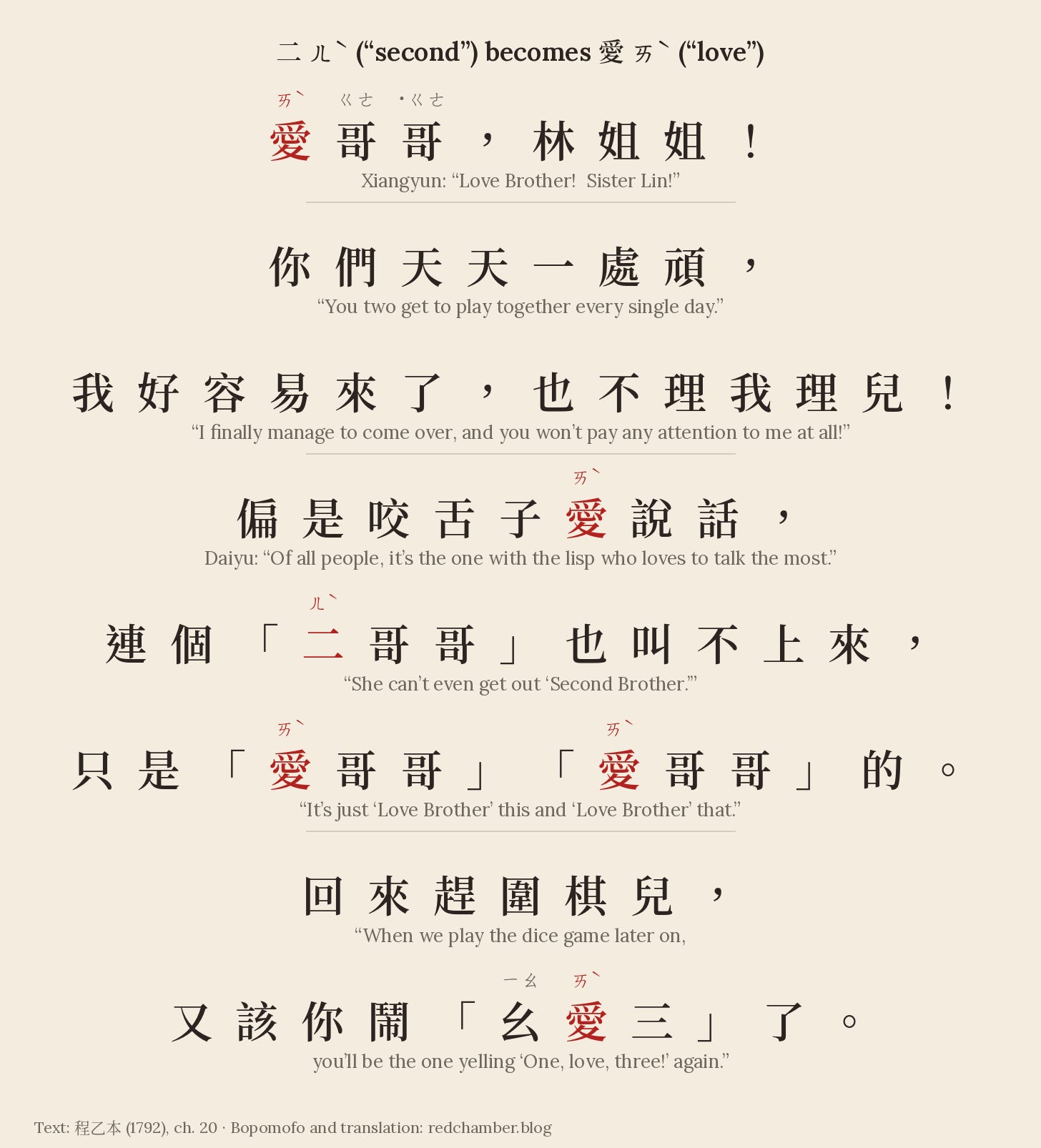
These are the lines the video quotes, from the 1792 edition. The Bopomofo sits over the key words. The letters in the joke are in red.
Why 二 becomes 愛
Baoyu is the second son, so everyone calls him 二哥哥, “Second Brother.”
Xiangyun can’t make the sound of 二. It’s èr in pinyin, and in Bopomofo it gets a letter all to itself: ㄦˋ. When she tries, what comes out is ㄞˋ, 愛. So 二哥哥 becomes 愛哥哥.
And 愛 means “love.”
“Second Brother” becomes “Love Brother,” minutes after a fight about love, in front of Daiyu. Then Daiyu pounces: “She can’t even get out ‘Second Brother.’” Even her dice-game “one, love, three” has the joke in it. The video does the rest, but look at the red letters in the image and say them out loud. ㄦˋ. ㄞˋ.
How did the English translators handle this? Hawkes and the Yangs each tried, and neither one could let an English reader hear it. We took it apart on Saturday’s podcast: Why Can’t Anyone Translate “Love Brother”?
Why Daiyu says 幺, not 一
In 幺愛三, “one, love, three,” the “one” isn’t 一 (yī). It’s 幺 (yāo), an old word for the one on a die. My 現代漢語詞典 gives the same meaning: the one on dice and dominoes.
People in China still use it for “one” in phone numbers and room numbers. The reason is 七, “seven.” 一 yī and 七 qī are easy to mix up on a bad line. So the dice game in Daiyu’s joke is still alive every time someone in Beijing gives you their number.
The other joke in the scene
Right before Xiangyun walks in, Daiyu teases Baoyu: 回來傷了風,又該餓著吵吃的了. That’s “You’ll catch a cold, and they’ll make you go without food, and you’ll be whining for something to eat again.” It’s a reference to an old custom of curing a cold by starving it, the reverse of our “feed a cold, starve a fever.” Daiyu is predicting that he’ll catch cold, the household will stop feeding him, and he’ll make a fuss. She’s already worrying about him a few lines before she starts roasting everyone.
Tell me if I’m right. Or tell me what pinyin does better that I’ve left out.
Read the scene, then meet the girl
If you came from the video, the next step is on this blog. Read the whole scene, free: Love Brother. Or meet the girl who can’t say 二: Shi Xiangyun.