


Today’s video asks whether Dream of the Red Chamber is written in a dead language. It isn’t, but the old language turns up where the author put it on purpose, and one of the best places is the walk through the new garden in Chapter 17.
You can watch the video here:
The video only has time for two or three names from that walk. The book writes down twenty-four, and they’re all below.
If you haven’t read that far, the setup is simple. The family has built a garden for a visit from Baoyu’s older sister, now an imperial consort, and every spot needs a name on a placard. Baoyu’s strict father, Jia Zheng, takes his scholarly hangers-on to draft them and drags Baoyu along as a test. Many garden names borrow a line from an old poem or classic, so every stop is a small contest in classical Chinese.
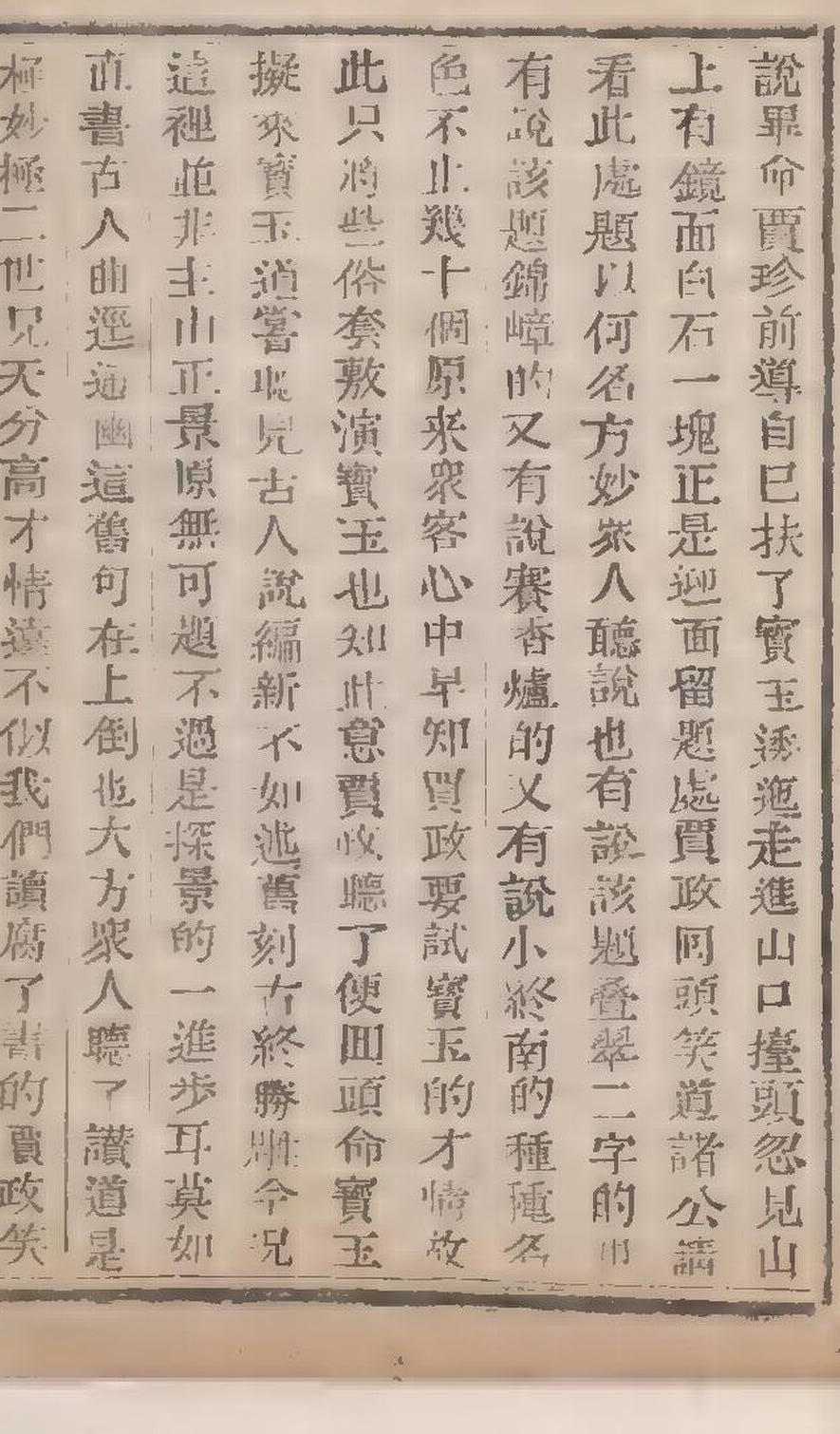
At the rock screen by the entrance, the scholars offer 迭翠 (Layered Emerald), 錦嶂 (Brocade Screen), 賽香爐 (Rival of the Incense Burner, after the peak in Li Bai’s waterfall poem) and 小終南 (Lesser Zhongnan, after a mountain known for hermits). The narrator says they picked tired names on purpose, to leave room for Baoyu. Baoyu offers 曲徑通幽 (A Winding Path Leads to a Secluded Spot), a line from a Tang poem by Chang Jian. Jia Zheng tells everyone to stop praising him.
At the pavilion over the water, the scholars take 翼然 (Outspread Wings) from Ouyang Xiu’s Account of the Old Drunkard’s Pavilion. Jia Zheng says it’s fine, but a pavilion over water needs a water word, and he suggests the character 瀉 (to pour) from the same essay. A guest builds it into the name 瀉玉 (Pouring Out Jade). Baoyu calls 瀉 crude for an imperial villa and offers 沁芳 (Soaking In Fragrance), which quotes nobody. Jia Zheng nods and says nothing.
At the bamboo lodge, 淇水遺風 (The Legacy of the Qi River) points to a Classic of Poetry song where bamboo stands for a gentleman, and 睢園遺蹟 (The Relics of the Sui Garden) points to a Han prince’s garden full of poets. Jia Zheng calls both of them common. Baoyu says the first stop of an imperial visit has to honor the throne and offers 有鳳來儀 (The Phoenix Arrives In Ritual Splendor), from the Book of Documents, where a phoenix visits the court of the sage-king Shun. Jia Zheng nods, then insults him. The video has the insult.
At the farm, the scholars suggest 杏花村 (Apricot Village), from Du Mu’s “Qingming,” one of the most famous poems in Chinese. Jia Zheng likes it, but a real village already has that name. Baoyu offers 杏簾在望 (Apricot Banner In Sight), from an old line about a tavern flag over red apricot blossoms, and then 稻香村 (Rice Fragrance Village), from a much less famous Tang poem by Xu Hun. The scholars clap. Jia Zheng calls him an ignorant beast.
At the cave where the stream comes out, 武陵源 (Wuling Spring) and 秦人舊舍 (The Old Home of the Qin People) both come from Tao Yuanming’s “Peach Blossom Spring,” about a village hidden away since the chaos of the Qin dynasty. Jia Zheng calls the first too literal and stale. Baoyu says the second is about fleeing from chaos and can’t be used. On a placard for an emperor’s consort, you can see why. His 蓼汀花漵 (Smartweed Sandbar and Flower Riverbank) simply describes the bank. Jia Zheng says it’s even worse.
At the hall covered in fragrant plants, the scholars offer 蘭風蕙露 (Orchid Wind and Angelica Dew), and Jia Zheng says it will have to do. Two scholars then offer couplets full of musk orchids, moonlight and islets. Baoyu points out that none of those are here. His 蘅芷清芬 (The Pure Fragrance of Wild Ginger and Angelica) names two plants he picked out among the herbs a few minutes earlier. Jia Zheng lets the name go by and attacks Baoyu’s couplet instead.
At the jade archway in front of the main hall, the scholars want 蓬萊仙境 (Penglai Fairyland), after the islands of the immortals. Jia Zheng shakes his head. For once Baoyu has nothing, because the place feels strangely familiar. Jia Zheng gives him one day.
At the water gate, Baoyu proposes 沁芳閘 (Soaking In Fragrance Gate). Jia Zheng snaps that they won’t use “Soaking In Fragrance” at all, though he nodded at the same name by the pavilion.
In the courtyard with the crabapple tree, the scholars offer 蕉鶴 (Plantain and Crane), an old painting motif, and 崇光泛彩 (Ripples of Radiant Light), from Su Dongpo’s poem on crabapple blossoms. Everyone, Jia Zheng included, loves the second one. Baoyu notes that the courtyard has a red crabapple and green plantains, and the name leaves out the plantains. He offers 紅香綠玉 (Red Fragrance and Green Jade). Jia Zheng calls it awful.
Put the list together and you can see the contest. The scholars mostly reach for the most famous sources, or stock phrases that would fit any garden, and at the first stop they were holding back on purpose. Baoyu borrows too, but only when the old line fits what is in front of him and who will walk past it. When nothing fits, he describes the place in plain words.
Jia Zheng nods at 沁芳 and 有鳳來儀, but he never says yes to one of Baoyu’s names out loud. The one name he praises outright, 崇光泛彩, came from the scholars, and so did the one he settles for, 蘭風蕙露. The scholars get the praise, and Baoyu gets the nods.
Jia Zheng gave Baoyu one day to name the archway in front of the main hall. If you’d been standing there, what would you have put on it, in four characters or four English words? Tell me in the comments.
The whole walk is in my translation, with the full Chinese and my notes on each allusion. It starts with The Naming War, and the pavilion and the bamboo lodge are Soaking In Fragrance and Ignored Tea and Abandoned Chess. The cave and the crabapple courtyard are Smartweed and Flowers and Red Fragrance and Green Jade.