


Fan fiction has a reputation. You probably picture a teenager up past midnight, writing a new chapter of a favorite show and posting it online for strangers to argue about.
That picture isn’t wrong. It’s just about two thousand years too late.
Readers have been writing their way into the books they love for as long as there have been books. Some of the results are posted online and forgotten in a week. Some of them are taught in universities. And one of the best examples I know sits in a single evening in Chapter 21 of Dream of the Red Chamber, where a continuation gets continued, and then continued again.
What Counts as Fan Fiction?
Here’s a working definition. Fan fiction is new writing that borrows someone else’s characters, world or words, and it’s written because you love the original, or because you can’t stand how it went.
It comes in a few familiar kinds. There’s the missing scene, the thing the author skipped. There’s the sequel, what happened next. There’s the side character’s story, when somebody in the background finally gets the spotlight. And there’s the “fix-it,” where a fan rewrites the ending they couldn’t accept.
Keep those four in mind, because every one of them is very old.
Homer Had Fans
The Iliad and the Odyssey leave a lot out. The Iliad doesn’t show the start of the Trojan War or the fall of Troy. The wooden horse barely appears in either poem.
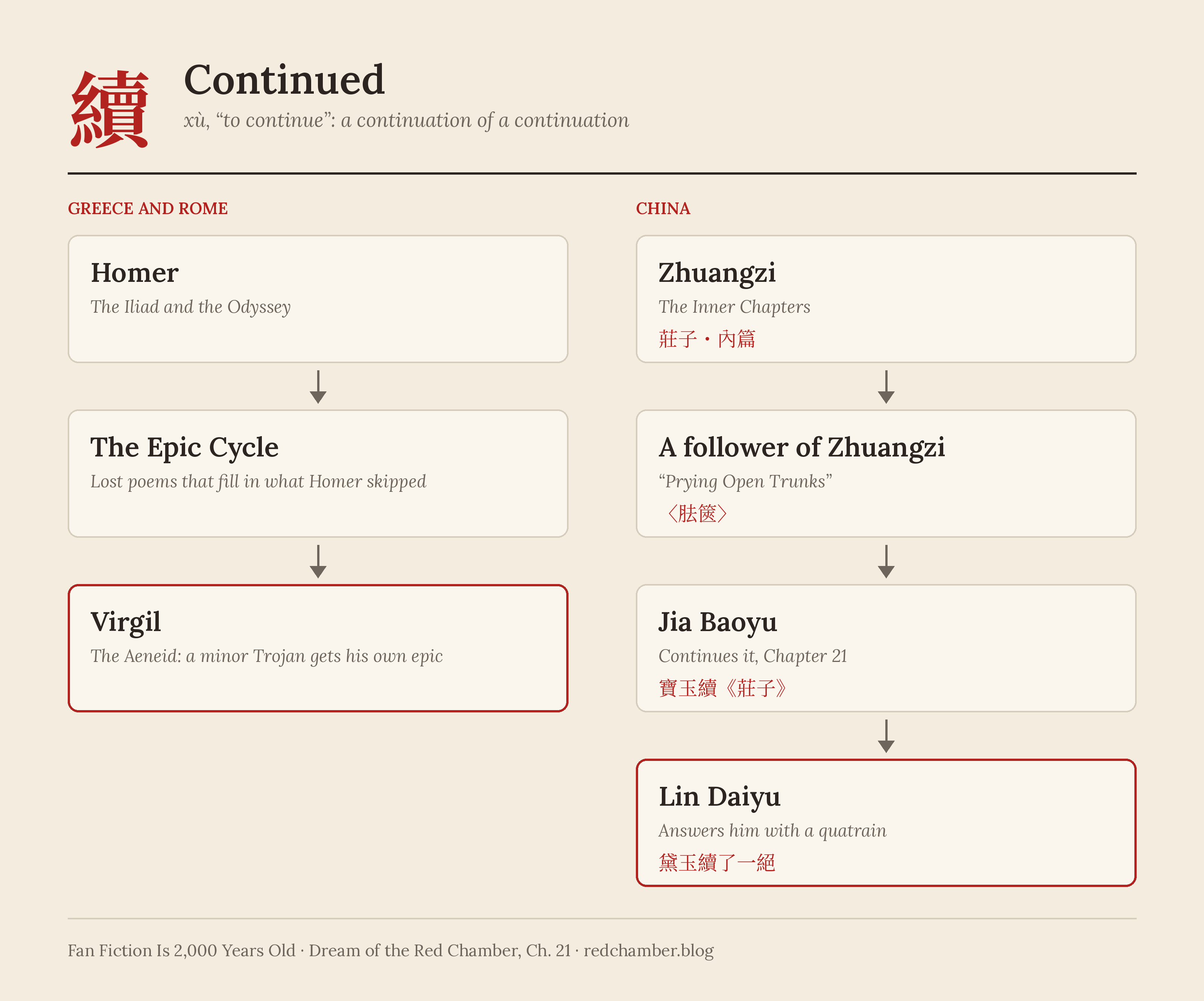
So the Greeks filled in the gaps. A whole set of epics, now called the Epic Cycle, covered everything Homer skipped: how the war started, the horse, the sack of the city, the long trip home. Almost all of it is lost. We know these poems mostly from summaries. But we know enough to see what they were doing.
My favorite is the Telegony, a sequel to the Odyssey. In it, Odysseus has a son by the witch Circe, and that son grows up and goes looking for his father. It does not end well. If that sounds like something you’d find on a fan site, I think that’s exactly the point.
Then came Virgil. In the Iliad, Aeneas is a secondary Trojan. He’s a good fighter, and at one point a god pulls him out of a fight he’s about to lose and says his family is destined to survive. That’s about it. Virgil took that minor character and, around 2,000 years ago, gave him his own epic, the Aeneid: Aeneas escapes the burning city, wanders the Mediterranean, and founds the line that leads to Rome.
That’s a side character getting the spin-off. It’s also one of the most admired poems ever written.
China Has a Word for It
Chinese has a perfectly ordinary word for this kind of writing: 續 (xù), “to continue.” You’ll find it in the titles of whole shelves of books. In Chinese literature, picking up where someone else left off was normal, and sometimes it was the highest compliment you could pay.
Even Zhuangzi, one of the great philosophers of ancient China, was something of a group project. The book that carries his name was put together over a long time. Most scholars think only the first seven chapters, the Inner Chapters, are close to Zhuangzi himself. Much of the rest was written by followers who kept the master’s voice going after he was gone.
The most famous Chinese example is probably 《金瓶梅》 (The Plum in the Golden Vase). It begins with a few chapters of Water Margin, the great outlaw novel, about a rich man named Ximen Qing and a married woman named Pan Jinlian. In Water Margin, their story is one short episode. The author of Jin Ping Mei took those two characters, changed what happens to them, and built an entire novel around them. (I’ll come back to Jin Ping Mei in a post in March.)
There are sequels and supplements to the other classic novels too. In the 1640s, a writer named Dong Yue (董說) wrote 《西遊補》, A Supplement to the Journey to the West. It slips a strange new adventure in between two chapters of the original, where the Monkey King gets trapped in a dream. That’s the missing scene, Ming style.
Three Continuations in One Evening
Now to Dream of the Red Chamber.
In Chapter 21, the hero, Jia Baoyu, has quarreled with the maids who look after him, and he’s spending a lonely night with two cups of wine and a copy of Zhuangzi. He reads a passage from a chapter called 〈胠篋〉, “Prying Open Trunks.” Then he picks up a brush and writes his own continuation, keeping Zhuangzi’s sentence patterns and swapping in the girls of his own household. (I translated that scene in Two Cups of Wine and Zhuangzi, and I took his passage apart line by line in Did Baoyu Mean It?)
Here’s the part I love. “Prying Open Trunks” is one of those later chapters. It was probably written by one of Zhuangzi’s followers, not by Zhuangzi. So when Baoyu continues it, he’s continuing a continuation.
The next morning, his cousin Lin Daiyu finds the book on his desk. She reads what he wrote, gets angry and amused at the same time, and picks up a brush of her own. She writes a four-line poem right there, answering him. It starts like this:
無端弄筆是何人? Who is this person, fiddling with a brush for no good reason?
And the verb the novel uses for what she does is the same one it used for Baoyu: 續了一絕, “she continued it with a quatrain.” That’s a continuation of a continuation of a continuation, all in one evening and the next morning.
Daiyu doesn’t see it that way, though. Her poem calls what Baoyu did 剿襲 (chāoxí), “plagiarism.” So the narrator says Baoyu continued Zhuangzi, and Daiyu says he copied him. That’s the oldest argument about fan fiction there is, and the novel has both sides of it in two lines.
And Then the Readers Joined In
The novel itself didn’t escape, either. It was first printed in the early 1790s, and within about five years readers were writing sequels to it. The first one, 《後紅樓夢》 (The Later Dream of the Red Chamber), was presented as if Cao Xueqin had written it himself. Many more followed. Depending on how strictly you count, there are somewhere between a dozen and a hundred of them. Most of them have one thing in common: their authors wanted a different story than the one Cao Xueqin gave them.
I won’t say any more about that here. We’ll get there.
Why Do People Do It?
Look back over these examples and you’ll find three reasons that keep coming up.
To argue. Baoyu argues with Zhuangzi. Daiyu argues with Baoyu. Writing on someone else’s page is the most direct way to answer them.
To give someone a life. Virgil looks at a Trojan who barely gets a scene in the Iliad and decides he deserves an epic.
To fix or fill in what’s missing. The Epic Cycle fills Homer’s gaps. Dong Yue adds an adventure. The Red Chamber sequels rewrite what readers couldn’t stand.
None of that has changed. Jean Rhys took the “madwoman in the attic” from Jane Eyre and gave her a whole novel, Wide Sargasso Sea. Tom Stoppard took two throwaway courtiers from Hamlet and made them the heroes of Rosencrantz and Guildenstern Are Dead. And Fifty Shades of Grey started out as Twilight fan fiction. Some continuations end up on syllabuses, and some end up in airport bookstores. It’s the same habit either way.
So, Is It Literature?
Here’s my verdict. The line between “fan fiction” and “literature” has very little to do with what the writer is doing. It mostly has to do with prestige, and with time. Give a continuation two thousand years and a good enough poet, and we call it the Aeneid.
Underneath, it’s the same thing every time. Continuing a book means reading it closely enough to answer back. That’s what Daiyu does. She reads what Baoyu wrote, she laughs, she gets angry, and she picks up the brush. That’s what a fan does.
I suppose a translation is a kind of continuation, too. I’m writing Cao Xueqin’s book over again in a language he never knew, and every choice I make is me answering him.
What book would you most like to continue, or fix? Tell me in the comments.
If you enjoyed this, there's a lot more where it came from. Members read every passage of my translation as it comes out, with the Chinese text and notes, plus the weekly podcast and posts like this one. It's $5 a month, and you're helping fund a complete modern translation of China's greatest novel.
New to the story? Chapter 1 starts here: The Dream Starts.
Start the story: The Dream Starts, or the Chapter 21 scene in Two Cups of Wine and Zhuangzi.
Next in the story: On Friday, Chapter 21 goes on, and somebody has to hide something fast.
Meet them: Jia Baoyu / Lin Daiyu / All the characters