


New Here? This is Chapter 22 of Dream of the Red Chamber, China's greatest novel, translated into modern English one scene at a time. Start with the Start Here guide, or meet the family on the Characters page.
Two nights ago, Baoyu decided he didn’t need anybody. He wrote a Buddhist verse to prove it, added a song to explain it, and went to bed with nothing weighing on his heart.
Previously: Daiyu found the paper first, called it “just a bit of fun,” and took it home. (See Just a Bit of Fun.)
This morning she shows it to her cousins. One of them blames herself. One of them knows exactly what to say to him. And one of them tells a story every educated reader in China knew by heart.
Who’s here: Lin Daiyu, Xue Baochai, Shi Xiangyun and Jia Baoyu (All the characters)
Two Translators Disagree. Daiyu adds two lines to Baoyu’s verse. In the Yangs’ translation, she adds two. In David Hawkes’s, she adds five, and the last one is “And there’s an end!” Mine, and the full comparison, are below.
The Translation
When Baochai had finished, she looked at the gatha as well, and laughed.
“This is my fault. That aria I recited yesterday is what set him off. This kind of religious writing and Zen sparring can change a person’s whole nature. If tomorrow he starts taking this crazy talk seriously and sets his heart on it, won’t it all have started with my aria? I’ll be the one to blame!”
With that, she tore the paper to shreds, handed the pieces to the maids and told them to burn it right away.
Daiyu smiled. “You shouldn’t have torn it up. Let me ask him. Come with me, both of you. I promise you I’ll cure him of this foolish idea.”
Talking as they went, the three of them came to see Baoyu.
Daiyu spoke first, smiling. “Baoyu, I have a question for you. Nothing is more precious than treasure, and nothing is harder than jade. So what is precious about you? What is hard about you?”
Baoyu couldn’t answer a word.
The two of them laughed. “This slow, and he’s practicing Zen!”
Xiangyun clapped her hands and laughed too. “Brother Bao loses!”
“You wrote, ‘When nothing’s left to call a proof, there is a place to stand,’” Daiyu went on. “That’s good, of course. But as I see it, it isn’t quite perfect yet. I’ll add two more lines:
With no place to stand at all,
Only then is it clean.”
“That’s it exactly,” said Baochai. “That’s understanding it all the way through. Long ago, when Huineng, the Sixth Patriarch of the Southern school, first went looking for a teacher, he came to Shaozhou. He heard that the Fifth Patriarch, Hongren, was at Huangmei, so he went there and worked as a kitchen monk. The Fifth Patriarch wanted to find an heir to his teaching, so he told all his monks to write a gatha. The senior monk, Shenxiu, said:
The body is the bodhi tree,
The mind is like a bright mirror’s stand.
Wipe it clean at every hour,
And never let the dust collect.
“Huineng was in the kitchen pounding rice. When he heard it, he said, ‘Beautiful, yes, but finished? Not yet.’ And he recited a gatha of his own:
Bodhi was never a tree,
And the bright mirror is no stand.
From the start, there is nothing at all.
What is there for the dust to stain?
“So the Fifth Patriarch passed his robe and bowl on to Huineng. This gatha today means the same thing. But this round of sparring isn’t finished yet. Is he just going to drop it?”
Daiyu laughed. “He couldn’t answer, so he loses. If he answered now, it wouldn’t count for anything. But from now on, no more talking about Zen. He doesn’t even know what the two of us know and can do. What business does he have practicing Zen?”
Baoyu had thought he was awakened. He hadn’t expected Daiyu to spring a question on him that he couldn’t answer. And Baochai had brought out the recorded sayings of the Zen masters. He had never seen either of them do anything like this before.
He thought it over. “So they understood all this before I did, and they still haven’t been enlightened. Why should I go looking for misery now?”
With that thought, he laughed. “Who’s practicing Zen? It was just a bit of fun in the moment, that’s all.”
And with that, the four of them were back the way they had always been.
Why would Daiyu win the argument and then ban Zen from the house? That's tomorrow's podcast, and free subscribers hear the first part. Subscribe and it comes straight to your inbox.
The Chinese Text
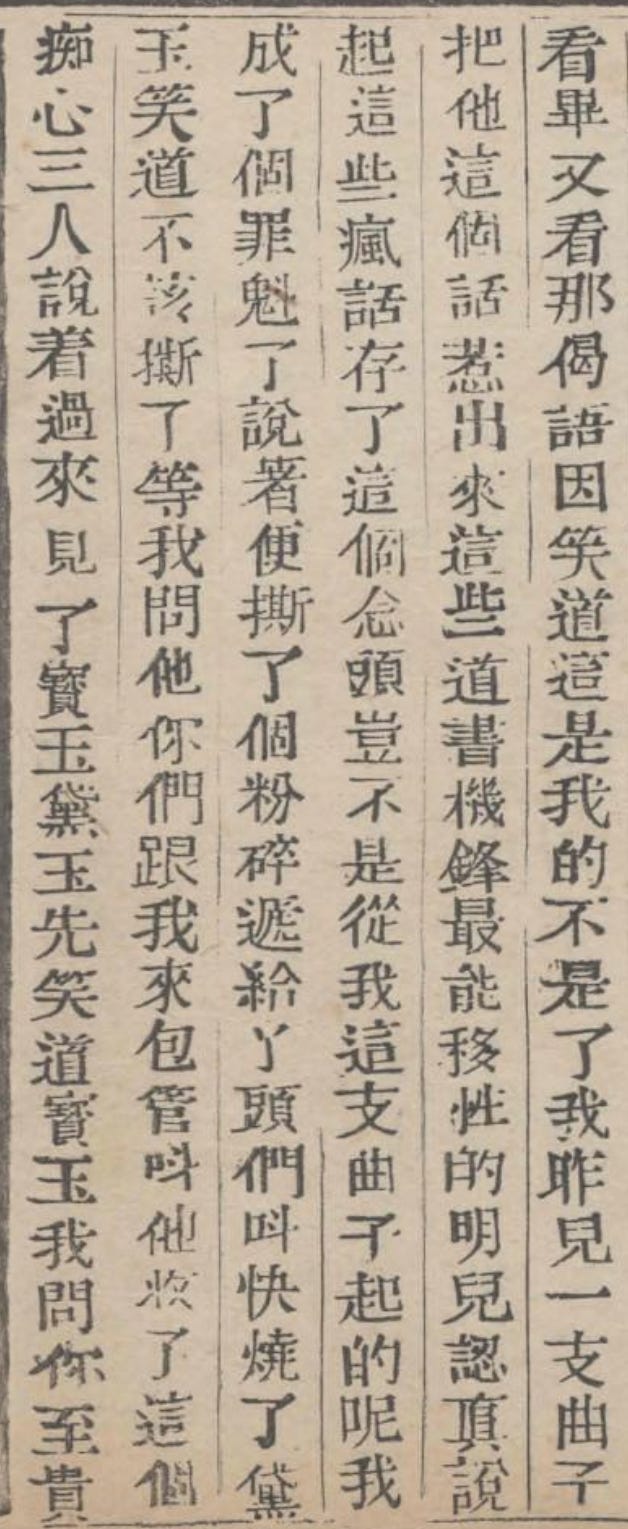
看畢,又看那偈語,因笑道:「這是我的不是了,我昨兒一支曲子把他這個話惹出來。這些道書機鋒,最能移性的,明兒認真說起這些瘋話,存了這個念頭,豈不是從我這支曲子起的呢?我成了個罪魁了!」說著,便撕了個粉碎,遞給丫頭們,叫快燒了。黛玉笑道:「不該撕了。等我問他。你們跟我來,包管叫他收了這個痴心。」
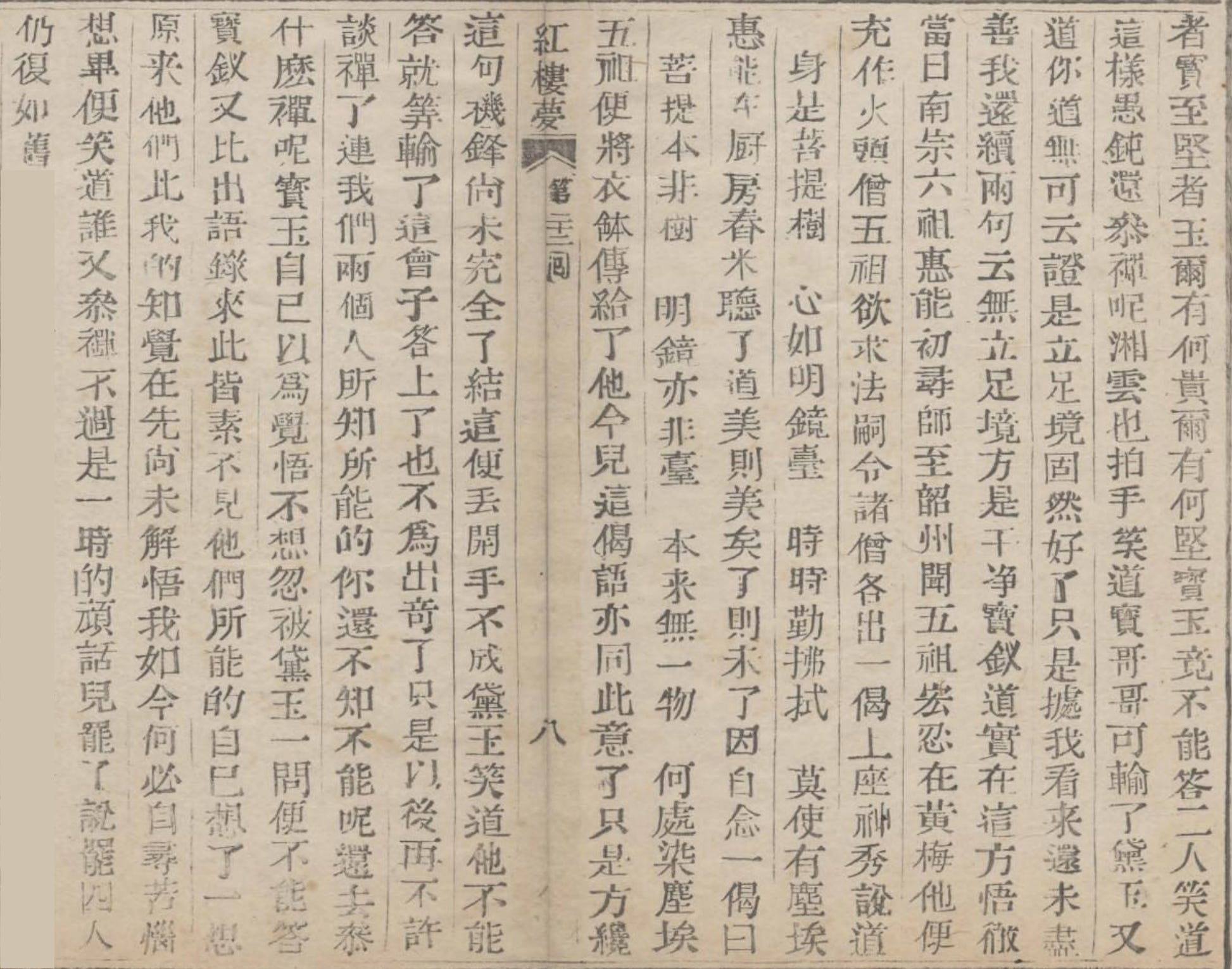
三人說著,過來見了寶玉。黛玉先笑道:「寶玉,我問你:至貴者寶,至堅者玉,爾有何貴?爾有何堅?」寶玉竟不能答。二人笑道:「這樣愚鈍,還參禪呢!」湘雲也拍手笑道:「寶哥哥可輸了!」黛玉又道:「你道『無可云證,是立足境』,固然好了,只是據我看來,還未盡善。我還續兩句云:『無立足境,方是乾淨。』」寶釵道:「實在,這方悟徹。當日南宗六祖惠能初尋師至韶州,聞五祖宏忍在黃梅,他便充作火頭僧。五祖欲求法嗣,令諸僧各出一偈。上座神秀說道:『身是菩提樹,心如明鏡臺。時時勤拂拭,莫使有塵埃。』惠能在廚房舂米,聽了,道:『美則美矣,了則未了,』因自念一偈曰:『菩提本非樹,明鏡亦非臺。本來無一物,何處染塵埃?』五祖便將衣缽傳給了他。今兒這偈語,亦同此意了。只是方才這句機鋒,尚未完全了結,這便丟開手不成?」黛玉笑道:「他不能答,就算輸了。這會子答上了,也不為出奇了。只是以後再不許談禪了。連我們兩個所知所能的,你還不知不能呢,還去參什麼禪呢!」
寶玉自己以為覺悟,不想忽被黛玉一問,便不能答;寶釵又比出語錄來:此皆素不見他們所能的。自己想了一想:「原來他們比我的知覺在先,尚未解悟,我如今何必自尋苦惱?」想畢,便笑道:「誰又參禪?不過是一時的玩話兒罷了。」說罷,四人仍復如舊。
Reading Notes
道書機鋒 (dàoshū jīfēng): religious writing and Zen sparring. 道書 literally means “books of the Way,” which usually means Daoist books, but what Baoyu wrote is Buddhist. Baochai is lumping all religious writing together. 機鋒 is a Chan Buddhist word for the quick, sharp exchanges between a master and a student, where a strange question or a sudden answer is meant to jolt someone into insight. 鋒 is the edge of a blade, so the word has a feel of swordplay. That’s what’s about to happen in Baoyu’s room.
移性 (yíxìng): to change a person’s nature. This is Baochai’s real worry. She isn’t afraid Baoyu wrote a bad poem. She’s afraid he means it, and that this kind of thinking could change who he is.
罪魁 (zuìkuí): the chief culprit, the ringleader of a crime. Baochai is half joking, but she does take the blame on herself, and she’s the one who destroys the evidence.
至貴者寶,至堅者玉 (zhì guì zhě bǎo, zhì jiān zhě yù): nothing is more precious than treasure, and nothing is harder than jade. Daiyu has built her question out of Baoyu’s own name. 寶 is “treasure” and 玉 is “jade,” so she’s asking him what he’s made of. And she asks in the style of a Zen master, with the old classical word for “you,” 爾 (ěr), instead of the everyday 你. Chan masters were famous for questions like this, about who you really are, which have no ready answer. Baoyu set himself up as a Zen adept, so Daiyu tests him like one, and he fails.
二人笑道 (èrrén xiào dào): the two of them laughed. The text doesn’t say which two. Xiangyun gets her own line right after, so it’s most likely Baochai and Daiyu, but it could also be Baochai and Xiangyun. The English keeps it as vague as the Chinese.
參禪 (cānchán): to practice Zen. 參 means to study something deeply, to puzzle over it, and in Chan it means sitting with a question until the answer breaks through. The girls use it to tease him: this slow, and he’s practicing Zen?
無立足境,方是乾淨 (wú lìzú jìng, fāng shì gānjìng): with no place to stand at all, only then is it clean. Baoyu’s gatha ended with a place to stand: when you need no proof from anyone, you finally have solid ground. Daiyu takes even that away. Needing a place to stand is still needing something. 乾淨 means clean, with nothing left over, and it sets up the dust in the two verses that follow.
南宗六祖惠能 (Nánzōng liùzǔ Huìnéng): Huineng (638-713), the Sixth Patriarch of the Southern school of Chan. “Patriarch” is the traditional title for each master in the line that Chan traces back to India. The Southern school taught that enlightenment comes all at once. The rival Northern school, linked to Shenxiu, was known for gradual practice. The story Baochai tells comes from the Platform Sutra of the Sixth Patriarch (《六祖壇經》), and it’s one of the most famous stories in Chinese Buddhism. Historians doubt it happened this way: Shenxiu seems to have left Hongren’s monastery years before Huineng arrived. But nobody in Baoyu’s room would have doubted it.
五祖宏忍 (wǔzǔ Hóngrěn): Hongren (601-674), the Fifth Patriarch, whose monastery was at Huangmei (黃梅), in today’s Hubei. His name is normally written 弘忍. The 1792 printing writes 宏 instead, because 弘 was part of the Qianlong emperor’s personal name (弘曆), and printers avoided it. It’s the same man, and the name sounds exactly the same.
火頭僧 (huǒtóu sēng): a kitchen monk. Literally a “fire-head monk,” the one who tends the stoves. In the story, the future Sixth Patriarch is the lowest worker in the monastery, pounding rice in the kitchen, while the senior monk writes the verse everyone expects to win.
上座神秀 (shàngzuò Shénxiù): Shenxiu, the senior monk. 上座 means the one who sits in the highest seat, the most senior of the monks. He was the obvious heir.
菩提 (pútí): bodhi, which means awakening or enlightenment. The Buddha reached enlightenment sitting under a tree, so it’s also the name of the tree, the bodhi tree. Both verses play on the double meaning. Shenxiu says the body is that tree, and the mind is a mirror that has to be wiped clean every day. Huineng answers that there’s no tree, no mirror stand, and nothing at all for the dust to land on. Shenxiu’s verse describes practice. Huineng’s says there was never anything to clean.
本非樹 … 何處染塵埃 (běn fēi shù … héchù rǎn chén’āi): if you look up Huineng’s verse, you’ll usually find it as 菩提本無樹 (”bodhi has no tree”) and 何處惹塵埃 (”where could dust gather?”). Baochai’s version has 本非樹, “was never a tree,” and 染, “to stain.” The meaning is the same. I’ve translated the verse the way Baochai says it.
美則美矣,了則未了 (měi zé měi yǐ, liǎo zé wèi liǎo): beautiful, yes, but finished? Not yet. 了 means “finished,” but it also means “to understand completely,” as in 了解. So Huineng is saying that the verse is lovely but doesn’t get all the way there. Baochai picks up the same word a moment later: this round of sparring 尚未完全了結, “isn’t finished yet.” Baoyu hasn’t finished either, in both senses.
衣缽 (yībō): robe and bowl. A Chan master passed his robe and begging bowl to the student he chose as his heir. The phrase is still everyday Chinese: someone who carries on a teacher’s work is called his 衣缽傳人, the heir to his robe and bowl.
語錄 (yǔlù): recorded sayings. This was a whole genre of Chan literature, collections of what the great masters said and the exchanges they had with their students. Baochai has just quoted from it from memory. The narrator tells us Baoyu had never seen either girl do anything like this, and that matters. Baoyu thought he was the one in the house who understood these things.
覺悟 / 解悟 (juéwù / jiěwù): awakening, understanding. Two posts ago, the narrator told us that Baoyu, after writing his gatha, “felt he understood it himself” (自己雖解悟). Now the narrator closes the loop: Baoyu “had thought he was awakened” (自己以為覺悟). And Baoyu’s own conclusion uses the same word: the girls understood all this before he did, and “they still haven’t been enlightened” (尚未解悟).
玩話兒 (wánhuàr): a joke, something said for fun. Remember what Daiyu called Baoyu’s song when Xiren showed it to her? 作的是個玩意兒, “It’s just a bit of fun.” Now Baoyu says the same thing about his own awakening. The person who saw through it first gets the last word, and he says it for her. (See Just a Bit of Fun.)
The Other Translations
Hawkes
When Lin Daiyu speaks with Jia Baoyu, David Hawkes elects not to translate the parts of his name. She renders 至貴者寶 as “’Bao‘ is that which is of all things the most precious” and 至堅者玉 as “’yu‘ is that which is of all things the most hard.”
Hawkes has Lin Daiyu add these five lines to Baoyu’s poem, not two:
But, I perpend,
To have no ground
On which to stand
Were yet more sound.
And there’s an end!
Perpend means to ponder or consider.
Hawkes translates the first gatha like this:
Our body like the Bo-tree is,
Our mind’s a mirror bright.
Then keep it clean and free from dust,
So it reflects the light!
He renders the second like this:
No real Bo-tree the body is,
The mind no mirror bright.
Since of the pair none’s really there,
On what could dust alight?
Both translations are perfectly fine.
Yang
The Yangs follow Hawkes’ lead in transliterating “Pao” and “Yu” rather than translating them.
The Yangs only give Daiyu two lines, which matches the Chinese text:
When there’s no place for feet to rest,
That is the purest state and best.
They translate the first gatha like this:
The body is a Bodhi tree,
The mind a mirror clear;
Then keep it clean and polished -
Let no dust settle there.
The second is like this:
The Bodhi tree is no tree,
The mirror no mirror clear;
Since nothing actually exists,
Where can any dust appear?
Both
Neither translation lets an English reader see how Daiyu’s question is built out of Baoyu’s own name. “Bao“ and “yu“ are just sounds unless you already know they mean “treasure” and “jade.” And both make Huineng’s verse rhyme with Shenxiu’s, which keeps the contest feel of the story: the second poem answers the first in the same form.
Daiyu wins the argument, and then she says no more talking about Zen. Why do you think she wants it to stop? Tell me in the comments.
Next in the story: On Sunday, a lantern arrives from the palace.
Go deeper: Thursday’s look at Baoyu’s two poems, in Did Baoyu Wake Up. And tomorrow’s podcast picks up where this passage leaves off.
Meet them: Lin Daiyu / Xue Baochai / Jia Baoyu / All the characters