


Renaming Everything
This might seem like a boring passage to you at first glance. However, this is one of the most important passages in all of chapter 18. There’s a lot of dense foreshadowing going on here, and we’re going to come back to this over and over again as we continue through the book.
My Translation
Jia Yuanchun also changed some of the other inscriptions. She named the building with the inscription “The Phoenix Arrives in Ritual Splendor” the “The Xiaoxiang Building.” She changed the inscription “Red Fragrance and Green Jade” to “Delighting in Red and Rejoicing in Green,” and called the building “The Red Delight Building.” The building called “The Pure Fragrance of Wild Ginger and Angelica” she named “Wild Growth Building.” “Apricot Banner In Sight” she named “The Hemp Washing Villa.”
She name the main tower the Grand View Tower. She called the tower to the east “Assembled Brocade Tower,” while she called the tower to the west “Fragrance Holding Tower.” She also gave out names such as Knotweed Breeze Studio, Lotus-Scent Veranda, Purple Caltrop Islet, and Floating Hearts Shoal. Among the plaques she had inscribed were “Pear Blossoms in Spring Rain,” “Paulownia Leaves Cut By The Autumn Wind,” and “Night Snow on Reeds and Rushes,” among other names. She also ordered that none of the old inscribed boards or couplets be taken down.
And then she composed this poem:
It houses the hills and holds the waters, constructed exquisitely;
So much hard work went into its final form!
Everything in the heavens and on earth is collected here.
This fragrant garden deserves to be named “Grand View.”
Translation Critique
Hawkes
Hawkes calls 瀟湘館 “The Naiad’s House.” A naiad is a female Greek deity associated with the water; in fact, the somewhat unusual English word comes directly from the ancient Greek word Νᾱϊάς. It’s an interesting allusion to 瀟湘 and the story of the spotted bamboo, but it loses the melancholy and foreboding sense of the Chinese original.
Hawkes translates 桐剪秋風 as “Paulownia leaves in autumn wind,” which is almost right, but not quite. He misses the word 剪, which means to cut. The title isn’t just a description of leaves in the wind. Rather, these are leaves that are being ripped apart by the wind.
Yang
The Yangs run into the same problem with 桐剪秋風. They call it “Plane Trees in Autumn Wind” and miss the description of the tree leaves being cut apart.
They call 荻蘆夜雪 “Artemisia in Evening Snow.” Artemisia refers to plants like wormwood, sagebrush, and tarragon.
Chinese Text

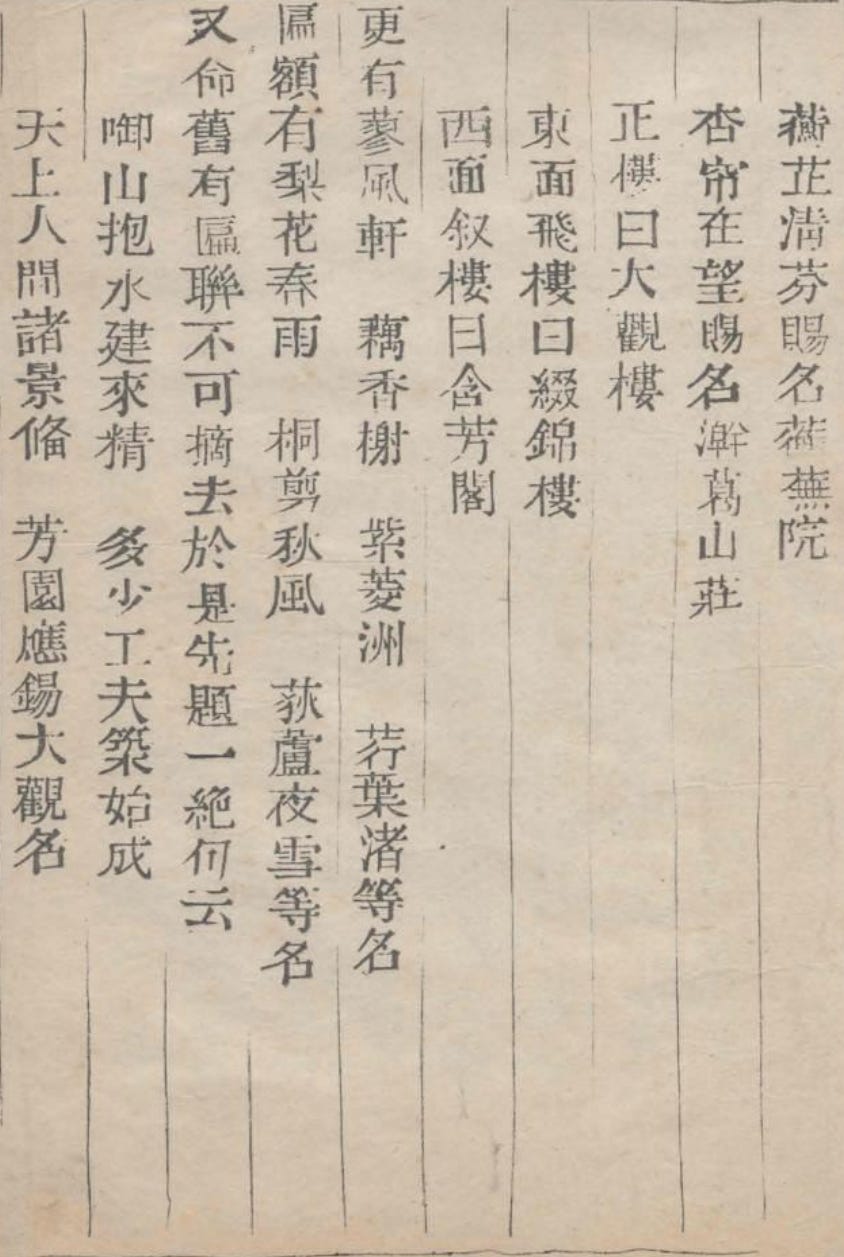
又改題:「有鳳來儀」,賜名瀟湘館。「紅香綠玉」,改作「怡紅快綠」,賜名怡紅院。「蘅芷清芬」,賜名「蘅蕪院」。「杏簾在望」,賜名澣葛山莊。正樓曰大觀樓。東面飛樓曰「綴錦閣」。西面飛樓曰含芳閣。更有蓼風軒、藕香榭、紫菱洲、荇葉渚等名。匾額有「梨花春雨」、「桐剪秋風」、「荻蘆夜雪」等名。又命舊有匾聯不可摘去。於是先題一絕句云:
銜山抱水建來精,多少工夫築始成。天上人間諸景備,芳園應錫大觀名。
Notice that the text in Chinese here is presented in a poetic form.
Translation Notes
瀟湘館 refers to the Xiao and Xiang rivers in modern day Hunan. You might vaguely recall a reference to “Xiang Consort Bamboo” in passages like this one:

This is a reference to the story of the two wives of the legendary Emperor Shun. When he passed away, they rushed to the banks of the Xiang river in Hunan Province. They cried bitterly while leaning against the bamboo groves there, leaving behind spots and stains that would never fade away. They then threw themselves into the Xiang river and drowned. By giving the building a name like this, Jia Yuanchun is unwittingly commenting on the future of the person who will live there.
When you first read it, you’ll probably think that 怡紅快綠 (Delighting in Red and Rejoicing in Green) probably seems really similar to 紅香綠玉 (Red Fragrance and Green Jade). The interesting thing here is that the word 玉 (jade) has been removed from the inscription.
蘅蕪 refers to fragrant herbs growing wildly and lushly, as if they were totally out of control.
澣葛 refers to washing kudzu or hemp, which is used in making cloth. The image here is a rustic life of hard work and farming.
飛樓 literally means a “flying tower.” This likely refers to the height of the towers, which look as if they’re flying in the air.
綴錦閣, or Assembled Brocade Tower, is an outward expression of beauty. Meanwhile, 含芳閣, or Fragrance Holding Tower, is the opposite: this would be an inward facing beauty, sort of like private virtue or ability that you don’t show anybody on the outside.
蓼風軒, or Knotweed Breeze studio, is a melancholy image. Knotweed (蓼風) generally signifies parting, the loneliness of a traveler, and the passage of time.
藕香榭, or Lotus-Root Fragrance Veranda, is a kind of paradox. The fragrance comes from the root of the lotus, which is the part that remains hidden. This description is somewhat reminiscent of the idiom 藕斷絲連, which refers to having deep feelings for somebody even after you’ve broken up.
紫菱洲, or Purple Caltrop Islet, is a reference to things that are rootless and vulnerable. The water caltrop (菱) is a plant that floats and drifts to the surface of the water without roots that anchor it to the shore.
荇葉渚, or Floating Hearts Shoal, is a similar reference to the one we just saw about the caltrop. 荇 refers to a floating water plant, and is a poetic allusion to 荇菜, which is directly described in one of the poems in The Book of Songs (詩經):
關關雎鳩,在河之洲。
窈窕淑女,君子好逑。
參差荇菜,左右流之。
窈窕淑女,寤寐求之。
The ospreys cry “guan guan” on the islet in the river.
The gentle and modest maiden is a good match for the gentleman.
The floating water plants are uneven; we gather them left and right.
The gentleman seeks that gentle and modest maiden both morning and night.
This is clearly a love poem, and the idea of that particular floating water plant brings up this idea of deep love and affection.
梨花春雨, or Pear Blossoms in Spring Rain, is an image of plants that are very beautiful but extremely short lived. This reminds us of this famous line from the famous 長恨歌 (Song of Everlasting Regret) by Bai Juyi:
玉容寂寞淚闌干,梨花一枝春帶雨。
Her jade face is desolate, tears streaming down,
Like a pear blossom bathed in the springtime rain.
This, of course, is an image of crying, and led to the idiom 梨花帶雨. And, as you might remember, this poem and its associated idiom is likely the source of Lin Daiyu’s name (林黛玉):

Notice, by the way, that the face of the girl is described as a “jade face” (玉容). We’ve seen these constant references to jade throughout almost all the poems that are alluded to in the poetry of Dream of the Red Chamber.
桐剪秋風, or Paulownia Leaves Cut By The Autumn Wind, is a pretty violent image. The Paulownia tree is the only tree that the phoenix will perch on – and, of course, the phoenix is a representation of the Empress, or the wife of the Emperor. The idea here is that the female representation of imperial authority will come to a very dark and awful end.
荻蘆夜雪, or Night Snow on Reeds and Rushes, is a desolate image of what remains after a household is destroyed. Everything is wiped clean; the snow covers all color, and the reeds and rushes on top offer a feeling of total desolation.
If you look closely, you’ll notice that there is a pattern in these three names. We start off with spring (春, from 梨花春雨), we go into autumn (秋, from 桐剪秋風), and we end up in winter (雪, or snow, from 荻蘆夜雪). There is no summer, which means that the promise of spring is never fulfilled.
Compared to all of this imagery, Jia Yuanchun’s final poem seems pretty anticlimactic and ordinary.