


The Four Plays
We’re not done with the literary references yet. This short paragraph will give you headaches if you try reading it without translation notes. Let’s jump in.
My Translation
After she had read these poems, Jia Yuanchun was absolutely delighted. “You’ve really improved a lot!” she exclaimed. She singled out the “Apricot Tavern” poem as the best of the four.
She then ordered that the name The Hemp Washing Villa be changed to Fragrant Rice Village. She also had Tanchun copy the ten or so poems onto embroidered stationary, and then ordered an eunuch to deliver them to the men in the outer rooms of the household.
When Jia Zheng and the others read the poems, they praised them without ceasing. Jia Zhen then composed an ode of his own about Jia Yuanchun’s return home.
Jia Yuanchun then ordered that delicacies like jade pudding and golden meats be given to Jia Baoyu and Jia Lan. Jia Lan was still young and didn’t understand any of these formalities, and so he simply bowed along with his mother and uncle.
While all this was happening, Jia Qiang had brought a group of actresses to the house and was waiting downstairs. He was starting to run out of patience when an eunuch came flying down the stairs. “The poems are done,” announced the eunuch. “Bring the playbill at once!” And so Jia Qiang quickly presented the list of plays along with a list of the names of the twelve girls.
Before long, four plays had been selected. These were:
The Grand Banquet
Begging for Skill
The Immortal’s Encounter
The Soul’s Departure
Jia Qiang hurried around, getting costumes ready and preparing the staging for the plays. Each of the girls had a voice so beautiful that it could split the stones, and each of them could dance with angelic posture. Though it was all obviously acting, the girls performed so well that they fully conveyed the extremes of joy and sorrow to the audience.
Translation Critique
Hawkes
Hawkes describes Jia Zheng’s poem as a “eulogy.” Normally a eulogy is a speech to honor a deceased person, usually at a funeral. However, it can also refer to the act of praising somebody. The word eulogy here is very odd, and carries a connotation with it that is not present in the Chinese text.
Hawkes calls the foods “junket and mince.” Junket here is a kind of cream cheese.
Hawkes offers a little bit of explanation about the scenes in each of the plays, but decides against using any explanatory footnotes:
Four pieces were chosen: “Shi-fan Entertains” from The Handful of Snow, “The Double Seventh” from The Palace of Eternal Youth, “The Meeting of the Immortals” from The Han-dan Road and Li-niang’s death-scene from The Return of the Soul.
I suppose the assumption here is that the reader is already familiar with these poems. However, when it comes to a book like Dream of the Red Chamber with many references to literature that doesn’t actually exist, it would have been nice to know that these plays were actual plays.
Yang
The Yangs have Jia Zheng compose a panegyric, which is a speech full of praise. This is a bit more appropriate than a eulogy, though the more accurate translation would simple be an “ode” or a “poem.”
The Yangs follow Hawkes in calling 瓊酪 “junket.” My guess is that they simply used Hawkes’ word; remember that the first volume of The Story of the Stone came out years before the Yangs released their translation.
The Yangs include footnotes that explain the names and authors of each of the plays, though they do not offer any additional commentary about the scenes. Actually, David Hawkes offers a lot more context than the Yangs do in this scene.
Chinese Text
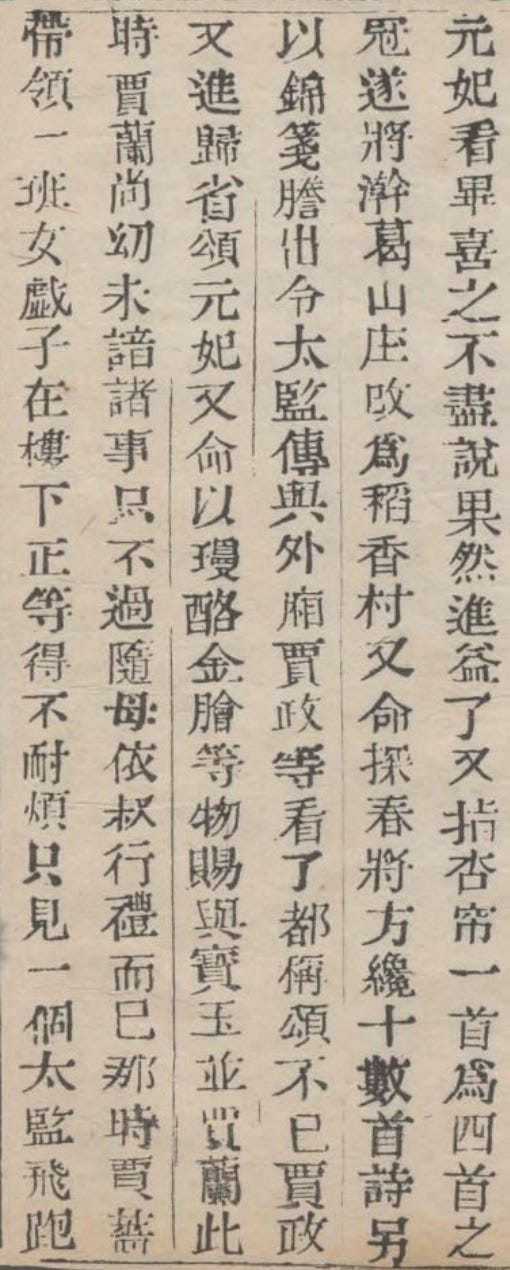
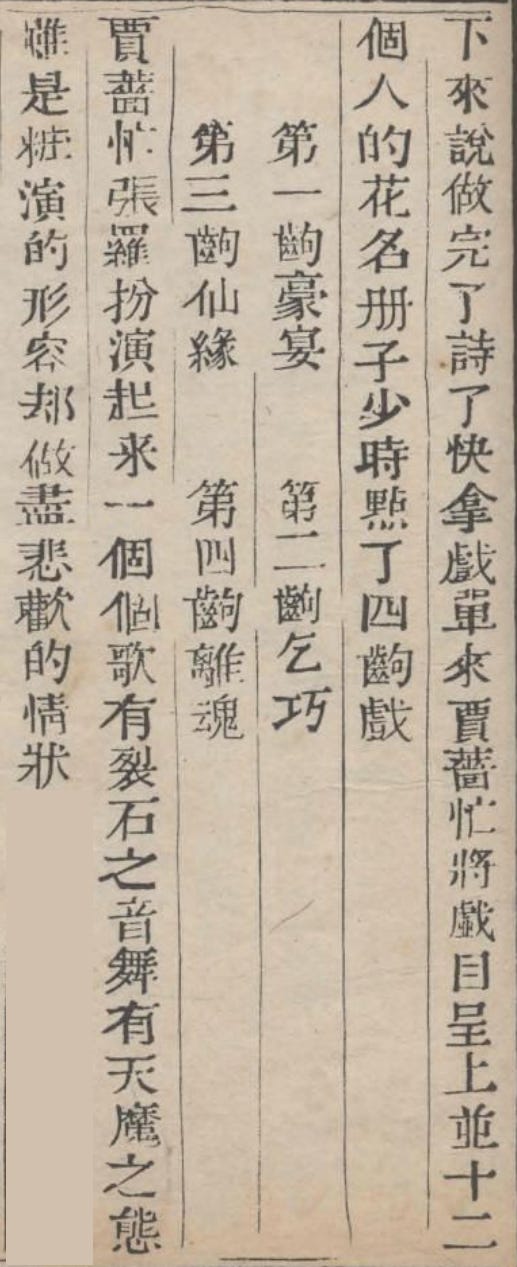
元妃看畢,喜之不盡,說:「果然進益了!」又指「杏簾」一首為四首之冠。遂將澣葛山莊改為稻香村,又命探春將方才十數首詩另以錦箋謄出,令太監傳與外廂。賈政等看了,都稱頌不已。賈政又進歸省頌。元妃又命以瓊酪金膾等物賜與寶玉並賈蘭。此時賈蘭尚幼,未諳諸事,只不過隨母依叔行禮而已。那時賈薔帶領一班女戲子,在樓下正等得不耐煩,只見一個太監飛跑下來說:「做完了詩了,快拿戲單來。」賈薔忙將戲目呈上,並十二個人的花名冊子。少時,點了四齣戲:第一齣,《豪宴》;第二齣,《乞巧》;第三齣,《仙緣》;第四齣,《離魂》。賈薔忙張羅扮演起來,一個個歌有裂石之音,舞有天魔之態。雖是裝演的形容,卻做盡悲歡的情狀。
Translation Notes
Jia Yuanchun singling out the “Apricot Tavern” poem as the best of the four (指「杏簾」一首為四首之冠) is ironic, since Lin Daiyu is the one who composed it.
The name 稻香村 (Fragrant Rice Village) comes straight from Lin Daiyu’s poem, in particular this line:
一畦春韮熟,十里稻花香。
There is one plot of land with young spring chives,
And miles of fragrant fields with rice blossoms.
If you think back a little bit, you’ll remember that 澣葛山莊, or “The Hemp Washing Villa,” was actually a direct reference to the Confucian ideal of feminine virtue. Changing it to the very expressive and sensory 稻香村 (Fragrant Rice Village) is a massive difference.
箋 means stationary, and so 錦箋 means embroidered stationary.
瓊酪 literally means “jade milk curd.” It’s not entirely clear what food this is supposed to be.
金膾 means something like “golden minced raw fish or meat.”
Jia Lan (賈蘭) is Li Wan’s son, and is Jia Baoyu’s nephew. We haven’t seen much about him yet; here’s an old post to refresh your memory:

The four plays are all significant.
豪宴, or The Grand Banquet, is an excerpt from a play called A Handful of Snow (一捧雪) by an early Qing dynasty playwright named Li Yu (李玉). This is the story of an official who owns a flawless jade cup called “A Handful of Snow.” A powerful minister wants to get the cup, and so he frames the official and destroys his whole family. This particular scene is the villain’s magnificent banquet, and is used here as a clear foreshadowing of the coming fall of the Jia family.
乞巧, or Begging for Skill, is an excerpt from a play called The Palace of Eternal Life (長生殿) by Hong Sheng (洪昇). This is another Qing dynasty play, and deals with the love story between Emperor Ming of the Tang dynasty and his beloved Yang Guifei. In this scene they vow their love to each other. However, the empire then collapses, and Yang Guifei is eventually forced to hang herself. This particular scene foretells the coming political disaster that will severely impact the Jia family.
仙緣, or The Immortal’s Encounter, is an excerpt from the play The Handan Dream (邯鄲記) by the Ming dynasty playwright Tang Xianzu (湯顯祖). This is about the scholar Lv Sheng meeting the Taoist immortal Lv Dongbin at an inn, hence the phrase “immortal encounter.” Lv Sheng has a dream during this scene in which he goes through an entire lifetime, including passing the imperial examinations, wining high office, receiving glory, then suffering disgrace and finally passing away. This points towards Jia Baoyu’s eventual destiny, and brings up questions about the difference between dreams and reality that permeate Dream of the Red Chamber.
離魂, or The Soul’s Departure, is an excerpt from The Peony Pavilion (牡丹亭), also by Tang Xianzu (湯顯祖). The Peony Pavilion is one of the most obvious influences on Dream of the Red Chamber, and references to this play will come up time and time again as we move forward. In this scene, a man named Du Liniang has a dream about a beautiful girl. He falls in love with her, but she grows sick and dies; in fact, “The Soul’s Departure” is the scene where her soul leaves her body. In the end, his love proves stronger than death: he finds her self-portrait, which causes her soul to return, and she is resurrected to marry him. This is a prediction of Lin Daiyu’s eventual fate.
Notice how Cao Xueqin merely names these plays and moves right along, even though this is one of the most significant literary passages in the entire chapter.
The reference to voices that can split stone and the posture of angels ( 歌有裂石之音,舞有天魔之態) likely seems a little bit odd to you. 歌有裂石之音, or a voice that can break the stones, refers to high, piercing, and resonant voices. While you can find similar hyperbolic descriptions of resonant voices in classical Chinese literature, this phrase is entirely a Cao Xueqin creation.
Meanwhile, 舞有天魔之態 is interesting. I translated 天魔 as “angels” to help the English version make sense, though it actually refers to the minions of the demon king Mara who assailed the Buddha with visions of worldly delight in an attempt to prevent his enlightenment. In fact, the word 天魔 itself is a transliteration of the Sanskrit word मार (Māra), which could also be translated literally as “death” or “the destroyer.”
There’s a historic connotation here as well. The last Emperor of the Yuan dynasty kept sixteen palace women, who were referred to as 十六天魔, or “the 16 heavenly demons.” They would dance in fancy dress for various spectacles with Buddhist connotations that would always degenerate into lascivious entertainment. The Emperor enjoyed these dances so much that he neglected the affairs of state, leading directly to the collapse of the dynasty. Therefore, this talk about “the dance of angels” refers directly to 天魔舞, or the collapse of an entire empire.